保障

Search documents
荀玉根:十张图看“投资于人”
Xin Lang Cai Jing· 2026-01-20 15:29
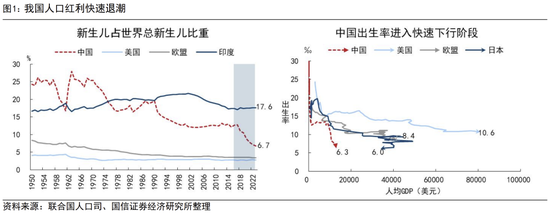
Group 1: Core Insights - The article emphasizes the strategic importance of "investment in people" alongside physical investment, as highlighted in the "14th Five-Year Plan" and the Central Economic Work Conference [1][22] - It identifies four key areas for "investment in people": childcare, education, health and wellness, and social security, aiming to explore potential directions for development [1][22] Group 2: Childcare - China's demographic dividend is rapidly declining, with the newborn global share dropping to below 7%, while India's remains stable at over 17% [2][23] - The birth rate in China has fallen to 6.3‰, significantly lower than that of the US, EU, and Japan at similar development stages [2][23] - High childcare costs are suppressing birth intentions, with the total cost of raising a child to adulthood being 6.3 times the per capita GDP, a figure that is among the highest globally [4][26] - Birth subsidies are effective in stabilizing birth rates, as seen in Nordic countries where higher subsidy levels correlate with smaller declines in birth rates [5][28] Group 3: Education - China's basic education is strong, but secondary and higher education levels are relatively weak, with only 31.8% and 16.2% of the population aged 25 and above having completed high school and higher education, respectively [7][30] - There is significant room for improvement in human capital, which is a key indicator of the effectiveness of "investment in people" [10][32] Group 4: Health and Wellness - The cultural and entertainment industry in China has substantial growth potential, with current spending on related services accounting for only 2.0% of household consumption, lower than in the US (3.8%) and France (2.9%) [12][34] - The average working hours in China are the highest among major economies, with workers averaging 46 hours per week, which may negatively impact health and service consumption [14][36] - Life expectancy in China has significantly increased from 57 years in 1970 to 79 years in 2023, indicating a growing demand for healthcare and long-term care services [16][39] Group 5: Social Security - China's pension system is heavily reliant on the first pillar, with private pensions making up only about 4.5%, significantly lower than Japan's 24% and the US's 121% [18][41] - The decline in housing security spending since 2017 indicates a need for improvement in this area, despite current spending levels being comparable to other major economies [20][43]