商科教育

Search documents
印媒:MBA新生减少,“商科+”更受欢迎
Huan Qiu Shi Bao· 2025-12-22 22:34
Core Insights - The global MBA enrollment has decreased by 6%, indicating a shift in student preferences towards more specialized and skills-oriented business education [1][2] Group 1: Changing Student Preferences - Students are moving away from traditional MBA programs and opting for more targeted, flexible, and employment-oriented business specializations, such as "business + technology" [2] - Despite the decline in MBA enrollment, interest in management education remains strong, with students becoming more selective in their choices [2][3] Group 2: Internal Balance Shift in Business Education - There is a notable shift in the internal balance of business education, with traditional MBA programs seeing a decline while specialized master's degrees in areas like business analytics, financial management, and fintech are expanding [3] - The report suggests that business degrees are increasingly being positioned for professionals with work experience rather than fresh graduates, emphasizing skills over titles [3] Group 3: Strategic International Education Choices - The number of international students pursuing master's degrees is on the rise, particularly in business-related fields, but their mobility is influenced by visa regulations and job prospects [4] - Students are now more focused on return on investment when evaluating study destinations and institutions, favoring shorter, skill-oriented programs with high employment rates [4] Group 4: Flexibility as a Competitive Advantage - Flexible learning formats are becoming a significant advantage, with online and hybrid learning models gaining popularity, especially among employers [4] - The evolving landscape of business education highlights the need for students to align their degrees with career stages, skill demands, and long-term goals to achieve success [5]
中欧全球首发AI智能体课程,三大亮点引领商科教育迈入“智效时代”
Qi Lu Wan Bao· 2025-12-12 06:59
Core Insights - The article highlights the launch of the world's first AI-powered course titled "AI Empowering Business Profit Strategies" by China Europe International Business School (CEIBS), marking a significant step in integrating AI into business education [1][2]. Group 1: Value Innovation - AI technology is fundamentally reshaping corporate production and organizational models, necessitating new management knowledge and talent cultivation methods [2]. - CEIBS aims to innovate teaching methods to cultivate interdisciplinary talents who can integrate AI theory, technology, products, and applications [2]. - The course represents CEIBS's commitment to leading a paradigm shift in management education, focusing on algorithm literacy and human-machine collaboration [2][3]. Group 2: Empowering Teaching - The course utilizes a real-world case study of a struggling hotel to embed AI systems into the learning process, allowing students to apply knowledge in practical scenarios [4]. - Students can leverage various AI tools to conduct decision analysis, fostering a holistic strategic thinking approach [4][5]. Group 3: Empowering Business Practice - The course provides students with a "scientific decision assistant" through AI agents, enabling data-driven and continuously optimized decision-making mechanisms in businesses [6]. - Feedback from students indicates that the AI system can quickly generate multiple pricing strategies based on industry data, aiding efficient decision-making for small and medium enterprises [6][7]. - The course encourages a rethinking of human-machine collaboration within companies, proposing a new decision-making process where AI handles simulations while humans make final decisions [7].
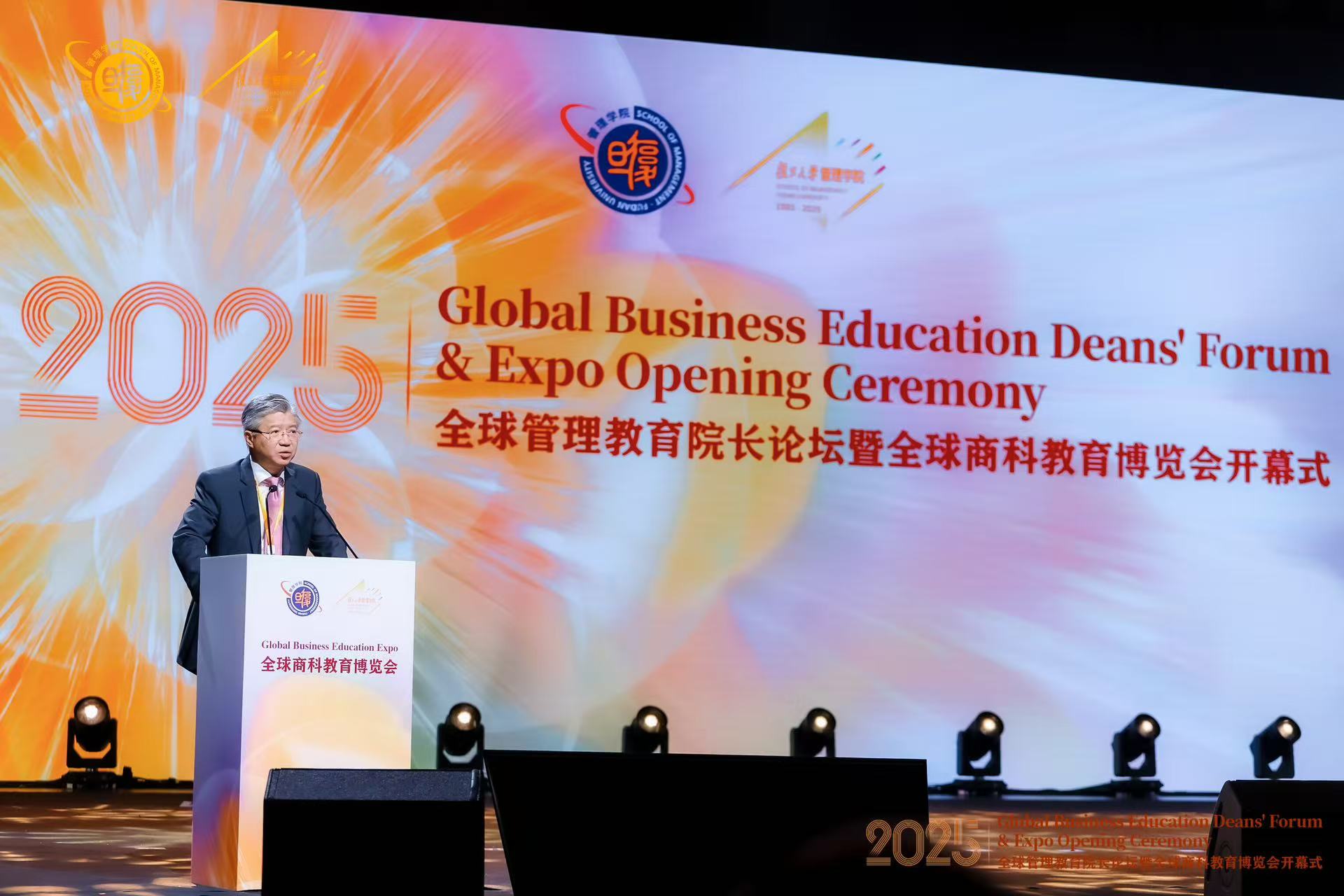
全球商科教育“最强大脑”聚首复旦
Guo Ji Jin Rong Bao· 2025-10-25 13:11
Core Insights - China's management education has achieved significant results in internationalization, research innovation, and talent cultivation, but faces challenges from a complex international environment [2] - The Global Business Education Expo was held to address the current needs of Chinese management education and aims to build a global consensus [2] - Nearly 50 top business schools and international organizations from five continents participated, including representatives from MIT Sloan School of Management, Yale School of Management, and London Business School [2] Event Highlights - The opening ceremony featured an interactive session titled "Youth Leadership: Global Youth Ask: What Will the Future Business World Look Like?" where youth representatives from Fudan University engaged in thoughtful discussions [2] - The "Global Management Education Deans Forum" focused on "Frontiers of Global Business Education Reform," bringing together global education leaders to foster connections for the future of business education [2] Challenges and Opportunities - The dean of Fudan University's School of Management, Lu Xiongwen, emphasized that current technological changes in China present new questions and opportunities for management education [2] - It is crucial for business education to apply theoretical knowledge to real-world problem-solving, which is a common challenge faced by global business schools [2]