
电动机制造

Search documents
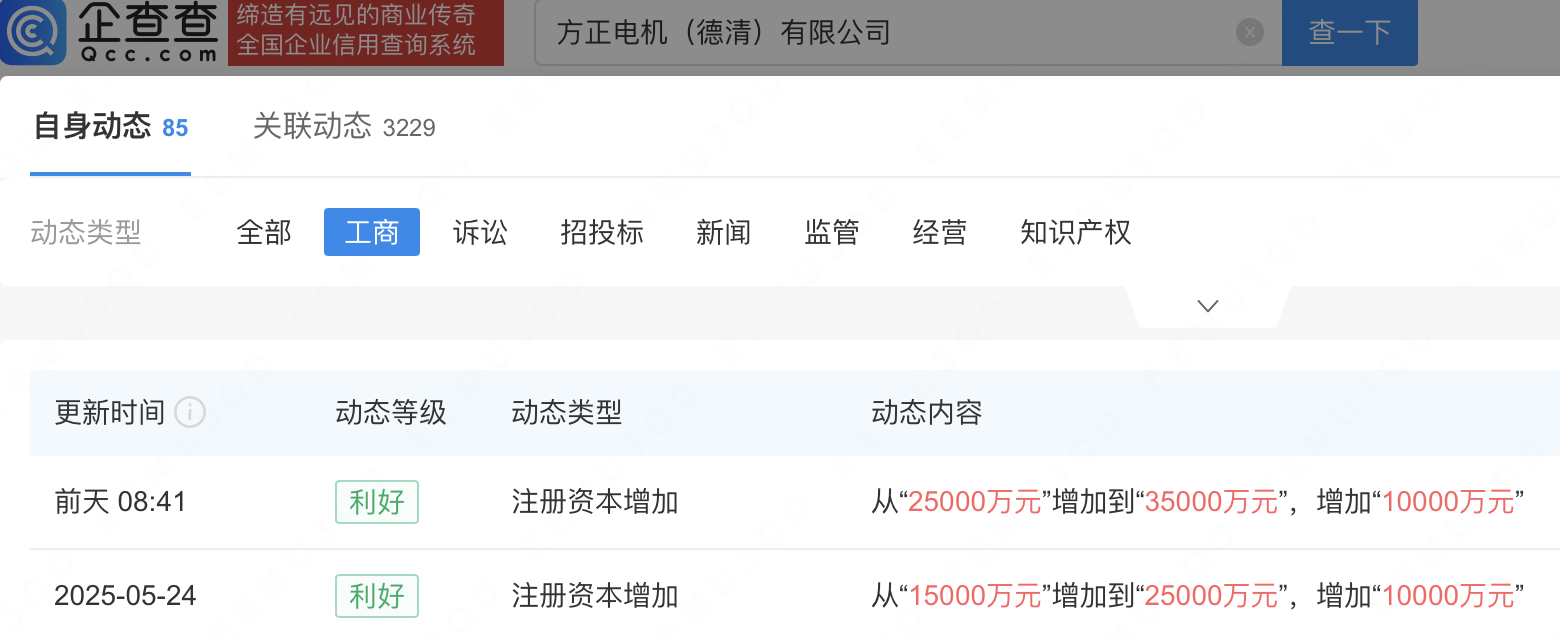
方正电机浙江全资电气机械制造公司增资至3.5亿
Qi Cha Cha· 2025-12-29 07:37
Group 1 - Founder Motor (Deqing) Co., Ltd. has increased its registered capital from 250 million yuan to 350 million yuan, following a previous increase from 150 million yuan to 250 million yuan in May [1][2] - The company was established in 2020 and is wholly owned by Founder Motor (002196) [1][2] - The legal representative of the company is Niu Mingkui, and its business scope includes manufacturing electric motors, developing motor control systems, and producing generators [1][2] Group 2 - The company is located in Deqing County, Huzhou City, Zhejiang Province, and has a workforce of 100-199 employees [2] - The company is registered as a limited liability company and is classified under the electric motor manufacturing industry [2][3] - The business activities also encompass sales and research related to electric vehicle components and charging facilities [2][3]


德国“隐形冠军”的困局——关税海啸中的国别观察
Xin Hua She· 2025-05-05 06:38
Group 1 - The article highlights the challenges faced by German companies, particularly medium-sized manufacturers like Tornado Electric Motors, due to the recent U.S. tariff policies, which have led to increased costs and uncertainty in the market [1][2] - The term "invisible champions" refers to small and medium-sized enterprises in Germany that excel in niche markets but are now struggling with the unpredictability of U.S. trade policies, which threaten their international supply chains [1][2] - Hermann Simon, a prominent management scholar, emphasizes that the current global supply chain integration means that any policy barriers can disrupt the entire system, affecting not just individual companies but the global economy as a whole [2][3] Group 2 - A significant portion of German companies, 28.3%, reported difficulty in predicting future business developments, marking the highest level of uncertainty since November 2022, largely attributed to U.S. tariff policies [3] - The German economy is under considerable pressure, with projections indicating negative growth for two consecutive years (2023 and 2024), and the government has lowered growth expectations for 2025 to zero, primarily due to U.S. tariff impacts [3][4] - A study from the Munich Institute for Economic Research estimates that U.S. "reciprocal tariff" measures could lead to a cumulative loss of €290 billion for the German economy between 2025 and 2028, equating to an average annual GDP loss of about 1.6% [4]