科技互联网教育

Search documents
红筹上市梦碎只因少做一步ODI备案?
Sou Hu Cai Jing· 2025-10-15 11:06
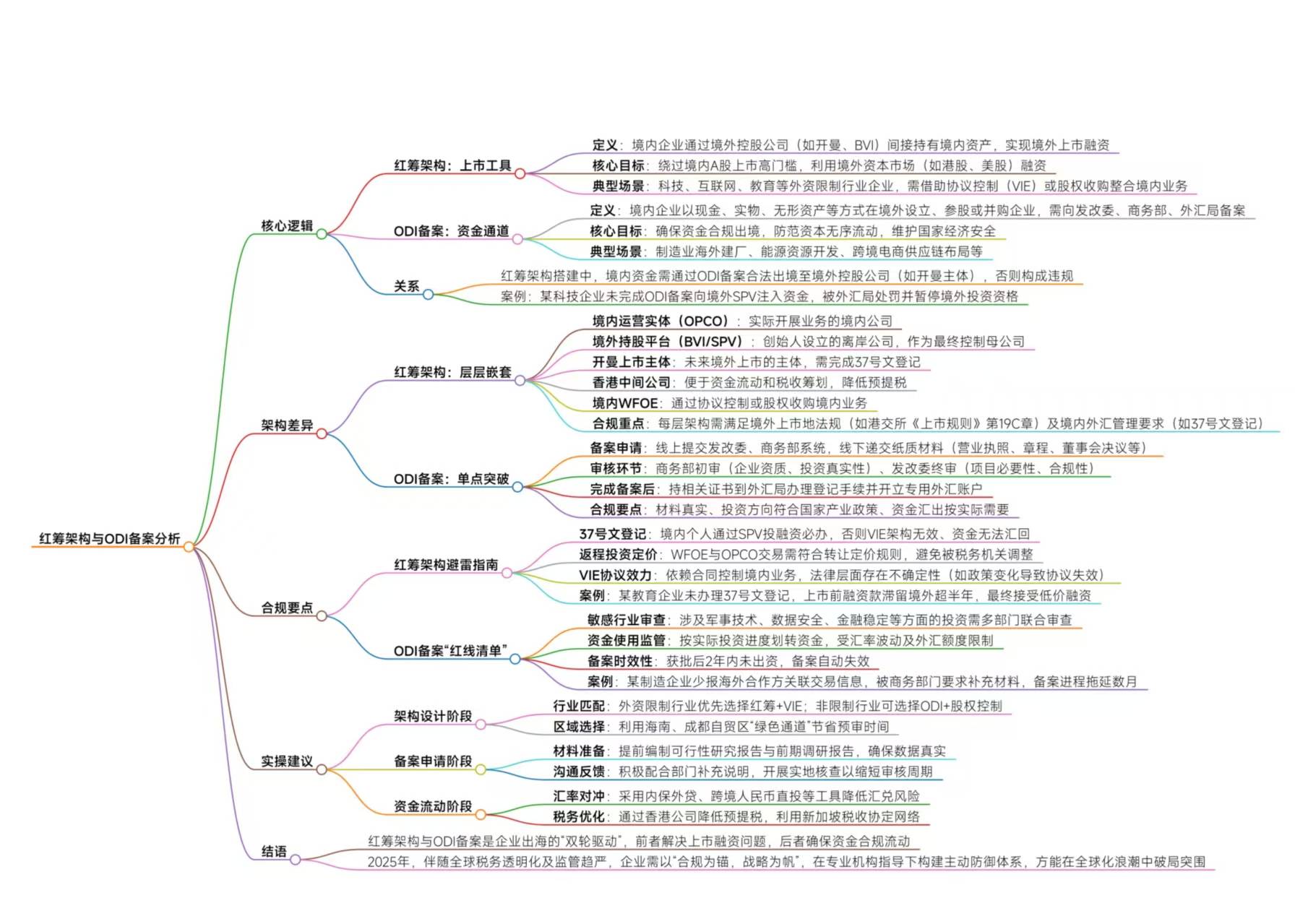
Core Viewpoint - The red-chip structure and ODI (Overseas Direct Investment) filing are independent yet closely related processes essential for companies seeking to go public and ensure compliant capital outflow [1][16]. Red-chip Structure - Definition: Domestic enterprises utilize offshore holding companies (e.g., Cayman Islands, BVI) to indirectly hold domestic assets for overseas listing and financing [3]. - Core Objective: To bypass the high barriers of domestic A-share listings and leverage overseas capital markets (e.g., Hong Kong, US) for financing [3]. - Typical Scenarios: Companies in restricted sectors such as technology, internet, and education use variable interest entity (VIE) agreements or equity acquisitions for domestic business integration [3]. ODI Filing - Definition: Domestic enterprises establish, invest in, or acquire foreign companies using cash, physical assets, or intangible assets, requiring filing with the National Development and Reform Commission (NDRC), Ministry of Commerce, and State Administration of Foreign Exchange [4]. - Core Objective: To ensure that funds can exit the country legally, prevent capital disorder, and maintain national economic security [5]. - Typical Scenarios: Overseas factory establishment in manufacturing, resource development in energy, and cross-border e-commerce supply chain layout [5]. Relationship Between Red-chip Structure and ODI Filing - Relationship: In establishing a red-chip structure, domestic funds must go through ODI filing to legally exit to the offshore holding company; failure to do so results in violations [6]. - Example: A technology company that failed to complete ODI filing before injecting funds into an offshore SPV faced penalties from the foreign exchange bureau, leading to a suspension of its overseas investment qualifications [6]. ODI Filing Process Design - Filing Application: Online submission to NDRC and Ministry of Commerce systems, followed by offline submission of physical documents (e.g., business license, articles of association, board resolutions) [9]. - Review Stages: Initial review by the Ministry of Commerce (enterprise qualifications, investment authenticity) and final review by NDRC (project necessity, compliance) [9]. - Post-filing: After completing the filing, companies must register with the foreign exchange bureau and open a dedicated foreign exchange account [9]. Compliance Risks in Red-chip Structure - Compliance Focus: Each layer of the structure must meet the regulations of the overseas listing location (e.g., Hong Kong Stock Exchange Listing Rules) and domestic foreign exchange management requirements [11]. - 37 Document Registration: Required for domestic individuals investing through SPVs; failure to register invalidates the VIE structure and prevents fund repatriation [12]. - Case Study: An education company that did not complete the 37 document registration faced delays in financing due to funds being stuck overseas for over six months [12]. Compliance Risks in ODI Filing - Risk Areas: Risks exist in the architecture design phase, filing application phase, and fund flow phase [14]. - Sensitive Industry Review: Investments in military technology, data security, and financial stability require joint reviews by multiple departments [15]. - Timeliness of Filing: If funds are not contributed within two years of approval, the filing automatically loses its validity [15]. Strategic Recommendations - Companies should adopt a compliance-centric approach while leveraging strategic frameworks to navigate the complexities of red-chip structures and ODI filings [16]. - Emphasis on proactive defense mechanisms and professional guidance is crucial for success in the global market [16].