
装备行业

Search documents
制造业智能化转型加快,重点行业存结构差异
Di Yi Cai Jing· 2026-02-26 12:50
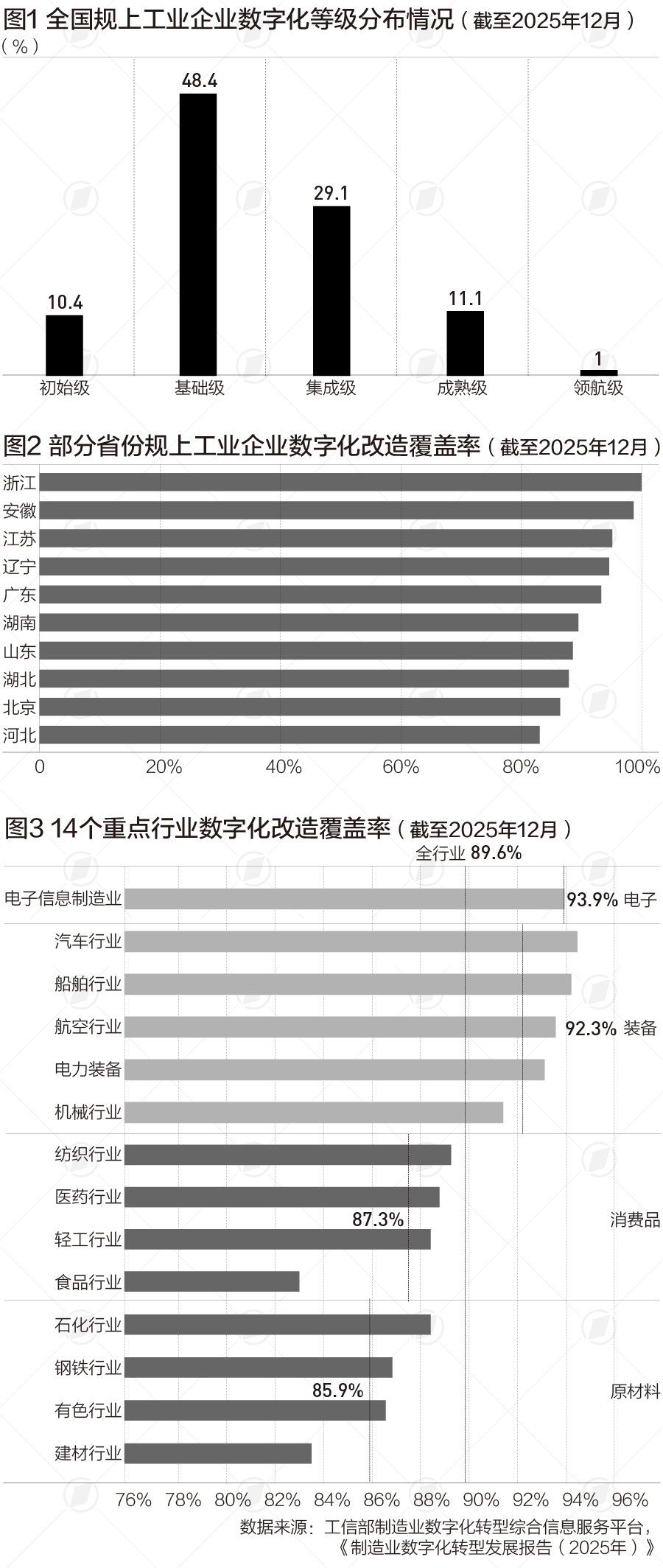
Core Viewpoint - By 2030, China aims to complete a round of digital transformation for industrial enterprises, amidst pressures from global industrial restructuring and the need for intelligent transformation in manufacturing [1][2]. Group 1: Digital Transformation Goals - The report outlines that by 2027, major industrial provinces and key parks will achieve full coverage of digital transformation for industrial enterprises, with a target for all industrial enterprises to complete digital transformation by 2030 [2]. - As of December 2025, the Ministry of Industry and Information Technology (MIIT) plans to issue digital transformation implementation plans for 14 key industries, setting clear transformation goals [2]. Group 2: Current Status and Growth - According to data from the National Taxation Administration, the procurement of automation and digital equipment by manufacturing enterprises is expected to grow by 11.3% and 10% year-on-year, respectively, by 2025 [3]. - The proportion of industrial enterprises engaged in digital transformation is projected to reach 89.6% by the end of 2025, with a digital production equipment penetration rate of 57.7% [3]. Group 3: Regional and Industry Disparities - Different provinces show varying levels of digital transformation, with Zhejiang, Anhui, and Guangdong nearing or exceeding 90% coverage among industrial enterprises [3][10]. - The automotive, shipbuilding, and electronic information manufacturing sectors have the highest rates of digital transformation, with 94.4%, 94.2%, and 93.9% of enterprises engaged in such efforts, respectively [10]. Group 4: Challenges and Recommendations - The report identifies challenges such as weak transformation foundations, insufficient technological products, and inadequate resource support for digital transformation [14]. - Recommendations include establishing unified industrial data interfaces, promoting data sharing among industry players, and leveraging central financial resources to support digital transformation projects [15].

无惧上半年相关业务收入下滑 中化装备拟收购化工装备、橡胶机械企业
Mei Ri Jing Ji Xin Wen· 2025-07-14 15:19
Core Viewpoint - Zhonghua Equipment is facing a projected loss for the first half of the year, while simultaneously planning to acquire two companies in the rubber machinery and chemical equipment sectors, indicating a strategic shift despite current financial challenges [1][2][3]. Group 1: Financial Performance - Zhonghua Equipment expects a net loss of between 14.71 million yuan and 22.06 million yuan for the first half of the year, which is an improvement compared to the previous year [1][2]. - The company anticipates a non-recurring net profit loss of between 9.87 million yuan and 17.22 million yuan for the same period [2]. - The decline in revenue is attributed to a slowdown in investment growth in the petrochemical and rubber tire industries, impacting equipment demand [3]. Group 2: Acquisition Plans - Zhonghua Equipment plans to acquire 100% of the shares of Yiyang Rubber Plastic Machinery Group Co., Ltd. and Beijing Blue Star Chemical Machinery Co., Ltd. through a share issuance [1][4]. - The acquisitions are part of a strategy to enhance the company's core competitiveness in the rubber machinery sector, supported by its parent company, China National Chemical Corporation [4][5]. - The company has previously managed Yiyang Rubber Machinery under a trust agreement due to conditions not being met for direct acquisition [5]. Group 3: Strategic Focus - The company is focusing on optimizing resource allocation internally and expanding market outreach externally, aiming to improve operational quality [3]. - A significant factor in the expected improvement in financial performance is the completion of a major asset restructuring project by the end of 2024, which will exclude overseas loss-making businesses from consolidated financial statements [3]. - Zhonghua Equipment plans to enhance market order acquisition and implement refined cost control measures in the second half of the year to boost operational efficiency [3].
