
软件与数据服务

Search documents
瑞银预警AI颠覆性变革冲击信贷市场 2026年基准情景违约规模750亿至1200亿美元
Jin Rong Jie· 2026-02-14 08:03
Core Insights - UBS Credit Strategy Head Matthew Mish warns that the rapid disruptive changes in artificial intelligence (AI) technology may impact the global credit market, leading to increased corporate default risks and systemic credit tightening [1] - The latest large models from organizations like Anthropic and OpenAI have accelerated the pace of AI disruption, necessitating a reassessment of credit risk evaluation frameworks [1] - The market's perception of AI has shifted from a technology-positive view to a "winner-takes-all" scenario, causing pressure on traditional industries and asset sell-offs in sectors like software, finance, real estate, and freight [1] Group 1: Default Predictions - According to UBS's baseline scenario, by the end of 2026, the leveraged loan and private credit sectors could see an increase in defaults ranging from $75 billion to $120 billion [2] - The projected default rates for leveraged loans and private credit could rise to as much as 2.5% and 4%, respectively, corresponding to market sizes of approximately $1.5 trillion and $2 trillion [2] - In extreme scenarios, if the AI transformation accelerates further, default rates could reach twice the baseline expectations, triggering what the market refers to as "tail risk" and leading to credit tightening in the loan market [2] Group 2: AI Sector Classification - UBS classifies AI sector companies into three categories: foundational large model developers, investment-grade software companies with robust financials, and high-debt private equity-controlled software and data service firms [2] - Mish believes that the third category of companies, which are under significant financial strain, has the lowest likelihood of emerging as winners in the rapidly changing landscape [2]
Porch(PRCH) - 2025 Q4 - Earnings Call Transcript
2026-02-11 23:00
Financial Data and Key Metrics Changes - Full year 2025 adjusted EBITDA reached $77 million, an 11-fold increase over 2024, translating into $65 million in cash flow from operations [3][14] - Q4 gross profit was $91 million, resulting in an 81% gross margin, while Q4 adjusted EBITDA was $23 million, a 21% margin [5][16] - Statutory surplus at the reciprocal grew approximately $50 million, ending 2025 almost 50% higher than 2024, with a total of $155 million in statutory surplus [3][12] Business Line Data and Key Metrics Changes - Insurance services revenue was $75.7 million in Q4, accounting for 60% of total revenue, with a gross margin of 86% [16][17] - Software and data segment revenue was $22.3 million, a 3% increase over the prior year, while consumer services revenue was $16.6 million, a 2% increase [18][20] - Reciprocal written premium (RWP) was $126 million in Q4, with a significant increase in new customer additions driving this growth [4][28] Market Data and Key Metrics Changes - The number of active agencies more than doubled year-over-year, with quote volumes increasing nearly 3x compared to the previous year [26][28] - New business premiums in December rose 104% compared to the January to October average, indicating strong market demand [6][28] - The competitive landscape is shifting from in-house agents to independent agents, which is favorable for the company [82] Company Strategy and Development Direction - The company aims for $600 million in organic reciprocal written premium in 2026, representing a 25% growth rate [4][23] - The launch of Porch Insurance is a key part of the strategy, providing a unique product that enhances conversion rates and agent profitability [8][51] - The company is focused on leveraging its data and technology to improve underwriting and risk assessment, creating a structural advantage in the market [9][63] Management's Comments on Operating Environment and Future Outlook - Management expressed confidence in achieving the 2026 growth targets, citing strong momentum in new customer additions and improved conversion rates [4][36] - The company noted that the insurance services division is offsetting soft U.S. housing conditions, which are expected to persist [24][71] - Management highlighted the importance of maintaining a healthy statutory surplus to support future growth [12][74] Other Important Information - The company ended 2025 with a cash position of $121.2 million, a $31.3 million increase from the beginning of the year [21][22] - A $2.5 million share repurchase program has been authorized by the board of directors [22] Q&A Session Questions and Answers Question: Can you provide insight into the pricing actions taken to drive acceleration and the flexibility for future pricing adjustments? - Management indicated that there is significant margin in the system, allowing for targeted pricing adjustments to improve conversion rates without dramatic changes [41][42] Question: How should we think about the operating leverage in RWP to EBITDA conversion as you scale RWP? - Management noted that the RWP to adjusted EBITDA conversion improved due to operating discipline and cost control, with expectations for continued improvement in 2026 [44][45] Question: Can you discuss the competitive landscape and any shifts observed in key markets? - Management acknowledged a shift from in-house agents to independent agents, which is beneficial for the company as it works with independent agents [82]

道指收盘首次站上5万点,芯片股集体反弹,金龙指数涨3.7%
Di Yi Cai Jing Zi Xun· 2026-02-07 00:55
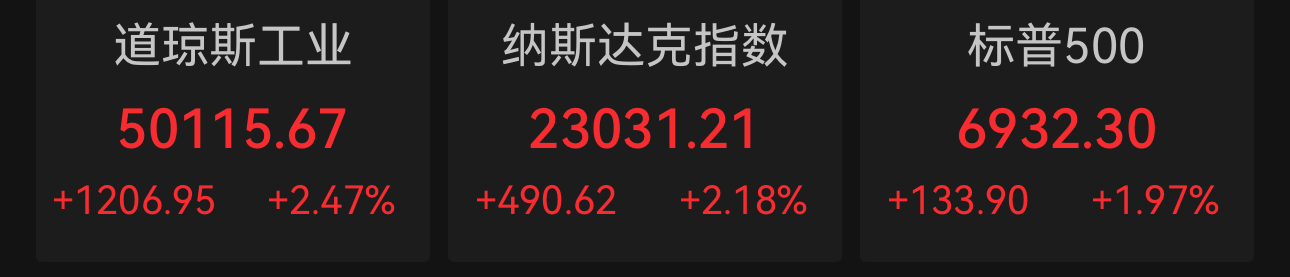
Market Overview - The US stock market experienced a significant rebound on Friday, with the S&P 500 and Nasdaq indices recovering from three consecutive days of decline, while the Dow Jones Industrial Average closed above 50,000 points for the first time in history [2][3] - The Dow Jones Industrial Average rose by 2.47% to close at 50,115.67 points, marking a record high; the S&P 500 increased by 1.97% to 6,932.30 points; and the Nasdaq Composite gained 2.18% to 23,031.21 points [2][3] - The Russell 2000 index, which reflects small-cap stock performance, surged by 3.6% [2] Sector Performance - Among the 11 sectors in the S&P 500, 9 sectors saw gains, with the Information Technology sector leading with a 4.1% increase, followed by the Industrial sector at 2.84% [3] - The Energy, Industrial, and Consumer Staples sectors reached new historical highs, with the S&P 500 Energy Index also setting a record [3] Weekly Performance - For the week, the Dow Jones rose by 2.5%, while the S&P 500 was nearly flat with a slight decline of 0.1%, and the Nasdaq fell by 1.9% [3] Notable Stock Movements - Nvidia saw a significant increase of 7.87% after a prior decline of 10.72% over five consecutive days; Tesla rose by 3.50%, Apple by 0.80%, and Microsoft by 1.90% [4][5] - Conversely, Amazon's stock dropped by 5.6%, impacting the overall gains of the three major indices due to investor concerns over a projected 50% increase in capital expenditures for the year [4][5] - Chip stocks collectively strengthened, with expectations of benefiting from increased capital investments in AI data centers by Amazon and Google [4] Chinese Stocks Performance - The Nasdaq Golden Dragon China Index rose by 3.71%, with notable increases in Alibaba (3.01%), Pinduoduo (3.65%), NIO (7.23%), Baidu (5.02%), JD.com (2.75%), and Tencent (2.33%) [6] Economic Indicators - The upcoming non-farm payroll report for January has been postponed due to a government shutdown, with economists predicting an addition of approximately 70,000 jobs and an unemployment rate of 4.4% [8] - Federal Reserve Vice Chairman Jefferson expressed a cautiously optimistic outlook for the economy in 2026, anticipating growth slightly above trend levels and a gradual return of inflation to the 2% target [8] Bond Market - The two-year US Treasury yield rose by 1.5 basis points to 3.498%, while the ten-year yield remained stable at 4.21% [9] Commodity Market - Oil prices increased, with Brent crude closing at $68.05 per barrel and US crude at $63.55 per barrel [10] - Gold prices rebounded, with spot gold rising by 3.9% to $4,954.92 per ounce, while silver saw an 8.6% increase [10]


道指收盘首次站上5万点 英伟达大涨近8% 芯片股集体反弹 金龙指数涨3.7%
Di Yi Cai Jing· 2026-02-07 00:31
Market Overview - The U.S. stock market experienced a significant rebound, with the S&P 500 and Nasdaq indices ending a three-day decline, while the Dow Jones Industrial Average closed above 50,000 points for the first time in history [1][3] - The Dow Jones Industrial Average rose by 2.47% to 50,115.67 points, marking a record closing high; the S&P 500 increased by 1.97% to 6,932.30 points; and the Nasdaq Composite climbed by 2.18% to 23,031.21 points [1] - The Russell 2000 index, which reflects small-cap stocks, surged by 3.6% [1] Sector Performance - Among the 11 sectors in the S&P 500, 9 sectors saw gains, with the Information Technology sector leading with a 4.1% increase, followed by the Industrial sector at 2.84% [3] - The Energy, Industrial, and Consumer Staples sectors reached historical highs, with the S&P 500 Energy Index also setting a record [3] Notable Stock Movements - Nvidia rebounded by 7.87% after a previous decline of 10.72% over five days; Tesla rose by 3.50%, Apple by 0.80%, and Microsoft by 1.90% [4] - Conversely, Amazon's stock fell by 5.6%, impacting the overall gains of the three major indices due to concerns over a projected 50% increase in capital expenditures [4] - Chip stocks collectively strengthened, with Nvidia and Broadcom being significant contributors to the S&P 500's rise, as market expectations grew regarding increased capital investments in AI data centers by Amazon and Google [5] Chinese Stocks Performance - The Nasdaq Golden Dragon China Index increased by 3.71%, with notable gains from Alibaba (3.01%), Pinduoduo (3.65%), NIO (7.23%), Baidu (5.02%), JD.com (2.75%), and Tencent (2.33%) [6] Economic Indicators - Over half of the S&P 500 companies have reported quarterly earnings, with approximately 80% exceeding analyst expectations, which is above the long-term average [8] - The non-farm payroll report for January was postponed due to a government shutdown, with economists predicting an addition of about 70,000 jobs and an unemployment rate of 4.4% [8] Federal Reserve Insights - The Vice Chairman of the Federal Reserve expressed a cautiously optimistic outlook for the economy in 2026, anticipating growth slightly above trend levels and a gradual return of inflation to the 2% target [9]

人工智能颠覆担忧叠加6000亿美元资本支出计划引发恐慌
Xin Lang Cai Jing· 2026-02-06 12:58
Core Viewpoint - The global technology and data stocks are experiencing significant declines due to investor concerns over the impact of new high-performance AI models on business operations and the substantial capital expenditure plans of major tech companies, totaling over $600 billion this year [1][2][3]. Group 1: Market Reactions - Major technology companies have announced AI-related capital expenditures exceeding $600 billion, which has intensified market fears [1][2]. - The global stock market has dropped 1.6% this week, marking the worst performance since November of the previous year [2][6]. - The S&P 500 index fell by 2% this week, with the market capitalization of U.S. software and data service companies decreasing by approximately $1 trillion since January 28 [2][6]. Group 2: Company-Specific Impacts - The stock prices of London-listed data analytics firms such as IHS Markit, Syntel, and Ipreo have declined by nearly 5%, 4%, and over 2% respectively [4][5]. - The London Stock Exchange Group's stock has seen a cumulative drop of 7% this week, indicating a significant downturn [4]. - In Europe, companies like Capgemini and Wipro have also experienced stock declines of 3% and nearly 4% respectively [5]. Group 3: Regional Market Trends - The Indian IT index has dropped nearly 7% this week, reflecting severe market turbulence [7]. - Indian software export companies saw their stock prices fall by 2% on Friday, with the sector's market capitalization evaporating by $22.5 billion this week [2][6]. - Concerns over potential industry disruption from AI advancements have led to aggressive sell-offs, even when tech giants signal increased spending in AI [7].

Porch(PRCH) - 2025 Q3 - Earnings Call Transcript
2025-11-05 23:00
Financial Data and Key Metrics Changes - Porch Group reported Q3 2025 adjusted EBITDA of $21 million, surpassing the initial target of $50 million for the year, with year-to-date adjusted EBITDA reaching $53.1 million [4][12] - Year-to-date gross profit increased by 119% compared to the previous year, with Q3 gross profit at $94 million and an 82% gross margin [5][12] - Cash flow from operations for Q3 was $29 million, contributing to a total of $71 million year-to-date [4][17] Business Line Data and Key Metrics Changes - Insurance services accounted for 64% of total revenue in Q3, with revenue from this segment at $73.8 million and an adjusted EBITDA margin of 34% [12][14] - Software and data segment revenue increased by 7% year-over-year to $24.6 million, while consumer services revenue rose by 9% to $19.4 million [16][17] - The conversion rate of reciprocal written premium (RWP) to insurance services adjusted EBITDA improved to 18% in Q3, up from 16% in Q2 [10][14] Market Data and Key Metrics Changes - Reciprocal written premium for Q3 was $138 million, reflecting a 14% increase from the previous quarter [20] - The company reported nearly 48,000 policies written in Q3, with an RWP per policy of $2,884 [21] - The reciprocal surplus combined with non-admitted assets increased by over $100 million quarter-over-quarter to $412 million [8][10] Company Strategy and Development Direction - The company aims to generate as much surplus as possible at the reciprocal while growing agent and quote volume to lower prices for new low-risk customers when appropriate [8][19] - The focus remains on maximizing long-term shareholder value rather than rapid premium growth, with a disciplined approach to scaling [32][60] - Investments in data capabilities and product innovation are expected to drive future growth, particularly in the software and data segments [25][26] Management's Comments on Operating Environment and Future Outlook - Management expressed confidence in achieving the full-year adjusted EBITDA target of $70 million, representing a tenfold increase from the previous year [4][18] - The company remains cautious about the housing market, which continues to present headwinds, but anticipates potential recovery in the future [41][42] - The management highlighted the importance of maintaining strong loss ratios and surplus generation to support future growth [57][60] Other Important Information - The company has repurchased $12.8 million of its 2026 convertible notes, resulting in a gain of approximately $400,000 [17] - The board has authorized management to repurchase remaining notes with cash from the balance sheet [17] Q&A Session Summary Question: Insights on reciprocal written premium and competitive landscape - Management emphasized the focus on maximizing long-term shareholder value and the ability to grow premium at a controlled pace without sacrificing margins [32][33] Question: Clarification on fourth quarter guidance and housing market impact - Management noted that while Q3 outperformed expectations, the housing market remains a challenge, and they are cautious about future forecasts [40][42] Question: Update on Home Factors and AI integration - The company is leveraging AI to enhance data insights and is on track to expand its Home Factors product line [48][49] Question: Capital allocation and M&A appetite - Management acknowledged the potential for M&A but did not provide specific details, indicating that having excess capital offers various strategic choices [68][69] Question: Insurance segment expansion and state presence - The company remains in 22 states but sees opportunities for expansion in 2026, with a streamlined process for entering new markets [73][74]