非金融机构支付

Search documents
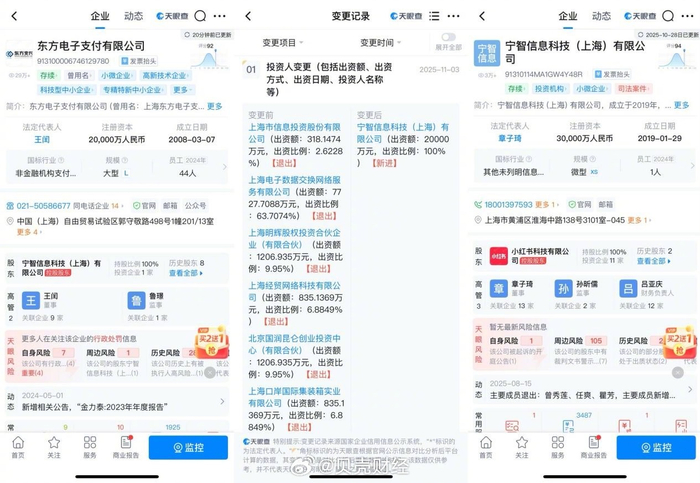
小红书全资子公司获支付牌照,增资东方支付至2亿元
Bei Ke Cai Jing· 2025-11-06 09:05
Core Viewpoint - Xiaohongshu has successfully obtained a payment license through its wholly-owned subsidiary, indicating a strategic move to enhance its financial infrastructure and capitalize on the growth of its e-commerce and local services [1][2]. Group 1: Payment License Acquisition - Xiaohongshu's acquisition of the payment license is seen as a necessary step to address the shortcomings in its financial infrastructure, enabling better control over transaction costs and user data [1]. - The change in ownership of Dongfang Electronic Payment Co., Ltd. to Ningzhi Information Technology (Shanghai) Co., Ltd., a wholly-owned subsidiary of Xiaohongshu, reflects a strategic shift towards self-sustaining payment capabilities [1][2]. Group 2: Financial Implications - The registered capital of Dongfang Payment has increased from 121 million RMB to 200 million RMB, a growth of over 65%, signaling a commitment to enhancing operational capabilities [1]. - Despite the investment, Dongfang Payment has faced financial challenges, with projected revenues of 8.88 million RMB and a net loss of 8 million RMB for 2024, indicating a need for improved transaction flow and customer engagement [2]. Group 3: Future Growth Potential - With the support of Xiaohongshu's platform, Dongfang Payment is expected to leverage high-frequency transaction scenarios such as live streaming rewards and in-store redemptions, which could enhance merchant engagement and profitability [2]. - The potential for exploring small consumer credit based on user credit profiles could further diversify revenue streams and improve financial performance [2].

从濒临退市到再获新生 中信金融资产助力困境企业“重新起航”
Jing Ji Guan Cha Wang· 2025-10-13 09:01
Core Insights - The successful bankruptcy restructuring of Rindong Holdings marks a significant achievement in the context of China's new bankruptcy regulations, showcasing the effective collaboration and expertise of CITIC Financial Assets Shenzhen Branch [2][6] Group 1: Company Overview - Rindong Holdings, once a leader in the third-party payment industry, faced severe financial distress in early 2024, with expanding losses and critical issues regarding its core payment licenses [3] - The company encountered liquidity shortages, maturing debts, and risks of asset liquidation, necessitating a structured bankruptcy reorganization [3][4] Group 2: Restructuring Process - CITIC Financial Assets Shenzhen Branch played a pivotal role in the restructuring process, leveraging its professional capabilities and experience to assess the feasibility of Rindong's reorganization [3][4] - The bankruptcy restructuring was initiated on December 30, 2024, with the Guangzhou Intermediate Court accepting the case, leading to the company's stock being marked with "ST" [4][5] - The restructuring faced challenges, including resistance from some original creditors and the lack of precedent for successful cases under the new regulations [4] Group 3: Strategic Actions - The Shenzhen branch focused on consolidating debts and enhancing creditor influence, which was crucial for advancing the restructuring process [4] - Key actions included acquiring debts from financial institutions like CITIC Bank to stabilize Rindong's balance sheet and mitigate risks of asset liquidation [4] - Collaboration with strategic investors and financial advisors facilitated the deep exploration of Rindong's value and resource integration, enhancing its operational capabilities [4][6] Group 4: Future Outlook - The restructuring process, completed by March 2025, is seen as a new benchmark for listed company reorganizations, emphasizing that bankruptcy is a starting point for resource reallocation rather than an endpoint [6] - Successful restructuring is expected to position Rindong Holdings as a representative of technological financial innovation, contributing to the integration of digital and real economies [6]