高熵合金

Search documents
研判2025!中国高熵合金行业制备工艺、相关政策、市场规模及发展趋势分析:高熵合金加速从实验室迈向产业化[图]
Chan Ye Xin Xi Wang· 2025-05-06 01:20
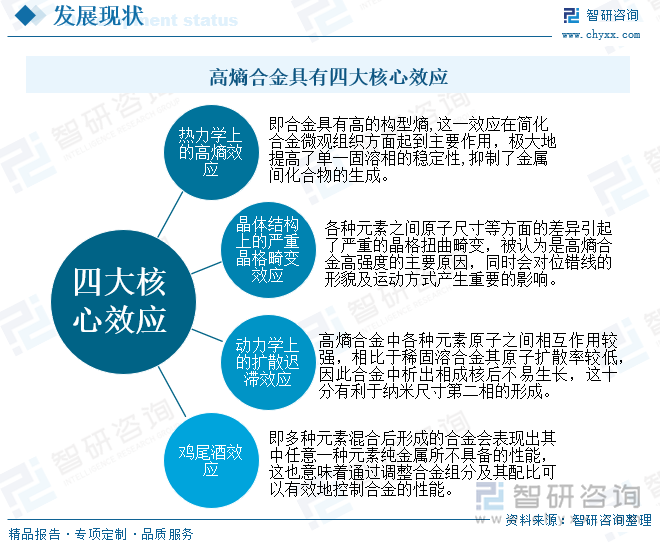
Core Insights - The concept of high-entropy alloys (HEAs) was proposed in 2004, revealing that alloys formed by mixing multiple elements in near/equal atomic ratios do not create complex intermetallic compounds but rather simple solid solution structures [1][2] - HEAs exhibit four core effects: thermodynamic high-entropy effect, severe lattice distortion effect, kinetic diffusion lag effect, and cocktail effect, leading to superior comprehensive performance [1][2] - The emergence of HEAs breaks traditional alloy design principles, opening up a broad design space for new materials [1][2] Industry Overview - HEAs can be applied in critical fields such as defense, aviation, and aerospace, with China making some progress in HEA research, although most studies remain in the laboratory stage and industrial promotion is slow [1][14] - The market size for China's HEA industry is projected to be approximately 0.83 million yuan in 2024 [14] Composition and Structure - HEAs can be classified based on structural types (FCC, BCC, HCP, amorphous, and intermetallic compounds) and phase types (single-phase, dual-phase, eutectic, and multiphase) [4] - Typical FCC HEA examples include equiatomic FeCoCrNiMn alloys, while BCC HEAs are primarily composed of IV-VI group elements [4] Preparation Techniques - Various methods for preparing HEAs have emerged, including arc melting, mechanical alloying, laser cladding, magnetron sputtering, 3D printing, and vapor deposition, categorized into solid-phase, liquid-phase, and gas-phase forming [6][8] Policy Support - A series of policies have been introduced in China to support the HEA industry, including its inclusion in the "Key Development Directory for Frontier Materials" and encouragement for basic research and original innovation [9][10] - Local governments in Gansu, Chongqing, and Ningxia have also issued policies to promote the development of the HEA industry [9][10] Standards Development - The national standard for HEA powders used in additive manufacturing (GB/T 42787-2023) was released in August 2023 and will be implemented in March 2024, aiming to improve product quality and market application [11][12] Future Trends - Future advancements in HEAs are expected in preparation technologies, leading to large-scale production, and further research into their performance and cost reduction will enable broader applications [16]