AI Image Generation

Search documents
对话LiblibAI 联合创始人张子捷:2000万创作者与一场工具革命 | NEXTA创新夜谈
3 6 Ke· 2025-09-12 03:24
Core Insights - The article discusses the transformative impact of AI, particularly generative models, on the creative industry, enabling individuals from various professional backgrounds to produce creative work with minimal effort [1][2] - LiblibAI, established in May 2023, has rapidly grown to become one of the largest AI image platforms in China, accumulating nearly 20 million creators and generating over 5 million images daily [1] Group 1: AI's Impact on Creative Work - AI has democratized creative processes, allowing non-professionals to create high-quality content, thus redefining the boundaries of creative labor [1][2] - The shift in creative production logic emphasizes imaginative demand over technical software skills, leading to new business opportunities and reshaping creator identities [2][5] Group 2: LiblibAI's Growth and Strategy - LiblibAI's user base grew to 10 million through a combination of grassroots outreach, organic social media sharing, and a closed-loop asset production model [7][10] - The platform supports a community-driven approach, allowing users to upload and share their style models, fostering a rich ecosystem of creativity [9][10] Group 3: Global Expansion and Market Adaptation - LiblibAI aims for global reach, initially targeting markets in Japan, South Korea, and Southeast Asia due to their similar aesthetic preferences and openness to AI tools [11][12] - The platform adapts to regional content preferences, with significant differences observed between domestic and international user demands [12] Group 4: Future of AI in Creative Industries - The integration of AI is expected to shift creative workflows from labor-intensive to creativity-intensive processes, allowing creators to focus on narrative and selection rather than execution [14][19] - Future creators will need to develop skills in expressing creative ideas clearly, as AI tools evolve to facilitate more natural interactions [15][16] Group 5: Long-term Vision and Industry Evolution - LiblibAI envisions a future where AI acts as a collaborative partner in the creative process, enhancing human creativity rather than replacing it [20][23] - The company aims to become a global hub for multi-modal AI creativity, connecting creators and developers worldwide [23]

一个流量屡创新高月入千万、但惨遭“嫌弃”的AI赛道
3 6 Ke· 2025-07-24 00:58
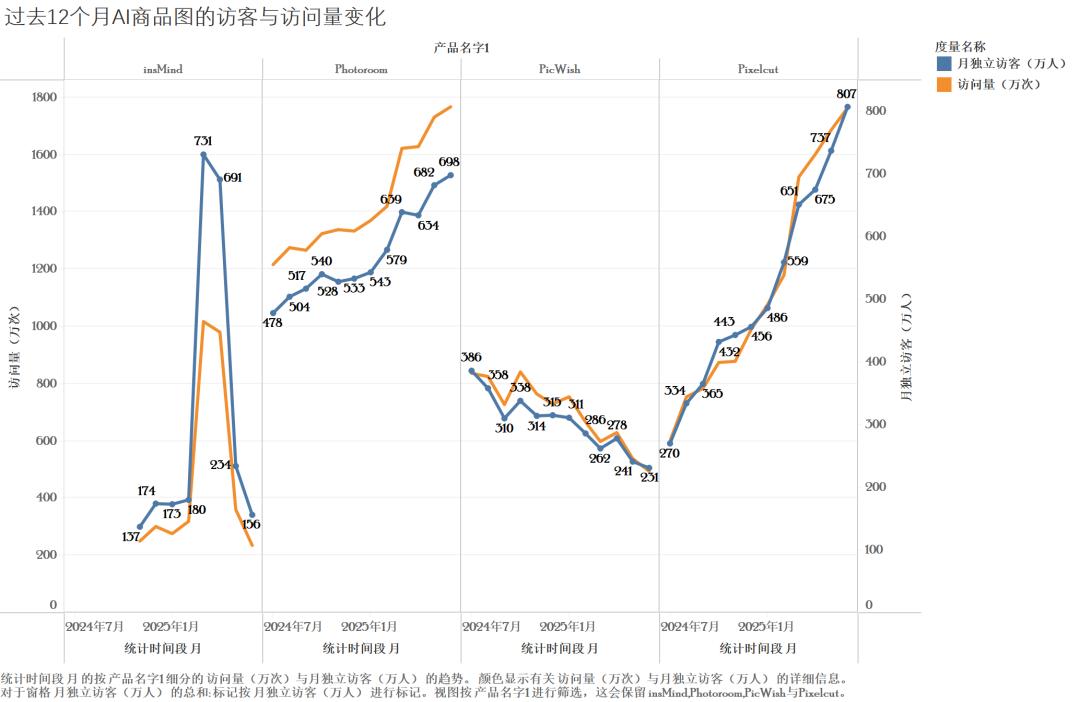
Core Insights - The AI product image sector is highly competitive, with leading products achieving record web traffic while newer entrants struggle to gain traction [1][24] - The market is characterized by a significant divide between top-tier products and those in the middle and lower tiers, with the latter facing declining user engagement [7][24] - Innovations in technology are prompting established products to expand their functionalities, such as Photoroom's introduction of virtual model features [2][24] Group 1: Market Dynamics - The AI product image market is experiencing intense competition, leading to a perception of being "overcrowded" [1][24] - Major players like Photoroom and Pixelcut are capturing the majority of new traffic, while mid-tier products struggle to maintain their user base [7][24] - The influx of new entrants, including established companies like Kuaishou and Alibaba, has not significantly altered the competitive landscape [1][24] Group 2: Product Performance - Photoroom and Pixelcut have demonstrated strong performance metrics, with Photoroom achieving a web traffic increase of 5.51 million visits, while Pixelcut gained 11.64 million visits [6][8] - The top two products are rapidly iterating on their features, enhancing their competitive edge through continuous improvements [7][8] - In contrast, products like PicWish and insMind have seen declines in traffic, indicating challenges in user retention and engagement [6][7] Group 3: User Experience and SEO Strategies - Pixelcut has effectively optimized its user experience, particularly in the background removal process, which has contributed to its rising popularity [13][19] - Both Photoroom and Pixelcut focus on maximizing user engagement through SEO strategies that enhance visibility for high-traffic keywords [21][22] - The user experience is critical, with companies needing to balance functionality and ease of use to retain customers [21][24] Group 4: Future Outlook - The AI product image sector is expected to continue evolving, with ongoing technological advancements shaping the competitive landscape [2][24] - Companies must leverage industry know-how and differentiate their offerings to succeed in this crowded market [46][24] - The introduction of new models like Kontext presents opportunities for innovation, but challenges remain in achieving consistent quality in AI-generated images [25][33]