
Power Semiconductor

Search documents
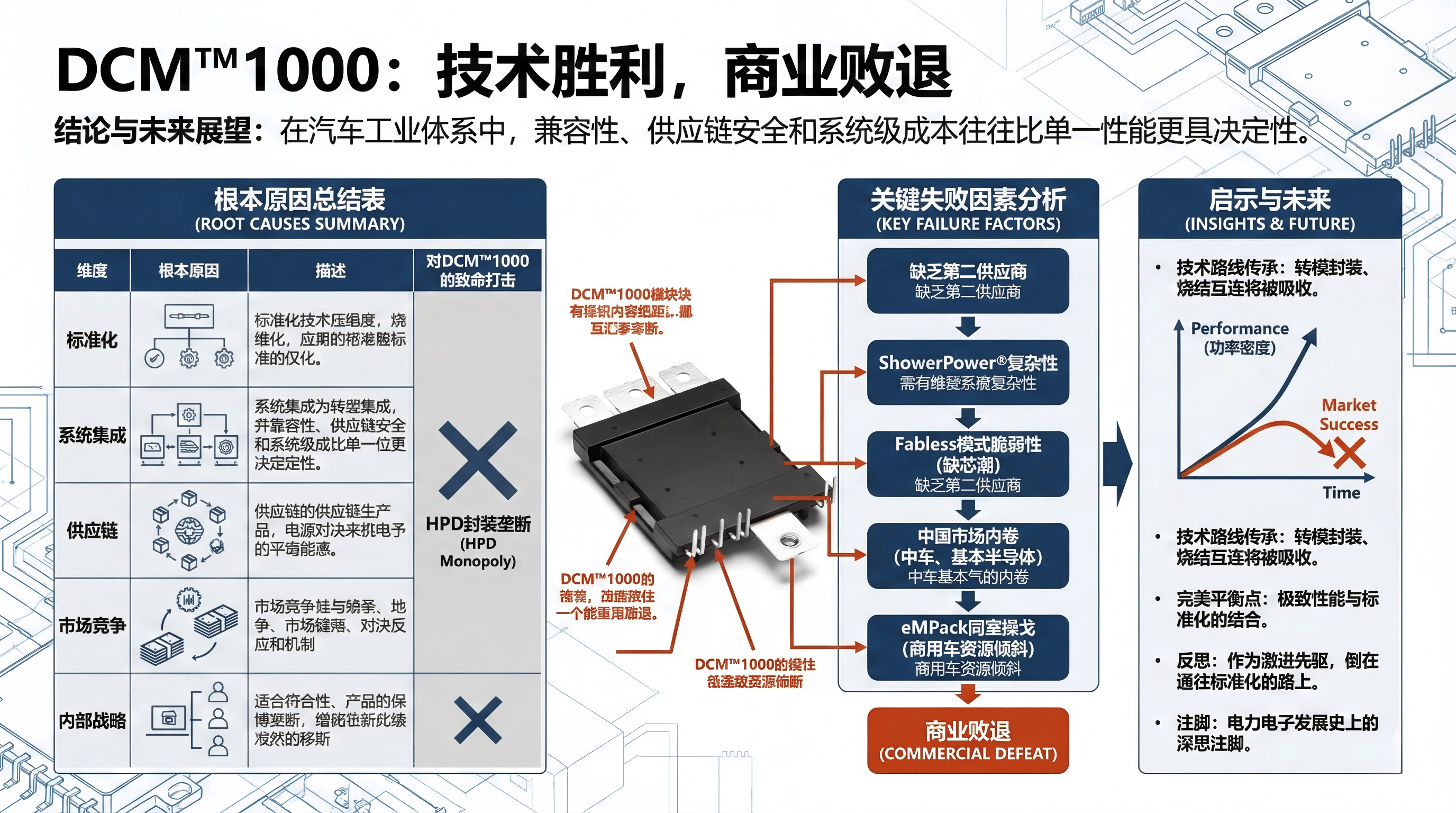
市场趋势分析:DCM1000以及类似封装的SiC模块在电驱动领域遭遇淘汰的原因
Sou Hu Cai Jing· 2026-01-03 05:08
Core Viewpoint - The DCM™1000 technology platform from Danfoss Silicon Power (now Semikron Danfoss) has faced significant market challenges despite its impressive technical specifications, leading to its marginalization in both the Chinese passenger vehicle market and the global commercial vehicle sector [2][8][44]. Group 1: Technical Challenges - DCM™1000 integrates advanced technologies such as Transfer Molding, Danfoss Bond Buffer® (DBB®), and ShowerPower® 3D cooling, which theoretically enhance power density and cycle life compared to traditional modules [2][12]. - The platform's failure is attributed to a "system-level cost trap," "standardization barriers," and the vulnerability of the fabless packaging model during supply chain crises [7][44]. - The unique mechanical interface and cooling design of DCM™1000 have become integration obstacles rather than advantages, especially in the face of strong competition from established products like Infineon's HybridPACK™ Drive [8][15]. Group 2: Market Dynamics - The passenger vehicle market emphasizes standardization, which has hindered DCM™1000's ability to compete against established industry standards [15][21]. - In the Chinese market, rapid growth and a focus on cost have led to intense price competition, further marginalizing DCM™1000 [29][32]. - Local suppliers have gained a competitive edge by offering compatible modules with customization and lower prices, making DCM™1000 less attractive [29][33]. Group 3: Internal Strategic Issues - The merger of Semikron and Danfoss has led to internal product line conflicts, with a strategic shift towards the eMPack platform, further limiting DCM's market presence [34][40]. - DCM™1000's complex design has resulted in higher manufacturing costs and lower yield rates, making it less viable in a cost-sensitive market [39][45]. Group 4: Supply Chain Vulnerabilities - The fabless model, which relies on external chip suppliers, has become a significant weakness during chip shortages, impacting DCM™1000's market entry opportunities [37][38]. - The inability to secure a stable supply of chips has led potential customers to favor suppliers with guaranteed availability, such as Infineon and onsemi [38][44]. Group 5: Future Outlook - Although DCM™1000 has failed as a packaging platform, its advocated technologies may influence future product definitions, emphasizing the need for a balance between extreme performance and standardization [50].

中国功率半导体行业:中国终端市场需求趋势更新-China Power Semiconductor Sector_ Updates on China end market demand trends
2025-07-25 07:15
Summary of China Power Semiconductor Sector Conference Call Industry Overview - The conference call focused on the **China Power Semiconductor Sector** and provided insights into market demand trends for the third quarter of 2025 (3Q25) [2][5][33]. - **Electric Vehicle (EV) demand** is highlighted as a key growth driver for the sector, with expectations of over **20% year-over-year growth** in 2025 [5][2]. - **Industrial demand** is expected to remain largely flat quarter-over-quarter (QoQ) in 3Q25 after a recovery in 2Q25, while **consumer demand** shows uncertainties due to tightening purchase subsidies for home appliances [2][5]. Company Ratings and Performance - J.P. Morgan maintains **Neutral ratings** on several companies in the sector, including **StarPower, United Nova, SICC, and NCE Power** [2][5]. - **StarPower and United Nova** are expected to have stable to slightly better gross margins (GMs) in 2Q25 compared to 1Q25, with a solid outlook for 3Q25 [2][5]. - Despite the positive outlook, no significant price increases for silicon power semiconductor suppliers are anticipated in the near future [2][5]. Demand by Application - **Automotive Sector**: Positive outlook for EV unit demand, with expectations of **20%+ YoY growth** in 2025 [5][2]. - **Industrial Sector**: Shipments increased nicely in 2Q25, but orders are expected to be flat in 3Q25 due to seasonal factors and uncertainties [5][2]. - **Consumer Sector**: Demand is trending down QoQ, influenced by temporary subsidy tightening and lack of momentum for consumer products [5][2]. Industry Profitability - Leading Chinese silicon power semiconductor companies are expected to maintain stable to slightly improved GMs in 2Q25, despite competitive pressures preventing direct wafer price increases [5][2]. - Pricing pressure for **IGBT components** has lessened, but **SiC materials and devices** are expected to face high pricing pressure, which may intensify further in 2026 [5][2]. Stock Implications - The **Neutral ratings** reflect the expectation of continued improvements in fundamentals for the covered stocks in 2Q-3Q25, but no inflection points for price hikes have been identified [5][2]. - Investors are advised to monitor potential price hikes or recoveries in the industry moving forward [5][2]. Valuation Metrics - A valuation table for the China power semiconductor sector was provided, detailing market capitalization, P/E ratios, EV/EBITDA, and expected EPS growth for various companies [6][2]. - Notable companies discussed include **CR Micro, NCE Power, Silan Micro, StarPower, United Nova, Yangjie Elec, and SICC**, with varying price targets and growth expectations [6][2]. Conclusion - The China Power Semiconductor Sector is poised for growth driven by EV demand, but faces challenges in industrial and consumer segments. The outlook remains cautious with Neutral ratings on key companies, emphasizing the need for investors to watch for potential price recoveries in the future [2][5][6].