
Small - Cap Stocks

Search documents
2 Ways to Trade a Small-Cap Comeback in 2026
Yahoo Finance· 2026-01-29 17:56
Core Viewpoint - Small-cap stocks are poised for a potential comeback in 2026, driven by favorable economic conditions, attractive valuations, and expected earnings growth, particularly following recent Fed rate cuts [1][7][14]. Group 1: Historical Performance and Valuation - Historically, small caps have outperformed in the months following Fed rate cuts, a trend observed since 1990 [1]. - The Russell 2000 is currently trading at 18 times earnings, while the S&P 600 trades at 15.9 times, compared to the S&P 500 at 27 times, indicating that small caps are at their cheapest relative to large caps since 1999 [3]. - Small caps have not outperformed the S&P 500 on a full-year basis since 2020, but their current valuations suggest a potential for significant outperformance [14]. Group 2: Economic Factors and Earnings Growth - Small companies benefit more quickly from Fed rate cuts due to their reliance on short-term bank loans, while large companies take longer to refinance [2]. - Bank of America forecasts that small-cap earnings will grow by 17% in 2026, compared to 14% for large caps, indicating a stronger profit growth outlook for small companies [7]. - The combination of rate cuts, accelerating earnings growth, and potential M&A activity creates a favorable environment for small caps [14]. Group 3: Investment Strategies and ETFs - Two ETFs provide distinct approaches to small-cap exposure: the Russell 2000 Index for broad-based exposure and the iShares Core S&P Small-Cap ETF (IJR) for a quality-focused basket [5][12]. - The Russell 2000 Index includes around 2,000 companies with market capitalizations typically ranging from $300 million to $2 billion, offering higher volatility due to the inclusion of speculative names [9]. - The IJR ETF applies stricter listing standards, filtering out riskier speculative names, which may result in lower volatility and more consistent returns [13]. Group 4: Market Dynamics and Opportunities - The dominance of a few megacap tech stocks has overshadowed small-cap performance, creating a compelling opportunity for investors to rotate into undervalued small-cap stocks [4][6]. - Analysts suggest that 2026 could be the best year for stock picking, particularly for small-cap stocks, as they offer better value for profit growth compared to megacaps [8]. - Small caps provide meaningful diversification away from the concentration in megacap stocks, making them an attractive option for investors seeking to balance their portfolios [15].
These 4 charts capture the whirlwind action in global markets so far this year
MarketWatch· 2026-01-24 13:00
Core Insights - Investors are currently experiencing significant volatility in Japan's bond market, indicating potential shifts in interest rates and investor sentiment [1] - There is a notable rally in small-cap stocks, suggesting a growing confidence in smaller companies and potential opportunities for higher returns [1] - Prices for natural gas, gold, and silver are surging, reflecting increased demand and possibly inflationary pressures in the market [1]


3 Unstoppable Growth ETFs to Stock Up On in 2026 and Beyond
The Motley Fool· 2025-12-11 12:00
Core Insights - Growth ETFs are positioned for significant growth, offering diversification and exposure to high-potential stocks, which can limit risk while capitalizing on growth opportunities [1][16] Group 1: Vanguard Russell 2000 ETF - The Vanguard Russell 2000 ETF contains 1,992 holdings, primarily small-cap stocks, which are defined as having a market capitalization of approximately $300 million to $2 billion, providing potential for explosive growth [3][4] - The ETF has achieved an average annual return of 9.18% over the last 10 years, suggesting that a $200 monthly investment could grow to around $209,000 after 25 years [6] - Approximately 20% of the fund is allocated to the industrials sector, ensuring diversification across various industries, which helps mitigate risk [5] Group 2: iShares Future AI and Tech ETF - The iShares Future AI and Tech ETF focuses on companies advancing AI technology, including software and infrastructure, with a total of 48 holdings, making it less diversified but highly targeted [7][8] - Despite its average return of 8.07% over the last five years, the ETF has seen a remarkable 33.77% return in the past 12 months, indicating potential for substantial growth in the AI sector [11] - The fund is considered riskier due to its smaller portfolio and the inherent volatility of the AI sector, as well as being a newer fund launched in 2018 [10] Group 3: Vanguard Information Technology ETF - The Vanguard Information Technology ETF includes 314 stocks from various technology sectors, with top holdings in major companies like Nvidia, Apple, and Microsoft [12][13] - This ETF has delivered a higher-than-average return of 22.18% per year over the last 10 years, suggesting that a $200 monthly investment could accumulate around $1.6 million after 25 years [15] - The ETF provides a balanced approach to tech exposure, focusing on large-cap stocks to help limit risk associated with the volatility of the tech sector [13]

Don't expect Fed to cut by 50 basis points in future, says Steve Grasso
Youtube· 2025-10-29 18:51
Group 1 - The Federal Reserve's interest rate decision is critical for market stability, with expectations of a 25 basis point cut at each available meeting, which would help manage government debt servicing costs [2][3] - The current economic environment shows a divergence in performance between profitable and unprofitable companies, particularly within the Russell 2000 index, with unprofitable companies outperforming [5] - The ongoing concern of inflation remains, despite not reaching the highs seen in the past few years, which poses a challenge for central bankers in balancing price stability and full employment [6][7] Group 2 - Tariffs are contributing to a one-time price shock in goods, and their impact on consumer prices is significant, with households facing an average cost of $1,000 due to tariffs, while benefiting from tax cuts of approximately $2,000 [8] - The reliance of smaller companies on variable rate debt financing is notable, with 30% of Russell 2000 companies depending on this type of financing, indicating potential vulnerabilities in a changing interest rate environment [4]

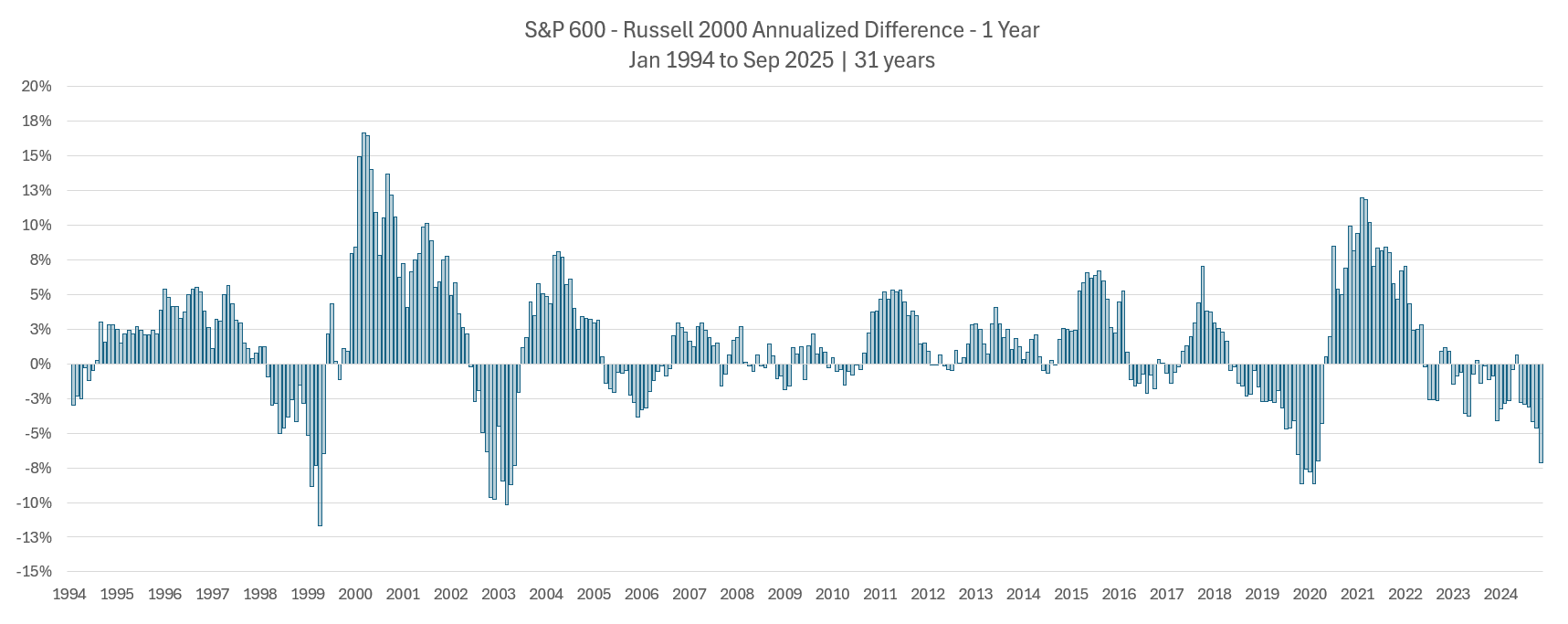
Does Eliminating Unprofitable Small Caps Improve Long Term Small Cap Index Performance?
Investment Moats· 2025-10-15 00:35
Core Insights - The article discusses the performance comparison between the S&P 600 and the Russell 2000, emphasizing the impact of profitability on investment returns [11][28]. - It highlights that the S&P 600, which requires companies to be profitable, has consistently outperformed the Russell 2000, which includes a significant number of unprofitable firms [10][14][28]. Group 1: Performance Comparison - The S&P 600 has shown better performance over various time frames compared to the Russell 2000, with most one-year, five-year, and ten-year rolling returns favoring the S&P 600 [14][19][22]. - Historical data indicates that investing in the S&P 600 for any ten-year period over the past 31 years would yield positive returns [26][28]. - The S&P 600's requirement for positive GAAP earnings contributes to a higher quality of aggregate earnings and cash flow, leading to improved returns [28][30]. Group 2: Investment Strategy - A systematic investment strategy that focuses on high profitability stocks can yield better returns compared to a strategy that includes low or non-profitable stocks [5][11]. - The article suggests that a diversified basket of profitable stocks can provide stable cash flow and high yield, akin to a long-term fixed income investment [7][8]. - The performance of the Russell 2000 is negatively impacted by its higher proportion of unprofitable companies, which dilutes overall returns [10][14].
Wall Street Expects Rally in Riskiest Stocks to Last 12 Months
Yahoo Finance· 2025-09-12 09:30
Core Viewpoint - The Russell 2000 Index, representing small-cap stocks, has experienced a significant rally, with strategists suggesting that this upward trend is just beginning [1][2]. Performance Summary - The Russell 2000 has surged nearly 10% since the end of July, outperforming the S&P 500, which has seen only half that advance [2]. - Analysts predict a potential 20% increase in the Russell 2000 over the next year, compared to an 11% forecast for the S&P 500 [2]. Historical Context - Small-cap stocks have underperformed larger companies since 2020, and despite recent gains, they still lag behind the S&P 500 in 2025 [3]. - The anticipated Federal Reserve rate cuts are expected to lower borrowing costs for Russell 2000 companies, potentially enhancing profit margins [3]. Market Sentiment - The recent market reaction to inflation and employment data has fueled optimism, with the Russell 2000 rising 1.2% in response to favorable economic indicators [4]. - Michael Casper from Bloomberg Intelligence notes that small-cap companies are particularly sensitive to the U.S. economy, and rate cuts could lead to increased support from investors [4]. Analyst Insights - Morgan Stanley's Michael Wilson suggests that Fed rate cuts could initiate a new phase in the bull market, positively impacting small-cap stocks [5]. - Wilson has upgraded small caps to neutral but is awaiting broader earnings revisions before fully committing [5]. Earnings Performance - In the current reporting season, over 60% of Russell 2000 stocks have exceeded earnings estimates, with results beating top-line expectations by an average of 130 basis points [6].