万家行业优选

Search documents
首份!公募践行“积极股东”角色,正式落地了!
证券时报· 2026-03-21 14:04
Core Viewpoint - The article highlights the transition of public funds from passive shareholders to active governance participants, as evidenced by Wan Jia Fund's disclosure of its voting results for the 2025 fiscal year, marking a significant step in the implementation of governance rules for public companies [1][6][8]. Group 1: Voting Participation and Results - Wan Jia Fund participated in 41 shareholder meetings in 2025, including 15 annual and 26 extraordinary meetings, covering over 552 voting proposals related to profit distribution, guarantee credit, and asset restructuring [3][5]. - Out of the 552 votes cast, Wan Jia Fund voted against 27 proposals, primarily concerning China Merchants Energy's low-price private placement plan, citing concerns over shareholder dilution and insufficient dividends [5][6]. Group 2: Regulatory Framework and Implementation - The disclosure of voting results is part of a broader initiative following the release of the "Rules for Public Fund Managers' Participation in Corporate Governance," which aims to establish a systematic approach for fund managers to engage in governance [7][9]. - The new regulations, effective from 2026, require public funds to disclose their voting results annually, enhancing transparency and encouraging funds to act as active shareholders [8][9]. Group 3: Institutional Environment and Trends - The evolving regulatory environment, including the reduction of shareholder proposal thresholds from 3% to 1%, has lowered the cost of participation for shareholders, facilitating greater involvement in corporate governance [9][10]. - Fund companies are increasingly adopting structured management systems to ensure responsible governance participation, with South Fund establishing a comprehensive process for managing investment responsibilities [9][10].


首份!公募践行“积极股东”角色,正式落地了!
券商中国· 2026-03-21 11:49
Core Viewpoint - The article discusses the formal transition of public funds from passive shareholders to active governance participants, as evidenced by the disclosure of voting results for the 2025 shareholder meetings by Wan Jia Fund, marking a significant step in the governance of public companies in China [1][6]. Group 1: Voting Participation and Results - Wan Jia Fund participated in 41 shareholder meetings in 2025, including 15 annual and 26 extraordinary meetings, covering over 552 voting items related to profit distribution, guarantees, capital increases, and asset restructuring [3][5]. - Out of 552 votes, Wan Jia Fund cast 27 dissenting votes, primarily against China Merchants Energy's capital increase plan, citing concerns over shareholder dilution and insufficient dividends [5][6]. - The fund's voting participation reflects a growing trend among public funds to engage actively in corporate governance, with other funds like Southern Fund also preparing to disclose their voting results [2][5]. Group 2: Regulatory Framework and Governance Actions - The disclosure of voting results is part of the implementation of the "Rules for Public Fund Managers' Participation in Corporate Governance," which aims to enhance the role of public funds as active shareholders [6][7]. - The new regulations, effective from 2026, require public funds to disclose their voting activities annually, promoting transparency and accountability in corporate governance [6][8]. - The revised Company Law, effective July 2024, lowers the threshold for shareholder proposals from 3% to 1%, significantly reducing the cost of participation in governance [8]. Group 3: ESG and Responsible Investment - The article highlights the growing importance of ESG (Environmental, Social, and Governance) investments, with public funds beginning to establish dedicated ESG roles and frameworks to enhance their governance participation [10]. - Despite the increasing focus on ESG, the number of newly established funds explicitly categorized as ESG or environmental protection-themed remains low, indicating potential growth opportunities in this sector [10].
公募基金年内派千亿元“红包雨” 单只产品最高分红超三十亿元
Xin Hua Wang· 2025-08-12 06:25
Core Viewpoint - A significant wave of fund distributions has occurred, with over 1,900 funds distributing more than 130 billion yuan in total this year, indicating a trend of sharing investment returns with investors during market fluctuations [1][3]. Fund Distribution Overview - As of June 22, 2023, 82 public funds announced distribution plans, with a total of 1,941 funds having made 2,761 distributions this year, amounting to 131.46 billion yuan [1]. - The number of funds distributing over 10 billion yuan has reached 17, with 41 funds distributing more than 5 billion yuan [2]. Notable Fund Performances - The top three funds by total distribution amount are: - Guangfa Small Cap Growth A: 3.096 billion yuan -招商中证白酒 A: 2.890 billion yuan -易方达价值精选: 2.793 billion yuan [2]. - Guangfa Small Cap Growth A's distribution this year has increased by over 190% compared to last year's total of 1.066 billion yuan [2]. Distribution Frequency - Some funds have shown a high frequency of distributions, with 25 funds distributing more than five times this year, and the highest being Baoying Core Advantage A and C classes, which distributed 10 times [1]. - 易方达价值精选 has distributed four times this year, maintaining a stable distribution pattern over the past two years [2][3]. Market Context and Strategy - Industry experts suggest that fund distributions aim to maximize investor benefits, especially in volatile markets, by sharing investment results and boosting investor confidence [3]. - Large funds may use substantial distributions to reduce management scale and mitigate holding risks, while also alleviating pressure from concentrated redemptions [3].
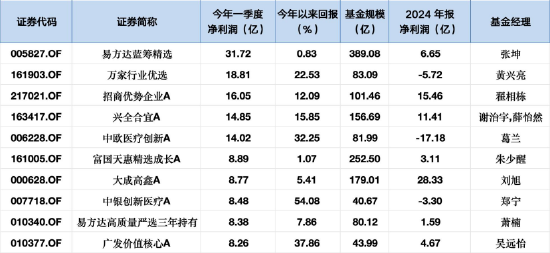
今年来十大盈亏基金盘点:易方达蓝筹31亿净利润领跑,中欧医疗创新A一季度强势扭亏14亿
Xin Lang Ji Jin· 2025-07-01 04:08
Core Insights - The article discusses the performance of various funds in the first quarter of 2025, highlighting significant profits and losses among them [1][2][3] Fund Performance Summary - E Fund Blue Chip Selection Mixed Fund (005827.OF) achieved the highest quarterly profit of 3.172 billion, making it the only equity fund to surpass the 3 billion mark [1][2] - The second tier of profitable funds includes Wanji Industry Selection (18.81 million), China Merchants Advantage Enterprises A (16.05 million), and others, indicating a clear performance hierarchy [1][2] - The article notes that the medical sector showed a strong recovery, with China Europe Medical Innovation A reversing a previous loss of 1.718 billion to achieve a quarterly return of 20.33% [2][6] Losses and Challenges - The top loss was recorded by Xingquan Trend Investment (163402.OF) with a quarterly loss of 935 million, reflecting a year-to-date return of -9.64% [3][4] - Other notable losses include Caizhong Value Momentum A (-648 million) and Caizhong Growth Selection A (-521 million), both managed by the same individual, indicating significant challenges in the TMT sector [6][7] - The article emphasizes the risks associated with large funds that may struggle to convert scale into effective returns, as seen with E Fund Blue Chip Selection [6][7] Market Dynamics - The article highlights the contrasting performance of funds, suggesting that investors should be cautious of both oversized funds that may underperform and smaller funds that may show high returns without substantial profit realization [7][8] - The ongoing market differentiation in the second quarter is expected to continue influencing fund performance, with a focus on those that can maintain scale flexibility while efficiently converting profits [7][8]