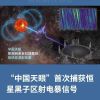
中国天眼FAST(500米口径球面射电望远镜)

Search documents
中国天眼,有新发现!
Qi Lu Wan Bao· 2025-10-18 08:25
Core Insights - A research team led by Professor Tian Hui from Peking University has successfully detected millisecond-level radio burst signals from stellar sunspot regions using the FAST (Five-hundred-meter Aperture Spherical Telescope) [2] - This discovery provides a new observational method for directly measuring the small-scale magnetic fields of stars and revealing the origins of stellar magnetic activity [2] Group 1: Research Findings - The detection of radio signals indicates that magnetic activity in stellar sunspot regions can accelerate electrons to extremely high energies, which then produce unique radio emissions as they spiral in the magnetic field [2] - Capturing these radio signals allows for direct analysis of the small-scale magnetic field structures on stellar surfaces, offering insights into the origins of stellar magnetic activity and the complex magnetic field structures of stars [2] Group 2: Technological Advancements - The success of this research is attributed to the high sensitivity and high resolution of the FAST telescope, which has improved the time resolution of stellar radio observations to the "sub-millisecond" level [2] - This advancement enables the capture of subtle variations in stellar radio emissions, making FAST one of the few devices in the world capable of such detailed observations [2]

首次捕获!这一大国重器有重要发现
证券时报· 2025-10-18 07:24
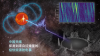
Core Viewpoint - The research team led by Professor Tian Hui from Peking University has successfully detected millisecond-level radio burst signals from stellar sunspot regions using the FAST telescope, providing a new observational method for studying stellar magnetic activity and its origins [2]. Group 1: Research Findings - The detection of radio signals indicates that magnetic activity in stellar sunspot regions can accelerate electrons to high energies, which then produce unique radio emissions as they spiral in the magnetic field [2]. - This breakthrough allows for direct analysis of the small-scale magnetic field structure on stellar surfaces, enhancing the understanding of complex stellar magnetic fields [2]. Group 2: Technological Advancements - The success of this research is attributed to the high sensitivity and resolution of the FAST telescope, which has improved the time resolution of stellar radio observations to the "sub-millisecond" level, enabling the capture of minute variations in stellar radio emissions [3]. - Currently, there are very few devices worldwide that can match the capabilities of FAST in this regard [3].