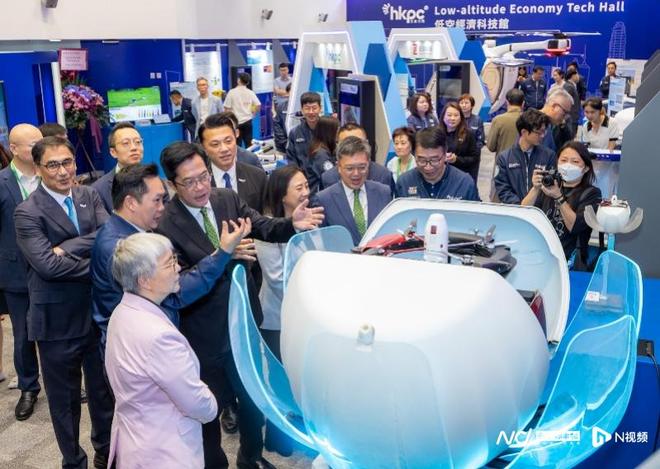
低空经济科技馆

Search documents
香港首个低空经济科技馆开幕,展示近20项尖端技术成果
Nan Fang Du Shi Bao· 2025-10-01 06:41
Core Insights - The opening of the "Low Altitude Economy Technology Museum" aims to promote the industrialization of Hong Kong's low altitude economy, providing a one-stop platform for research results transformation, technology validation, standard setting, and application implementation [1][3]. Group 1: Museum Overview - The museum is located in the Hong Kong Productivity Building and showcases nearly 20 cutting-edge technological achievements from Hong Kong and mainland China, covering the entire industry chain [3]. - Key areas of focus include technology standard setting, materials and manufacturing technology, eVTOL, medium-sized drone technology, testing, low altitude digital infrastructure, air traffic management, geographic information systems, and various application scenarios [3][4]. - The museum also offers hands-on experiences with small drones, allowing visitors to engage with advanced technologies [3]. Group 2: Government Initiatives - The Hong Kong government is actively promoting the development of the low altitude economy and emphasizes the need for collaboration with partners across various sectors [3][4]. - In March, the government announced the first batch of 38 "regulatory sandbox" pilot projects, with 17 projects already in testing and an expectation to have 28 projects operational by the end of October [3]. Group 3: Strategic Goals - The museum serves not only as a space for showcasing innovative technologies but also as a testing ground for institutional innovation [3][4]. - The goal is to gather the strengths of government, industry, academia, and research to explore airspace management models and application scenarios suitable for high-density urban environments, aiming to create a "low altitude economy model" unique to Hong Kong [3]. Group 4: Economic Potential - Hong Kong possesses unique advantages, being "backed by the motherland and connected to the world," and has multiple high-value scenarios for low altitude economy development, including high-end logistics, emergency response, cultural tourism integration, industrial applications, public services, and unmanned driving [4].