华为 Watch Ultimate 2

Search documents
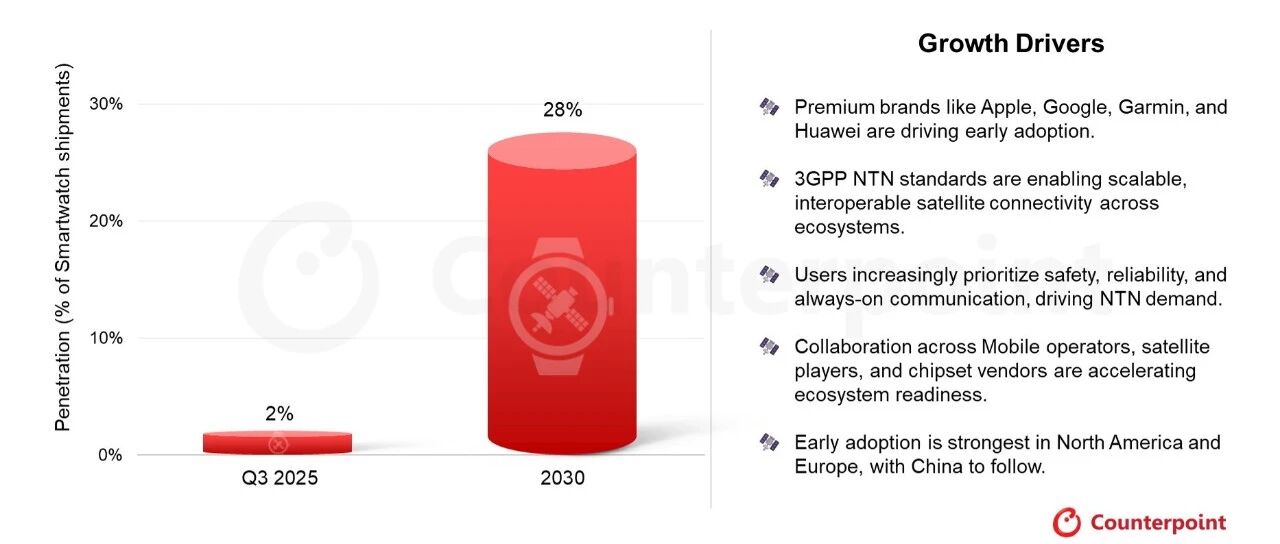
Counterpoint:预计支持卫星通信的智能手表出货占比将增至2030年的28%
智通财经网· 2025-11-28 01:36
Core Insights - The market share of smartwatches supporting satellite communication is expected to increase from 2% in Q3 2025 to 28% by Q3 2030, driven by early market leaders like Apple and Huawei, and later by Google and Garmin as standardization occurs [1][5]. Market Trends - The early market (2025-2026) will be dominated by brands with proprietary satellite solutions, while from 2027 onwards, the adoption of standardized NB-NTN technology will accelerate the integration of satellite modems into wearable devices [1][5]. - Currently, satellite features are primarily found in high-end smartwatches priced above $500, but as NB-NTN technology scales, this barrier will gradually lower, allowing mid-range products to adopt satellite communication [5]. Brand Strategies - **Apple**: Plans to expand satellite functionality to the Apple Watch Ultra 3 by Q3 2025, utilizing a partnership with Globalstar for bidirectional NTN messaging and SOS features [6]. - **Google**: The Pixel Watch 4 will be the first Wear OS smartwatch to support true bidirectional satellite communication based on the 3GPP standard, allowing direct satellite messaging without smartphone pairing [6]. - **Garmin**: The Fenix 8 Pro will support bidirectional SOS and satellite messaging across North America and Europe, reinforcing Garmin's position in safety and exploration [10]. - **Huawei**: The Watch Ultimate 2 will utilize China's Tiantong-1 system for satellite communication, currently limited to the domestic market [10].




智能手表迈入卫星连接与全球覆盖新时代
Counterpoint Research· 2025-11-28 01:03
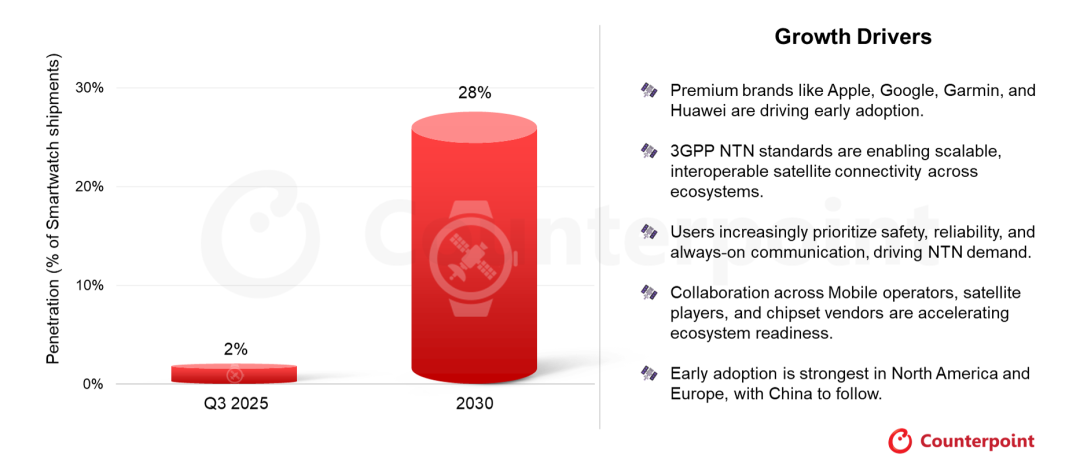
Core Viewpoint - The article discusses the significant growth potential of satellite-enabled smartwatches, predicting that their shipment share will increase from 2% in Q3 2025 to 28% by 2030, driven by advancements in NB-NTN technology and increasing consumer demand for reliable connectivity in remote areas [4][5][9]. Market Trends - Satellite-enabled smartwatches are emerging as a frontier in the wearable device ecosystem, connecting terrestrial networks with non-terrestrial networks (NTN) [5]. - The early market (2025-2026) will be dominated by brands like Apple and Huawei, which have proprietary satellite solutions, while from 2027 onwards, more Android OEMs will adopt standardized NB-NTN technology [5][8]. Adoption Drivers - The introduction of satellite SOS services by Apple in 2022 and Huawei's satellite connectivity service in 2023 has shifted satellite communication from niche to mainstream [9]. - The demand for reliable communication in outdoor and remote areas is expected to accelerate the adoption of satellite smartwatches [9]. Brand Strategies - Apple plans to expand its satellite functionality to the Apple Watch Ultra 3 by Q3 2025, partnering with Globalstar for two-way NTN messaging and SOS features [10]. - Google’s Pixel Watch 4 will be the first Wear OS smartwatch to support true two-way satellite communication based on the 3GPP NB-NTN standard [13]. - Garmin's Fenix 8 Pro will support two-way SOS and satellite messaging, reinforcing its position in the outdoor safety market [14]. - Huawei's Watch Ultimate 2 will utilize China's Tiantong system for satellite communication, currently limited to the domestic market [15]. Ecosystem Development - The development of NB-NTN in wearables is driven by advancements in chipsets and collaborations with satellite operators [16]. - Major chipset platforms are integrating NB-IoT and NTN functionalities, laying the groundwork for the next generation of satellite-enabled wearables [16]. - The competition will focus on battery efficiency, seamless switching between cellular and satellite networks, and stronger partnerships with satellite service providers [16].