华安动态灵活配置A

Search documents
“双十”经理蒋璆“清仓式”卸任,华安基金一年痛失两位权益干将
Zhong Guo Jing Ji Wang· 2026-01-26 02:52
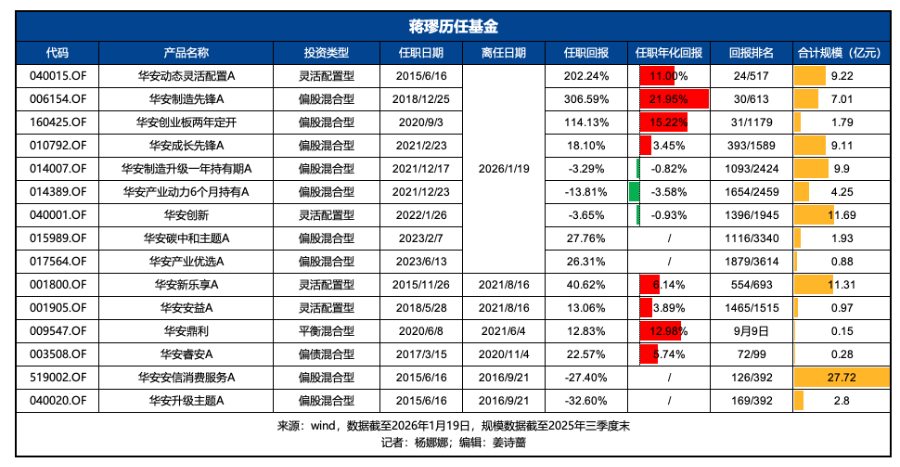
Core Viewpoint - The departure of seasoned fund manager Jiang Qiu from Huazhong Fund marks the second significant loss of an equity talent within a year, raising concerns about the stability and performance of the fund's investment team [1][7]. Group 1: Departure of Key Personnel - Jiang Qiu, a veteran with over 14 years of experience, has resigned and liquidated all nine managed products as of January 19, 2026, potentially moving to private equity [1][2]. - This follows the earlier departure of Li Xin in May 2025, who also left all managed products for personal reasons [1][7]. - The loss of these two key figures has created a gap in Huazhong Fund's mid-level talent, particularly affecting the stability of performance in its equity investment team [1][7]. Group 2: Performance of Managed Products - Jiang Qiu's managed products had a total scale of 55.78 billion yuan, with six out of nine products showing positive returns [2][5]. - The best-performing product, Huazhong Dynamic Flexible Allocation, achieved a return of 202.24% and an annualized return of 11% over more than ten years [2][3]. - Conversely, some products under Jiang Qiu's management, such as Huazhong Innovation, reported negative returns, highlighting performance inconsistencies [5][6]. Group 3: Impact on Fund Management - The current equity team at Huazhong Fund is experiencing significant talent loss, with several managers underperforming [11][12]. - The fund's active equity management scale has decreased from 1,896.99 billion yuan in 2021 to 880.34 billion yuan by the end of 2025, indicating a substantial contraction [13]. - Hu Yibin remains the only fund manager managing over 100 billion yuan, emphasizing the shrinking talent pool within the firm [13][14]. Group 4: Future Outlook and Strategy - Experts suggest that Huazhong Fund needs to strengthen its internal research capabilities and enhance the training of younger fund managers to rebuild its competitive edge [18]. - The firm aims to maintain a balanced investment strategy and improve its performance despite recent challenges [17][18].


华安基金“双十”老将蒋璆“清仓式”卸任!下一站或奔私
2 1 Shi Ji Jing Ji Bao Dao· 2026-01-20 13:15
Core Viewpoint - The resignation of Jiang Qiu, a senior fund manager at Huashan Fund, after over 14 years, is attributed to "personal reasons," and he has completely exited from managing all nine funds under his supervision, with speculation that he may transition to private equity [1][4][19]. Fund Performance Summary - Jiang Qiu managed nine funds, with notable performances including: - Huashan Dynamic Flexible Allocation A, which achieved a return of 202.24% since its inception, with an annualized return of 11.00%, ranking 24th out of 517 in its category [5]. - Huashan Manufacturing Pioneer A, with a return of 306.59% and an annualized return of 21.95%, ranking 30th out of 613 [5][6]. - Huashan Growth Pioneer A, which had a return of 18.10% and ranked 393rd out of 1589 [5]. - Conversely, some funds under Jiang's management performed poorly, such as: - Huashan Manufacturing Upgrade One-Year Holding A, which recorded a loss of 3.29% since inception [7]. - Huashan Industry Power Six-Month Holding A, with a loss of 13.81% [7]. Market Context and Fund Management Challenges - Jiang Qiu's management coincided with market highs, leading to significant inflows into his funds, but subsequent market corrections resulted in substantial losses for investors who entered at peak times [10]. - The performance of Jiang's funds reflects a broader issue in the industry where fund managers may experience strong long-term returns, but individual investor experiences can vary significantly due to market timing and fund inflows [10][12]. Transition and Future Implications - Jiang Qiu's departure may impact Huashan Fund's investment team and the performance continuity of the funds he managed, raising concerns among investors about the ability of new managers to maintain performance [19]. - The trend of fund managers transitioning to private equity or other platforms reflects ongoing changes in the industry, driven by competitive pressures and personal career aspirations [23].