
固态电解质磷酸钛铝锂

Search documents
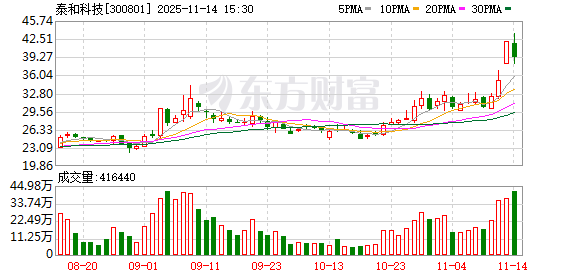
泰和科技:公司的固态电解质磷酸钛铝锂可应用于氧化物固态电池
Zheng Quan Ri Bao· 2025-11-14 10:41
Core Viewpoint - Taihe Technology announced on November 14 that its solid-state electrolyte lithium titanium aluminum phosphate can be applied in oxide solid-state batteries, currently in the pilot test stage [2] Company Summary - Taihe Technology is developing solid-state electrolytes for use in advanced battery technologies [2] - The company is currently in the pilot testing phase for its lithium titanium aluminum phosphate electrolyte [2] Industry Summary - The application of solid-state electrolytes is a significant advancement in the battery industry, particularly for oxide solid-state batteries [2] - The ongoing development and testing of solid-state technologies indicate a trend towards more efficient and safer battery solutions in the market [2]


泰和科技(300801) - 2025年11月4日投资者关系活动记录表
2025-11-14 01:06
Group 1: Company Overview - The company is Shandong Taihe Technology Co., Ltd., with the stock code 300801 and the abbreviation Taihe Technology [1]. Group 2: Investor Relations Activity - The investor relations activity took place on November 4, 2025, from 13:30 to 15:30 at the company's conference room in Zaozhuang, Shandong [2]. - Participants included representatives from Huatai Securities, CITIC Securities, Zheshang Securities, Changjiang Securities, Guotai Junan Asset Management, and Shenzhen Haiya Jin控 [2]. Group 3: Product Development - The lithium sulfide product is currently in the pilot test stage [2]. - The solid-state electrolyte lithium titanium phosphate can be applied to oxide solid-state batteries and is also in the pilot test stage [2]. Group 4: R&D Team Composition - The R&D team is led by an expert group, primarily composed of professionals recruited from universities and trained internally, with most members holding graduate degrees [3]. Group 5: Future Profit Growth Points - Future profit growth points include water treatment agents, electronic chemicals (various high-purity materials, chelating agents, dispersants), battery materials (including sodium battery anodes and cathodes, solid-state electrolyte raw materials like lithium sulfide and sulfide solid electrolytes), new materials, and synthetic biology [3].