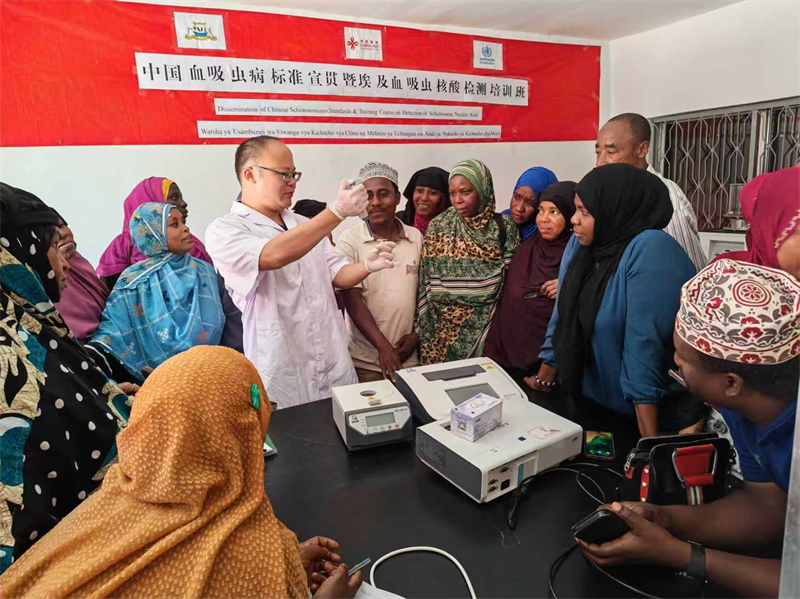
埃及血吸虫核酸检测技术

Search documents
中国标准助力桑给巴尔消除血吸虫病危害
Xin Hua She· 2025-10-15 04:58
Core Points - The event on October 14, World Standards Day, featured a training session on schistosomiasis prevention and control standards in Zanzibar, Tanzania, organized by a Chinese expert group [1] - The training included a systematic explanation of multiple Chinese standards for schistosomiasis prevention and control, along with a demonstration of nucleic acid testing technology for Egyptian schistosomiasis [1] - Over 60 health professionals from various health departments in Zanzibar participated in the training, aimed at enhancing their technical capabilities and promoting standardized and scientific practices in schistosomiasis control [1]
中国标准助力桑给巴尔加快消除血吸虫病危害
人民网-国际频道 原创稿· 2025-10-15 02:30
Core Viewpoint - The training program for schistosomiasis control in Zanzibar, Tanzania, aims to enhance the professional skills of local public health personnel and standardize the prevention efforts against schistosomiasis, leveraging China's successful experiences in the field [1][2]. Group 1: Training Program Details - The training session included over 60 local technical personnel who participated in the Chinese schistosomiasis standard dissemination and training on Egyptian schistosomiasis nucleic acid detection [1]. - The expert group provided systematic explanations of various Chinese standards related to schistosomiasis management, including patient management, egg detection methods, and chemical treatment protocols [2]. - Practical demonstrations of nucleic acid detection techniques were conducted, covering sample collection, DNA extraction, and result interpretation, allowing participants to engage in hands-on practice [2]. Group 2: Impact and Future Applications - Participants expressed that the training deepened their understanding of schistosomiasis control standards and equipped them with advanced nucleic acid detection techniques [2]. - The knowledge gained from the training is expected to be applied in their future work, contributing to the standardization of schistosomiasis prevention workflows and supporting the goal of eliminating the disease [2].