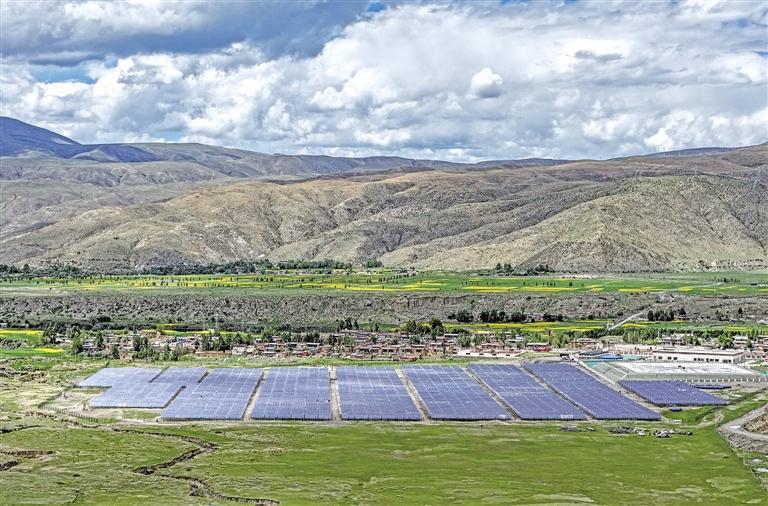
太阳能供暖系统

Search documents
在世界屋脊“追光逐日”
Jin Rong Shi Bao· 2025-09-23 03:35
Core Viewpoint - The news highlights the significant advancements in clean energy development in Tibet, particularly through large-scale projects like the Yarlung Tsangpo River hydropower project and various solar thermal initiatives, which are transforming the region's energy landscape and supporting economic growth while prioritizing ecological sustainability. Group 1: Clean Energy Projects - The Yarlung Tsangpo River hydropower project, with a total investment of 1.2 trillion yuan, is the largest clean energy development project globally, aimed at reshaping China's energy structure and accelerating the construction of clean energy bases in Tibet [1] - The "zero-carbon" solar thermal project in Ali, with a total investment of 2.78 billion yuan, is designed to provide heating and electricity, significantly reducing reliance on coal and minimizing greenhouse gas emissions [3][4] - The solar heating project in Ritut County, which connects 1,080 households to solar heating, represents a shift towards renewable energy solutions in a region with harsh winter conditions [5][6] Group 2: Economic and Environmental Impact - Tibet's GDP growth rate reached 7.2% in the first half of the year, the highest in the country, reflecting the region's economic transformation alongside its commitment to ecological preservation [1] - The clean energy projects are expected to provide an annual reduction of 9.2 million tons of CO2 emissions and 103 tons of particulate matter, contributing to a greener environment [3][6] - The integration of advanced technologies in clean energy projects is expected to create new job opportunities and enhance local income sources, with over 6,000 jobs supported through financing for equipment and project development [7][9] Group 3: Financial Support and Green Financing - The People's Bank of China in the Ali region has implemented various financial support policies to facilitate the development of green industries, resulting in a 25% annual growth in green loan balances during the 14th Five-Year Plan period [11] - The financing structure for the "zero-carbon" project involved a syndicate loan approach, with a total credit of 1.715 billion yuan, demonstrating innovative financial solutions to support large-scale clean energy initiatives [9][10] - The region's green loan balance reached 195.619 billion yuan by June 2025, accounting for nearly 30% of total loans, indicating a strong commitment to sustainable financing practices [11]
在离太阳最近的地方“发热”
Shan Xi Ri Bao· 2025-08-25 00:51
Core Viewpoint - The article highlights the development and implementation of solar energy heating systems in Tibet, emphasizing the importance of utilizing local solar resources to improve living conditions in the region [1][10][21]. Group 1: Research and Development - The research team, led by Liu Jiaping and Liu Yanfeng, faced numerous challenges in developing a solar heating system suitable for the harsh conditions of the Tibetan Plateau [5][6][15]. - Over a span of ten years, the team conducted extensive field research and testing, overcoming technical difficulties related to solar energy collection, storage, and distribution [7][16][26]. - The team developed large solar collectors that convert solar energy directly into heat, which is then stored for winter heating [16][21]. Group 2: Project Implementation - In 2018, the first large-scale solar heating demonstration project was completed in Langkazi County, covering an area of 23,000 square meters and capable of heating over 110,000 square meters of residential space without using coal, gas, or electricity [21][27]. - The project has achieved a 100% operational guarantee over four years, resulting in a reduction of 13,000 tons of carbon dioxide emissions annually [22][27]. - The research team has assisted in establishing over 30 solar heating pilot projects across various regions in Tibet, benefiting more than 500,000 residents [27]. Group 3: Future Prospects - The team aims to expand solar heating solutions across Tibet, with plans to integrate additional functionalities such as oxygen supply and humidity control to enhance living conditions [27]. - The ongoing efforts and innovations in solar energy technology are expected to lead to widespread adoption of solar heating systems in suitable areas of Tibet within a few years [27].