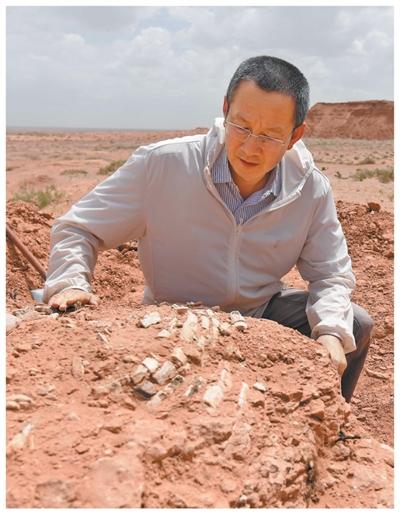
始祖鸟化石

Search documents
【人民日报】恐龙和鸟是否“沾亲带故”
Ren Min Ri Bao· 2026-02-09 03:40
Core Viewpoint - The article discusses the evolutionary link between dinosaurs and birds, highlighting significant fossil discoveries that challenge previous understandings of this relationship [6][8][14]. Group 1: Evolutionary Evidence - The discovery of numerous dinosaur fossils in China has revealed that some dinosaurs had feathers and exhibited early flight capabilities, suggesting that flight was not exclusive to birds [6][10]. - The "Zhenghe Bamin Bird" fossil, discovered in 2025, indicates that modern bird body structures appeared as early as the Late Jurassic, predating previous assumptions by nearly 20 million years [8][14]. - Xu Xing posits that the Archaeopteryx is more closely related to small theropod dinosaurs than to modern birds, with increasing scholarly support for this view [7][10]. Group 2: Survival of Birds - Modern birds survived the mass extinction event 66 million years ago primarily due to their smaller size, which allowed them to find food more easily during periods of scarcity [10][11]. - The survival of birds was also linked to their habitat preferences, as many surviving species lived near water bodies, which provided food sources during the extinction event [11][12]. - Enhanced flight capabilities in surviving bird species allowed them to evade disasters and seek new habitats, leading to a natural selection process that favored stronger flying abilities [11][12]. Group 3: Theories of Flight Origin - Two main hypotheses exist regarding the origin of flight in dinosaurs: the "ground-up" theory, which suggests that running dinosaurs developed wings, and the "tree-down" theory, which posits that tree-dwelling dinosaurs glided down and evolved flight [13][14]. - Xu Xing's research supports the "tree-down" hypothesis, proposing that four-winged dinosaurs were more likely to have evolved from tree-dwelling ancestors [13][14]. Group 4: Ongoing Research and Future Prospects - Current technology does not allow for the revival of dinosaurs, as ancient DNA is not preserved in fossils; however, advancements in synthetic biology may enable the creation of species resembling dinosaurs [12][14]. - Ongoing research aims to uncover more fossil evidence and ancient proteins to better understand the evolutionary transition from dinosaurs to birds [14].

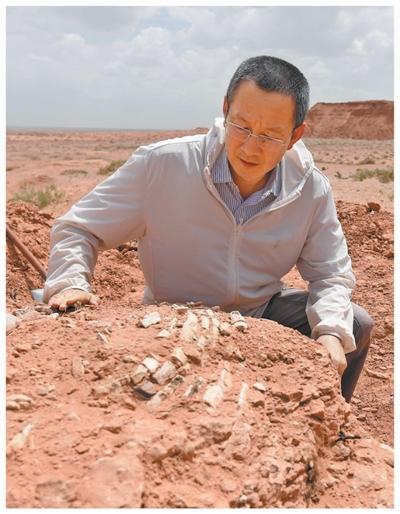
恐龙和鸟是否“沾亲带故”(院士讲科普)
Ren Min Ri Bao· 2026-02-07 00:48
Core Viewpoint - The article discusses the evolutionary link between dinosaurs and birds, highlighting recent discoveries that challenge traditional views on this relationship and the characteristics that define birds [5][8][10]. Group 1: Evolutionary Discoveries - The discovery of numerous dinosaur fossils in China has revealed that some dinosaurs had feathers and the ability to fly, suggesting that flight was not exclusive to birds [7][8]. - The "Zhenghe Bamin Bird" fossil, discovered in 2025, indicates that modern bird body structures appeared as early as the Late Jurassic period, pushing back the timeline for key evolutionary traits by nearly 20 million years [9]. Group 2: Characteristics of Birds and Dinosaurs - The distinction between birds and dinosaurs is often based on evolutionary trees, with features like feathers, skeletal structure, and lung design being critical for classification [8][12]. - The article posits that the earliest birds, such as the "Zhenghe Bamin Bird," are more closely related to modern birds than to dinosaurs, marking a significant evolutionary step [9]. Group 3: Survival of Birds - Modern birds survived the mass extinction event 66 million years ago due to their smaller size, which allowed them to find food more easily during shortages [11]. - The article notes that the survival of birds was also linked to their habitats near water bodies, which provided food sources during the extinction event [12]. Group 4: Theories of Flight Origin - Two main hypotheses exist regarding the origin of flight in dinosaurs: the "ground-up" theory, which suggests that running dinosaurs developed wings, and the "tree-down" theory, which posits that tree-dwelling dinosaurs glided down [14]. - Recent findings of four-winged dinosaurs support the "tree-down" hypothesis, indicating that these creatures may have used all four limbs for gliding [14]. Group 5: Ongoing Research and Future Prospects - The article emphasizes the ongoing search for fossil evidence to further understand the transition from dinosaurs to birds, with researchers exploring various environments for potential discoveries [15]. - The potential for synthetic biology to create organisms resembling dinosaurs is mentioned, although true resurrection remains currently impossible due to the lack of preserved DNA [13].