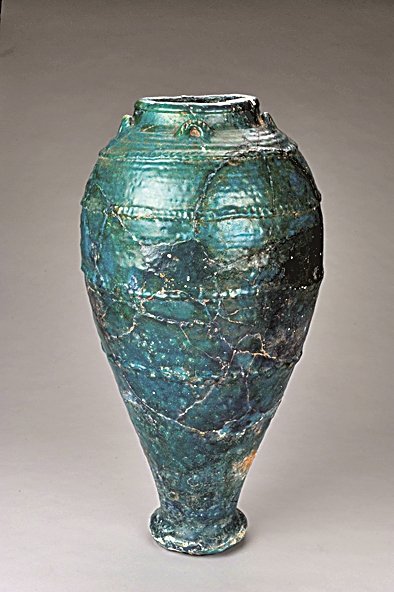
孔雀蓝釉陶瓶

Search documents
【晒晒咱的镇馆之宝㊵】孔雀蓝釉陶瓶:见证海上丝绸之路的繁荣
Xin Lang Cai Jing· 2026-01-25 19:17
Core Viewpoint - The article highlights the significance of a peacock blue glazed pottery vase discovered in a tomb from the Five Dynasties and Ten Kingdoms period, emphasizing its historical, cultural, and artistic value as a testament to the maritime Silk Road and cultural exchanges between China and the West [3][4]. Group 1: Historical Context - The peacock blue glazed pottery vase was found in the tomb of Liu Hua, the wife of Wang Yanjun, the third ruler of the Min Kingdom, during an archaeological excavation in 1965 [3]. - The vase is one of the earliest examples of peacock blue glazed pottery in China, with a height of nearly 80 centimeters and a unique blue-green glaze reminiscent of peacock feathers [3]. Group 2: Cultural Significance - The pottery vases exhibit strong foreign influences, with similar artifacts found in regions such as Iraq, Iran, and Pakistan, suggesting they originated from the Persian region around the 9th century [3]. - The article discusses the role of overseas trade in facilitating the arrival of these artifacts in China, particularly through the flourishing maritime Silk Road during the 8th century [3]. Group 3: Usage and Function - Experts suggest that the pottery vases were likely not used for practical purposes due to their porous texture, but rather served as "eternal lamps" in the tomb, reflecting a blend of foreign objects with local customs [4]. - The vases are now preserved in various museums, symbolizing the cultural exchange and historical connections between China and the West [4].