富国中证军工A

Search documents
四只亏损超百亿基金的启示!
Xin Lang Cai Jing· 2025-12-05 03:45
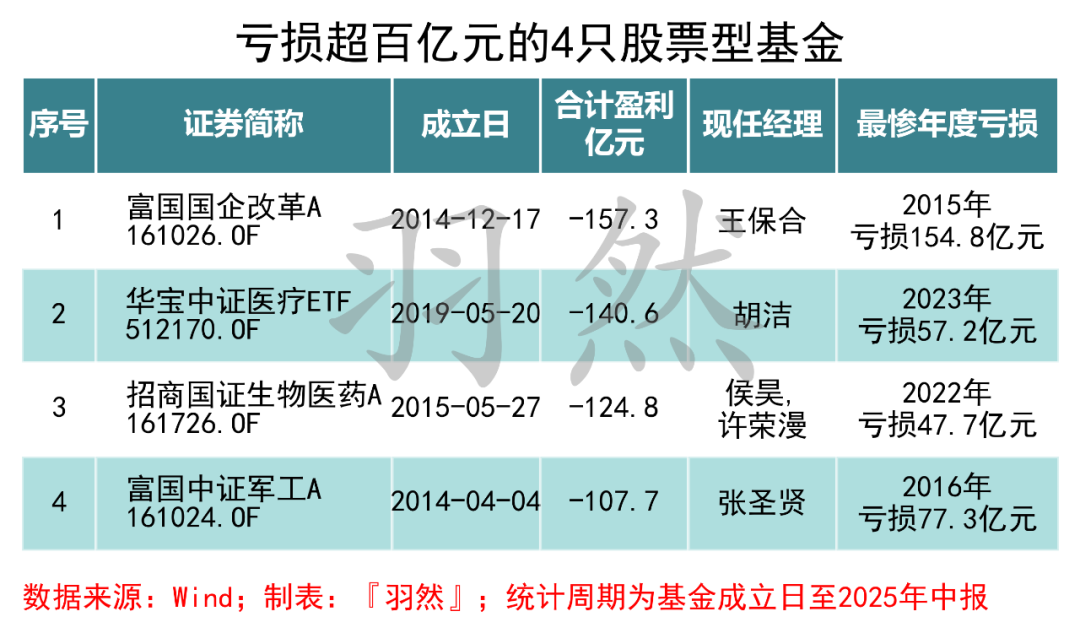
Core Insights - The article highlights the coexistence of risk and return in investment, emphasizing that some funds have incurred significant losses due to systemic reasons or misallocation, with four index funds losing over 10 billion yuan each [13][10]. Fund Summaries - **Fuguo State-Owned Enterprise Reform A**: Established in 2014, this fund tracks the China Securities State-Owned Enterprise Reform Index. It experienced a significant loss of over 15.4 billion yuan in 2015 due to market volatility and regulatory adjustments, reflecting the vulnerability of thematic index funds when policy hotspots fade [4][16]. - **Huabao CSI Medical ETF**: This fund, representing the medical industry, tracks the CSI Medical Index. It faced cumulative losses exceeding 14 billion yuan, particularly during the adjustment period following high valuations driven by the pandemic and subsequent policy changes [5][17]. - **Zhaoshang National Bio-Medicine A**: Focusing on the bio-pharmaceutical sector, this fund tracks the National Bio-Medicine Index. It suffered a loss of approximately 12.48 billion yuan as the sector faced a downturn following a period of high capital influx and tightening regulations [6][17]. - **Fuguo CSI Military Industry A**: Tracking the CSI Military Industry Index, this fund has lost around 10.77 billion yuan. Despite its relative resilience during initial market volatility in 2015, it experienced several years of decline, highlighting the cyclical nature of defense sector investments [7][17]. Common Characteristics of the Funds - All four funds expanded during periods of high market enthusiasm, leading to inflated valuations and increased risk of significant corrections [8][18]. - The sectors tracked by these funds exhibit high volatility, strong cyclicality, and sensitivity to policy changes, making them susceptible to downturns during periods of declining industry sentiment [9][19]. Market Context - Systemic market risks and sector corrections, particularly in years like 2015, 2016, and 2022, exacerbated the losses experienced by these funds, indicating that index funds are not inherently stable investment vehicles [10][20]. - The recent growth of index funds calls for caution among ordinary investors, especially regarding those with already high valuations [11][20].