床上用品四件套

Search documents
“看闻摸”选购床上用品四件套
Xin Lang Cai Jing· 2026-01-06 21:35
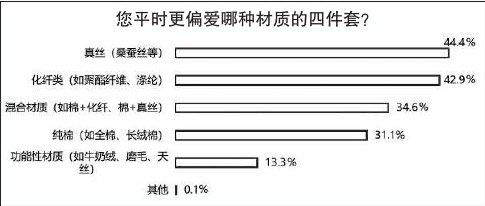
Core Insights - The article emphasizes the importance of beddings, particularly four-piece sets, in enhancing sleep quality during winter [3] - It highlights consumer preferences and safety considerations when purchasing bedding products [4][5] Consumer Preferences - 57.4% of respondents prioritize breathability when selecting bedding, while 37.1% focus on fabric feel, 36.3% on durability, and 32.9% on design [3] - A diverse range of material preferences exists among consumers, with 44.4% favoring silk, 42.9% preferring synthetic fibers, and 31.1% choosing pure cotton [4][5] Safety and Quality Considerations - The Jiangsu Consumer Protection Committee advises consumers to check labels for material composition, safety categories, and manufacturer information to avoid vague descriptions [3] - Consumers are encouraged to use a three-step method (look, smell, touch) to assess product safety and quality [3] Material Characteristics - Each material has its pros and cons: cotton is breathable and soft but wrinkles easily; Tencel offers a cooling effect but is more expensive; silk is skin-friendly but requires careful washing; polyester is cost-effective but less breathable [4][5] - The article notes that finer yarn counts (40-80) are considered the "golden range" for quality, with higher counts being more expensive [5] Purchasing Recommendations - Consumers are advised to avoid blindly pursuing high-priced items and instead match their purchases to personal needs and usage scenarios [5] - It is recommended to buy from reputable stores or official online platforms and to keep receipts and records for potential quality issues [5]

深夜通报:立案调查!
第一财经· 2025-09-22 02:48
Core Viewpoint - The article highlights the issue of false advertising and quality misrepresentation in the bedding industry, particularly regarding "four-piece sets" sold through online platforms and live-streaming channels, leading to consumer deception and potential health risks [4][6][9]. Group 1: Regulatory Response - On September 22, the Haining Market Supervision Administration in Zhejiang Province announced an investigation into the reported false labeling of bedding products following a report by CCTV Finance [3]. - The administration plans to conduct a comprehensive inspection and crackdown on illegal activities to protect consumer rights and maintain fair market competition [3]. Group 2: Consumer Complaints and Misleading Marketing - Consumers reported that some online live-streaming hosts promoted bedding products as "A-class maternal and infant grade" and "high thread count," which were often inferior quality items [4][6]. - The marketing tactics used by these hosts included enticing phrases and promises of significant discounts, making it easy for consumers to be misled [4][6]. Group 3: Quality Standards and Misrepresentation - According to national standards, infant textile products must meet A-class requirements and be labeled as "infant products," while products in direct skin contact should meet at least B-class standards [4]. - Many products marketed as "100-thread count" or higher were found to be falsely advertised, with actual thread counts often much lower, typically between 30 and 80 [6][7]. Group 4: Industry Practices and Deceptive Labels - Some manufacturers and retailers admitted to inflating product specifications, such as thread count and material quality, to increase prices and profits [9][10][13]. - Instances of "three-no" products (no manufacturer name, address, or contact information) were reported, facilitating the sale of counterfeit goods [10]. - Some businesses provided fake testing reports and labels to mislead consumers, with detailed forgeries that could easily deceive [10][11]. Group 5: Market Dynamics and Profitability - The article notes that despite low production costs, businesses could still achieve significant profits by selling falsely labeled bedding products [9][11]. - The practice of mislabeling and deceptive marketing is described as an open secret within the e-commerce platform, indicating a widespread issue in the industry [7].