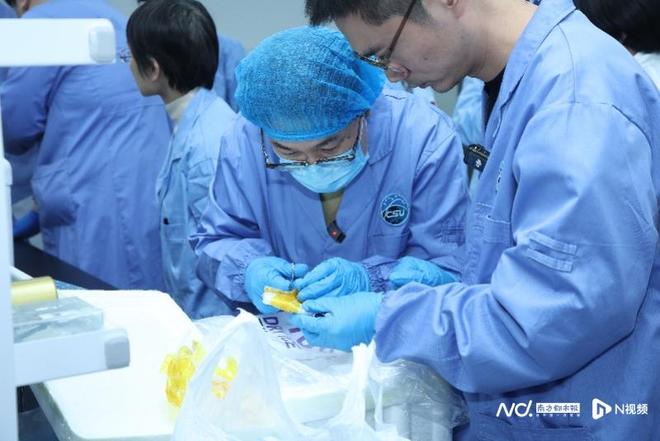
弛豫铁电单晶

Search documents
小鼠等空间站科学实验样品搭载“神二十一”返回并交付科学家
Nan Fang Du Shi Bao· 2025-11-15 02:40
Core Viewpoint - The successful return of the ninth batch of space science experiment samples from the Chinese space station via the Shenzhou 21 spacecraft marks a significant advancement in understanding the effects of space environments on biological and material sciences [1][3]. Group 1: Biological Research - The returned biological samples include 9 types of life science experiments, such as mice, zebrafish, and other organisms, weighing approximately 46.67 kilograms in total [1]. - Scientists will conduct research on the behavior and physiological biochemical indicators of the mice to understand their stress responses and adaptive changes to the space environment [3]. - Further biological analyses, including transcriptome sequencing and proteomics, will be performed on the returned cell samples to explore the impact of microgravity on biological mechanisms and potential intervention targets for related diseases [5]. Group 2: Material Science Research - The materials returned include tungsten-hafnium alloys, soft magnetic materials, and relaxor ferroelectric single crystals, which will be analyzed for their structural morphology, chemical composition, and distribution differences [5]. - Research will focus on how gravity affects material growth, segregation, solidification defects, and performance, contributing to the development of high-performance materials for satellite communication and lunar base construction [5]. Group 3: Combustion Research - The combustion samples returned include flame synthesis products of semiconductor nanomaterials and carbon soot samples, which will be analyzed to understand the characteristics of nanoparticle generation [5]. - The findings are expected to support the development of extraterrestrial nanomaterials, new energy systems, space fire prevention technologies, and advanced functional nanocarbon materials [5].