
拉索(高海拔宇宙线观测站)

Search documents
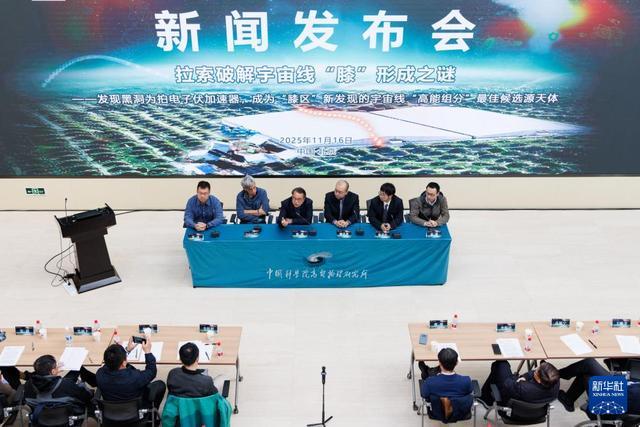
“拉索”破解宇宙线“膝”形成之谜
Huan Qiu Wang Zi Xun· 2025-11-17 01:49
Core Insights - The latest scientific findings from China's high-altitude cosmic ray observatory "LHAASO" indicate that micro-quasars formed by the interaction of black holes and companion stars act as powerful "particle accelerators," capable of accelerating cosmic rays to energies above the "knee" [1][4][8] - This research, led by the Institute of High Energy Physics of the Chinese Academy of Sciences, provides significant observational evidence for understanding the role of black holes in the origin of cosmic rays [5][9] - The discovery not only resolves a long-standing mystery regarding the formation of the cosmic ray "knee" but also establishes a connection between the "knee" structure and specific celestial objects, namely black hole jet systems, paving a new path for understanding extreme physical processes in the universe [7][9] Research and Publication - The research was conducted by an international team led by the Institute of High Energy Physics and the findings were published in the international academic journals "National Science Review" and "Science Bulletin" [5][9] - The LHAASO facility is a major national scientific infrastructure focused on cosmic ray observation research [4][8]

科学“邂逅”艺术,追求真理与美(新语)
Ren Min Ri Bao· 2025-07-08 22:33
Group 1 - The article highlights the collaboration between the China Science and Technology Museum and the China Coal Mine Art Troupe to create an immersive drama that connects ancient and modern scientific achievements [1][2] - The drama titled "The Light of Huaxia - The Flame of Civilization" uses the mysterious connection between celestial bodies to facilitate dialogue between historical figures like Su Song and contemporary scientists [1][2] - The integration of science and art aims to enhance public understanding of science, particularly among youth, by making complex scientific concepts more accessible through storytelling and immersive experiences [2][3] Group 2 - The article emphasizes the importance of cultural context in promoting scientific literacy, suggesting that a culturally rich environment is essential for nurturing scientific inquiry [2][3] - The China Science and Technology Museum plans to continue exploring the cultural narratives behind scientific discoveries, aiming to engage the public and foster a love for science through artistic expression [3]