易方达全球成长精选

Search documents
跨境ETF规模首次突破万亿 百亿级产品激增至25只
Zheng Quan Shi Bao· 2026-01-14 18:21
Group 1 - The total scale of cross-border ETFs reached 1,009.8 billion RMB as of January 13, marking the first time it has surpassed the trillion RMB threshold, with a growth of 138% from 424.2 billion RMB in early 2025 [1][2] - The leading cross-border ETF is the Invesco Hong Kong Internet ETF, with a scale of 91.509 billion RMB, followed by the Huaxia Hang Seng Technology Index ETF at approximately 53.434 billion RMB [2] - As of January 14, 2026, the premium rate for the Invesco Nasdaq Technology ETF reached 19.28%, indicating a significant demand-supply imbalance in the secondary market [4] Group 2 - The QDII market has shown strong performance, with 95.2% of 650 comparable QDII funds reporting net value increases in 2025, driven by sectors like artificial intelligence and innovative pharmaceuticals [3] - Fund managers remain optimistic about investment opportunities in Hong Kong stocks, viewing them as a bridge for foreign capital into Chinese assets, particularly in the technology sector [6][7] - The S&P 500 index is expected to see a 10% growth in earnings per share in 2026, which will support continued stock market gains [7]
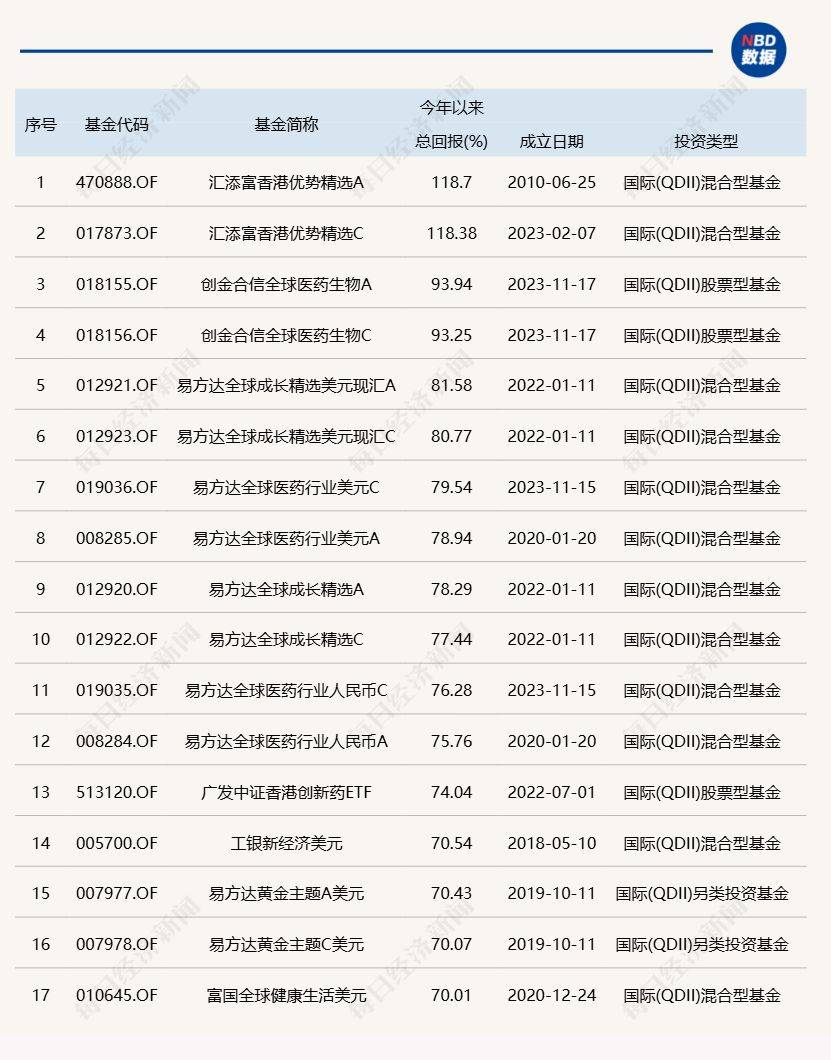
QDII基金2025年业绩爆发,17只收益率超70%,2026年该怎么投?
Mei Ri Jing Ji Xin Wen· 2025-12-25 14:51
Core Insights - QDII funds have emerged as a significant channel for investors to participate in global wealth growth amid increasing volatility in global capital markets and diversified asset allocation needs [1] - In 2025, QDII funds delivered impressive returns, with many products achieving high yields, and the focus for 2026 will be on investment opportunities in Hong Kong and U.S. markets [1][2] Group 1: 2025 Performance Review - The QDII fund market showed a clear trend of "overall improvement with partial differentiation," with over half of the products achieving returns exceeding 15% and 17 products surpassing 70% [2] - Notable performers included Huatai-PB Hong Kong Advantage Selection, with A and C class shares returning 118.70% and 118.38% respectively, and several other funds in the healthcare and technology sectors also achieving over 70% returns [2] - However, there was significant performance differentiation, with some funds focused on single assets, such as oil and real estate, experiencing negative returns, highlighting the risks associated with concentrated investments [2] Group 2: 2026 Opportunity Outlook - Market expectations for QDII funds in 2026 are optimistic, particularly for U.S. and Hong Kong stocks, with a focus on sectors like innovative pharmaceuticals and new consumption [3][4] - Analysts remain positive about the mid-term trends in the innovative pharmaceutical sector, despite some short-term risks related to high valuations and geopolitical tensions [3] - The Hong Kong market is expected to benefit from increased participation and recognition, with a focus on the performance of innovative pharmaceutical companies and their R&D capabilities [4] Group 3: Investment Strategy for 2026 - Investment strategies for 2026 suggest allocating to broad-based index QDII funds tracking major indices like NASDAQ 100 and S&P 500, as well as comprehensive index funds covering the Hong Kong market [5] - Given potential market volatility, a dollar-cost averaging approach is recommended to mitigate risks associated with short-term fluctuations, particularly in the Hong Kong market [5][6] - Investors are advised to consider the investment management capabilities of fund managers, the research strength of fund companies, and fee structures when selecting QDII funds to build a diversified portfolio for long-term growth [6]
QDII基金2025年业绩爆发:17只收益率超70%,2026年该怎么投?
Sou Hu Cai Jing· 2025-12-22 03:17
Core Viewpoint - QDII funds have emerged as a significant channel for investors to participate in global wealth growth amid increasing volatility in global capital markets and diversified asset allocation needs [1]. Group 1: 2025 Performance Overview - As of December 18, 2025, the QDII fund market showed a clear trend of "overall improvement with partial differentiation," with most products achieving positive returns [2]. - Over half of the QDII products recorded returns exceeding 15%, with more than 50 products surpassing 50%, and 17 products achieving returns over 70%, with some top products exceeding 100% [2]. - Notable performers include Huatai-PineBridge Hong Kong Advantage Selection A and C classes, with total returns of 118.70% and 118.38% respectively, leading the market [3]. Group 2: 2026 Investment Outlook - The market is optimistic about investment opportunities in QDII funds for 2026, particularly in Hong Kong and U.S. stocks, with a focus on sectors like innovative pharmaceuticals and new consumption [4][5]. - Analysts suggest that the structural trends in the innovative pharmaceutical sector are expected to continue, despite some short-term risks related to high valuations and geopolitical disturbances [5]. - The Hong Kong market is viewed positively due to its expanding asset base and increasing participation from mainland investors, with a notable reduction in the AH premium [5]. Group 3: Investment Strategy for 2026 - Investment strategies for 2026 recommend allocating to broad-based index QDII funds tracking major indices like the Nasdaq 100 and S&P 500, as well as comprehensive index funds covering the Hong Kong market [6]. - Given potential market volatility, a systematic investment approach such as dollar-cost averaging is advised to mitigate risks associated with short-term market fluctuations [7]. - Investors are encouraged to consider the management capabilities of fund managers, the research strength of fund companies, and fee structures when selecting QDII funds to build a diversified portfolio for long-term asset appreciation [7].

公募QDII,加仓美股
券商中国· 2025-11-21 08:15
Core Viewpoint - Public QDII funds are leveraging their positions in the US stock market to enhance net value defense and differentiate their product offerings amidst the recent pullback in the Hong Kong stock market [1][2]. Group 1: Performance of QDII Funds - Despite an overall decline in net value for public QDII funds in recent months, those with a focus on US stocks have shown strong performance, ranking among the top in net value gains during market adjustments [2][4]. - Notable QDII funds such as CICC Global Healthcare and E Fund Global Growth Select have reported significant gains of 11.78% and 7.22% respectively over the past month, making them some of the few active equity QDIIs to achieve positive returns [2]. Group 2: Stock Selection and Market Strategy - Core stocks from the US market have bolstered the net value defense of these funds, with examples like Cidara, which saw a 105% increase in a single day due to a major acquisition announcement [3]. - The strategy of reallocating from Hong Kong stocks to US stocks has been evident, with some funds increasing their US stock positions significantly, such as CICC Global Healthcare, which shifted from 3% to 71% in US stocks within a quarter [6]. Group 3: Differentiation and Market Trends - The trend of increasing US stock positions among public QDIIs has been apparent since the end of Q3, as funds seek to distinguish themselves in a competitive market [4][5]. - The E Fund Asia Select QDII, managed by a prominent fund manager, has benefited from a 40% annual return, attributed to a 32.24% allocation in US stocks, significantly higher than earlier in the year [5]. Group 4: Impact of AI and Technology - The demand for computing power driven by AI technology has significantly enhanced the attractiveness of US QDIIs, with fund managers optimistic about the long-term investment value in leading tech companies [7][8]. - The rapid growth in AI applications has led to increased expectations for the scale of computing infrastructure, with funds like Jianxin Emerging Markets QDII holding 50% in US stocks, reflecting a strategic focus on this sector [8].