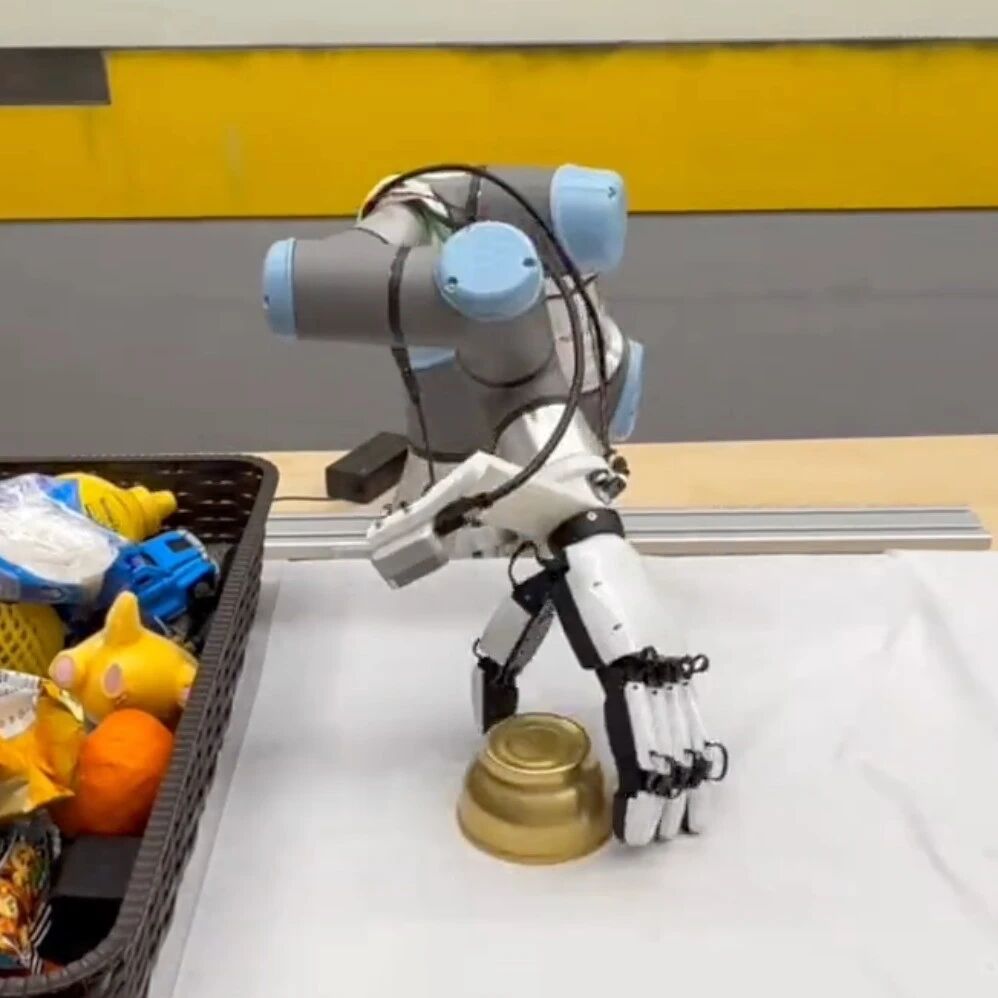
星动 XHAND1 灵巧手

Search documents
效率提升25%,灵巧操作数采困境被「臂-手共享自主框架」解决
机器之心· 2025-12-11 10:00
Core Insights - The article discusses the significant advancements in achieving dexterous manipulation capabilities in robotics through the Vision-Language-Action (VLA) model, addressing the critical challenge of high-quality data acquisition for training these models [2][6]. Group 1: Key Contributions - The research introduces a Shared Autonomy framework that effectively divides control responsibilities between human operators and autonomous AI systems, significantly reducing cognitive load and data collection costs [2][12][15]. - The DexGrasp-VLA strategy is highlighted as a foundational element of the Shared Autonomy framework, integrating multimodal inputs including tactile feedback, which enhances the robot's ability to adaptively grasp objects [9][20]. - The study establishes a complete technical system composed of four core modules, achieving a closed-loop from data collection to policy optimization [5][8]. Group 2: Data Collection and Efficiency - The Shared Autonomy framework has improved the efficiency of high-quality data collection by 25%, allowing for more data to be collected per hour and compressing the development-deployment cycle to under one day [33]. - The framework has demonstrated a near-industrial standard performance with approximately 90% success rate in grasping over 50 different objects, facilitating the transition of dexterous manipulation technology from concept validation to practical deployment [33]. Group 3: Mechanisms and Enhancements - The Arm-Hand Feature Enhancement module is designed to model and integrate the kinematic differences between the arm and hand, resulting in more natural and robust coordination of macro and micro actions [16][19]. - The Corrective Human-in-the-Loop mechanism allows the robot to learn from failures by incorporating human demonstrations of correct actions, continuously improving the strategy and generalizing to edge cases [20][34]. Group 4: Future Directions - Future research directions include expanding the framework to more complex tasks such as object reorientation and precise placement, as well as exploring intelligent fusion mechanisms to address challenges in tactile feedback [36]. - The potential for autonomous error recognition and recovery through reinforcement learning is also discussed, aiming for a smooth transition from human-robot collaboration to full autonomy [36].