
植入式微晶水凝胶传感器

Search documents
植入式无创传感器研发取得重要进展
Huan Qiu Wang Zi Xun· 2026-02-24 01:19
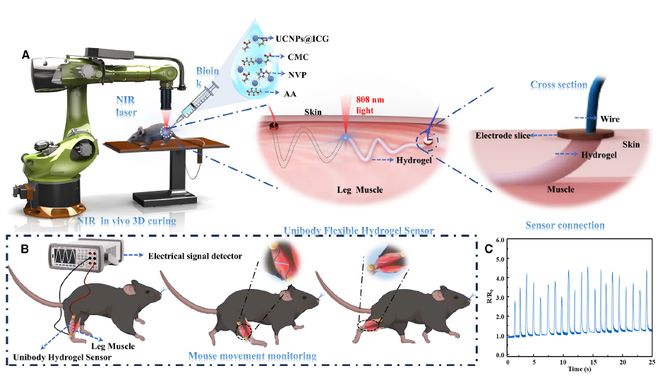
Core Viewpoint - The development of an implantable microcrystalline hydrogel sensor using near-infrared 3D printing technology represents a significant technological breakthrough in non-invasive in-situ construction for physiological signal monitoring [1][3]. Group 1: Technology Innovation - The research team has created a flexible hydrogel biosensor that can be formed directly in the body, addressing the limitations of traditional surgical implantation methods [3]. - The innovative technology utilizes near-infrared 3D printing to induce in-body photopolymerization through a core-shell upconversion nanoparticle and indocyanine green sensitization mechanism [3][4]. Group 2: Performance and Applications - In animal experiments with mice, the sensor accurately captured muscle movement states and converted them into electrical signals without any invasive procedures, demonstrating excellent monitoring capabilities [3]. - The multifunctional microcrystalline hydrogel material used in the sensor offers good flexibility and biocompatibility, paving the way for non-invasive solutions in customized manufacturing of implantable sensors [4]. - This technology has the potential for widespread application in clinical scenarios such as neuromuscular monitoring and chronic disease management, promoting the development of medical monitoring devices towards non-invasiveness, precision, and personalization [4].

植入式微晶水凝胶传感器研发成功
Ke Ji Ri Bao· 2026-02-24 00:40
Core Insights - The research team from Kunming University of Science and Technology has developed an implantable microcrystalline hydrogel sensor that can be constructed in situ and non-invasively using near-infrared 3D printing technology, marking a significant breakthrough in the field of non-invasive implantable sensors [1][2] Group 1: Technology and Innovation - The innovative technology allows for the "in-body one-step formation" of the sensor, addressing the core limitations of traditional implant methods, which often involve surgical procedures that can cause tissue damage and lack sufficient biocompatibility [1] - The sensor utilizes a multifunctional microcrystalline hydrogel material that combines flexibility and biocompatibility, providing a non-invasive solution for the customized manufacturing of implantable flexible sensors [2] Group 2: Applications and Future Prospects - This technology has the potential to significantly enhance personalized health monitoring and early disease diagnosis, offering important technical support for the innovation of related medical devices [2] - The sensor is expected to find widespread application in clinical scenarios such as neuromuscular monitoring and chronic disease management, promoting the development of medical monitoring devices towards non-invasiveness, precision, and personalization [2]