模块机组

Search documents
2025年中国模块机组市场深度回调,存量竞争下品牌格局加速分化
Xin Lang Cai Jing· 2026-02-24 11:11
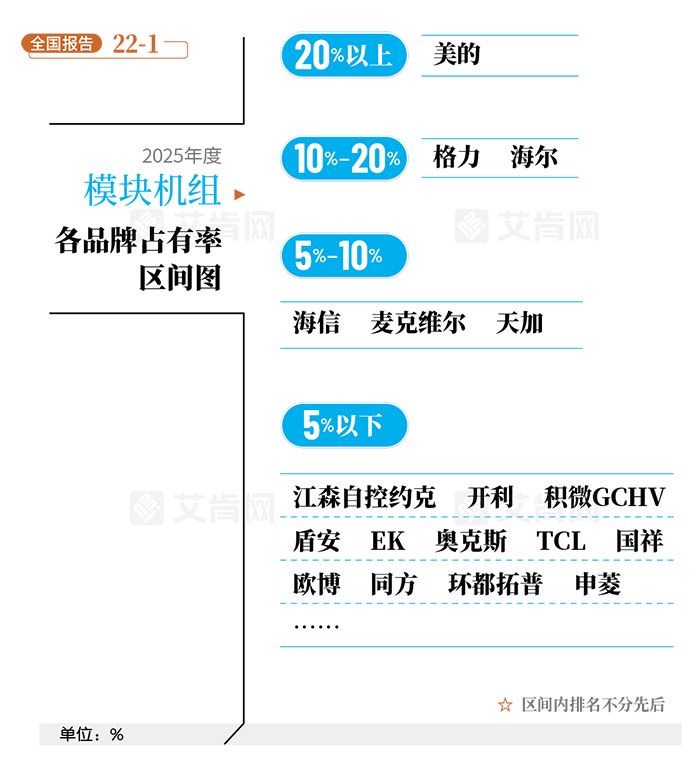
Core Insights - The report by Aiken Network indicates a significant downturn in the Chinese central air conditioning modular unit market, with a year-on-year sales decline of 15.6%, which is less severe than the overall central air conditioning industry [1][5] - The market share of modular units within the central air conditioning products remains stable at approximately 6.6%, marking a transition from growth expansion to a phase of stock competition [1][5] - Intense price competition is observed, particularly in small to medium-sized projects and standardized products, leading to reduced profit margins across the industry [1][5] Market Dynamics - The slowdown in new project investments and increased delays are impacting traditional advantages in large modular units, yet the demand for upgrades and renovations driven by carbon neutrality goals provides market support [1][5] - Specific segments such as data center backup cooling, regional energy stations, and modern agricultural temperature control still present competitive advantages for modular units due to their cost and flexibility requirements [1][5] Product Trends - Products using R410A and R32 refrigerants have become mainstream, while leading brands are beginning to promote models using R290, which has a lower Global Warming Potential (GWP), as part of their technological differentiation strategy [6][10] Brand Performance - The market share distribution for modular units in 2025 shows Midea leading with over 20% share, followed by Gree and Haier with 10%-20%, and brands like Hisense, Macwell, and Tianka holding 5%-10% [2][7] - Brands with less than 5% market share include York, Carrier, and others, indicating a highly competitive landscape where companies leverage localized strategies and niche technologies for breakthroughs [2][7] Regional Distribution - The modular unit market is highly concentrated in economically developed regions, with East China holding 28.4% and North China 26.3%, together accounting for over half of the market share [3][8] - Southwest, Central, and South China regions represent the third tier of the market with shares of 14.4%, 12.6%, and 12.5% respectively, while Northwest and Northeast regions combined account for less than 6% [3][8] Future Outlook - As the market enters a phase of stock competition, brand differentiation will intensify, with a focus on environmental technology, tailored solutions for specific scenarios, and deep regional operational capabilities becoming critical for companies to stand out [5][10]