
残月

Search documents
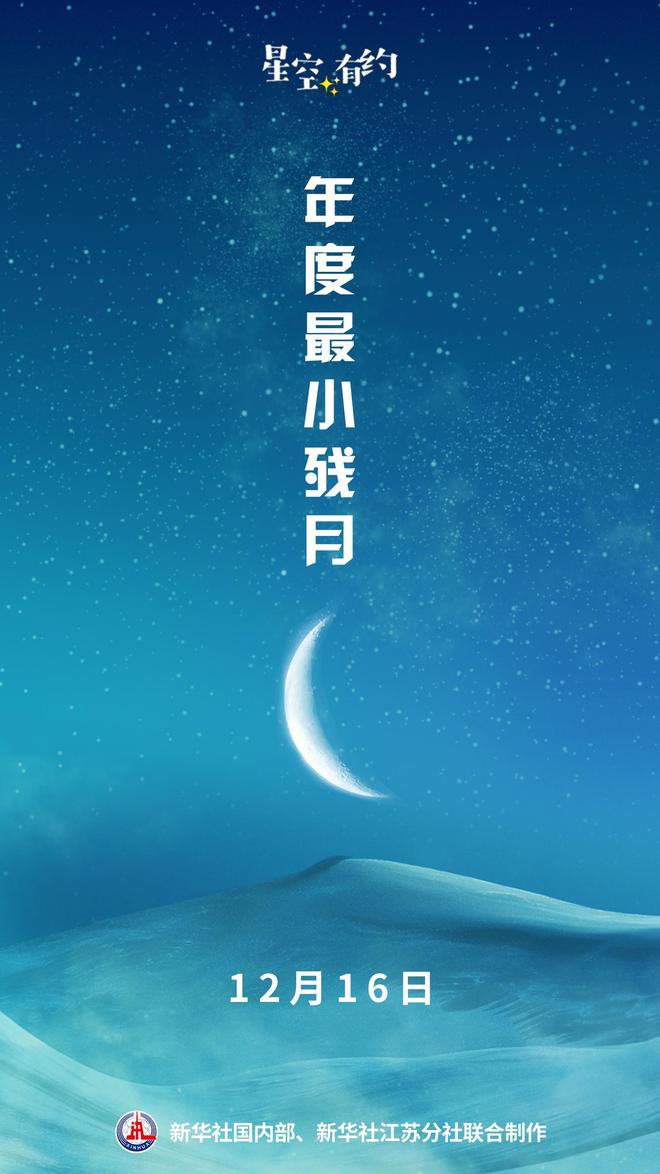
星空有约|12月16日将迎本年度最小残月
Xin Hua She· 2025-12-14 04:50
Group 1 - The smallest waning crescent moon of the year will occur on December 16, appearing as a thin silver hook in the sky [1] - The second largest full moon of the year, known as the "supermoon," was observed on December 5, and the largest gibbous moon will appear on December 31, showcasing significant changes in the moon's phases within a month [4][10] - The waning crescent moon marks the end of a lunar cycle, while the gibbous moon occurs between the first quarter and full moon phases, indicating a brightening moon surface that is not yet fully illuminated [7] Group 2 - The visibility of the waning crescent moon on December 16 will be in the eastern sky before sunrise, appearing as a 'C' shape, while the gibbous moon will rise in the eastern sky a few hours before sunset, resembling a 'D' shape [10] - The rapid changes in the moon's size within 30 days are due to the overlapping of lunar phases and the moon's orbital patterns, with the average interval between the waning crescent and gibbous moon being approximately 15 days [13]

19、20日凌晨,上演“双星伴月”
Xin Hua She· 2025-09-17 07:12
Core Points - The article discusses the upcoming celestial event where Venus will closely approach the star Xuanyuan 14 on the nights of September 19 and 20, with the closest distance occurring on the morning of the 20th [1][2] - The event will also feature a crescent moon appearing near these two celestial bodies, creating a "double star and moon" phenomenon for public viewing [1][2] Summary by Sections - **Celestial Event Details** - Venus will be visible as the brightest star in the sky, except for the sun and moon, throughout the year until the end of December [1] - On September 19 and 20, Venus will be seen moving from the constellation Cancer to Leo, with the closest angular distance to Xuanyuan 14 being 0.5 degrees, equivalent to the width of a full moon [1] - **Viewing Recommendations** - Public is encouraged to find locations with minimal light pollution, such as rural areas or mountain tops, to observe the event after 4 AM [2] - Venus has a brightness of -3.9 magnitude, making it easily visible, while Xuanyuan 14 has a brightness of 1.4 magnitude [2] - The crescent moon will appear above the stars on the 19th and below them on the 20th, with the moon being more challenging to spot due to its smaller size and lower elevation on the 20th [2]