
海洋动力卫星

Search documents
新华社权威速览丨从探洋识冰到巡天瞰海:中国海洋卫星大家族都有哪些成员?
Xin Hua She· 2025-12-21 01:01
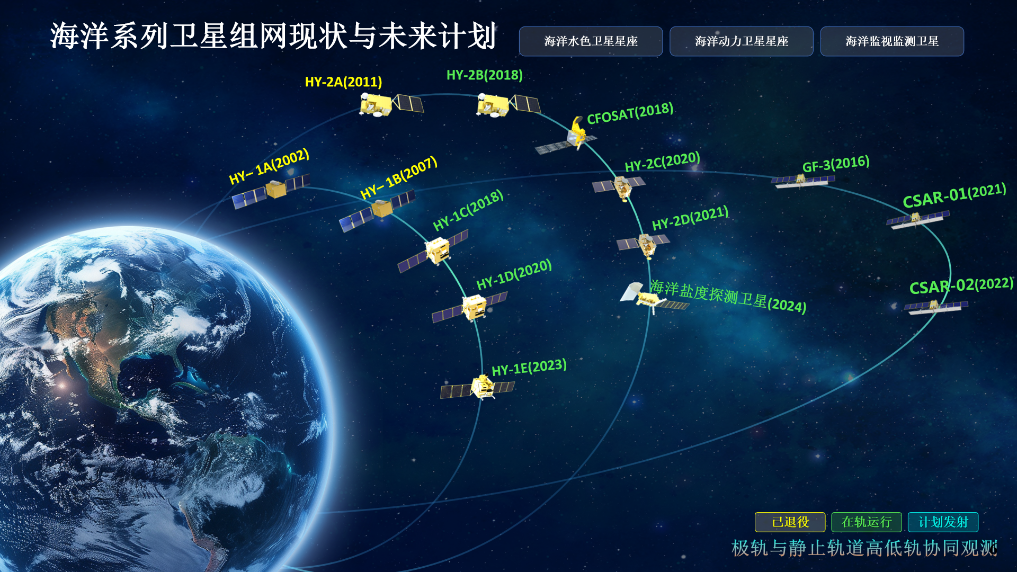
Core Viewpoint - The article discusses the development and capabilities of China's marine satellite family, highlighting their roles in ocean monitoring and research, particularly during the recent Antarctic expedition. Group 1: Marine Monitoring Satellites - China has established a marine satellite observation system, creating a "marine perception network" with three operational marine monitoring satellites currently in orbit, including the Gaofen satellite and two 1-meter C-SAR satellites [3][4]. - The marine monitoring satellites are capable of providing all-weather, high-resolution microwave observations, which are essential for navigation through ice and for maintaining maritime rights [4]. Group 2: Ocean Color Satellites - The ocean color satellites, including Haiyang-1C, 1D, and 1E, can accurately capture ecological parameters such as chlorophyll concentration and sediment levels by measuring the sunlight reflected from the sea surface [6][7]. - These satellites have achieved medium-resolution daily coverage of China's coastal waters, with plans to launch additional satellites to enhance ecological and coastal monitoring capabilities [7][9]. Group 3: Ocean Dynamics Satellites - The ocean dynamics satellites can simultaneously measure various marine environmental parameters, including sea surface height, wind fields, sea surface temperature, and wave heights, with five satellites currently in orbit [10][11]. - The operational satellites include Haiyang-2B, Haiyang-2C, and Haiyang-2D, contributing to a comprehensive understanding of ocean dynamics [11].


从探洋识冰到巡天瞰海:中国海洋卫星大家族都有哪些成员?
Xin Lang Cai Jing· 2025-12-20 13:55
Group 1 - The article discusses the establishment of China's marine satellite observation system, which is referred to as the "marine perception network" [3][4] - The marine monitoring satellites currently in orbit include three satellites: GaoFen series, 1-meter C-SAR satellites 01 and 02, which provide all-weather, high-resolution microwave observation capabilities [3][4] - The marine monitoring satellites are expected to achieve high and low orbit satellite networking observation by 2030 [4] Group 2 - The marine color satellites, including Haiyang-1C, Haiyang-1D, and Haiyang-1E, are capable of accurately obtaining ecological parameters such as chlorophyll concentration and suspended sediment through the reflection spectrum of seawater [4][5] - Future launches will include Haiyang-1F and high-orbit marine and coastal environment monitoring satellites to enhance marine ecological and coastal observation capabilities [5] - The marine dynamic satellites can measure various ocean dynamic environmental parameters, with five satellites currently in orbit, including Haiyang-2B and others [5]

新华社权威速览|从探洋识冰到巡天瞰海:中国海洋卫星大家族都有哪些成员?
Xin Hua She· 2025-12-20 13:34
Group 1 - The core viewpoint of the article highlights the development and significance of China's marine satellite family, which plays a crucial role in ocean monitoring and research [2][3]. - The marine monitoring satellites currently in orbit include three key satellites: GaoFen series, 1-meter C-SAR satellites 01 and 02, which provide all-weather, high-resolution microwave observations [3][4]. - By 2030, the marine monitoring satellites aim to achieve a networked observation system combining high and low orbit satellites [4]. Group 2 - The ocean color satellites, including Haiyang-1C, Haiyang-1D, and Haiyang-1E, are capable of accurately measuring ecological parameters such as chlorophyll concentration and suspended sediments through spectral reflection of sunlight [6][8]. - Future launches will include Haiyang-1F and high-orbit coastal environment monitoring satellites to enhance marine ecological and coastal observation capabilities [8]. - The ocean dynamic satellites can measure various marine environmental parameters, with five satellites currently in orbit, including Haiyang-2B, Haiyang-2C, and Haiyang-2D [10][11]. Group 3 - The article emphasizes the importance of these satellites in maintaining marine rights and providing critical data for oceanic research and environmental monitoring [4][10]. - The marine satellite system is described as a comprehensive "ocean perception network" that supports China's maritime interests and scientific endeavors [3][4].

从探洋识冰到巡天瞰海!我国海洋卫星大显身手
Xin Hua Wang· 2025-12-18 20:48
Core Viewpoint - China's marine satellites play a crucial role in supporting Antarctic research and enhancing maritime monitoring capabilities, contributing to national marine governance and resource management [1][2][4]. Group 1: Marine Satellite Overview - China has established a collaborative observation system consisting of three major series of marine satellites: marine color, marine dynamics, and marine monitoring satellites, with a total of 11 satellites in orbit [1][6]. - The marine monitoring satellites, with three currently in orbit, provide all-weather, all-time high-resolution observations, enabling navigation through ice and monitoring illegal foreign fishing activities [2][4]. - The marine color satellites serve as detailed "health observers" of the ocean, monitoring phenomena such as algal blooms and ice disasters, and supporting fisheries forecasting [3][6]. Group 2: Specific Satellite Functions - The marine dynamics satellites, with five currently in orbit, measure various oceanic parameters including sea surface height, wind fields, sea surface temperature, and wave heights, acting as "fitness monitors" for the ocean [4][6]. - The marine color satellite series includes Ocean No. 1 C, D, and E, providing global coverage with a resolution of 1 kilometer three times daily, and additional monitoring capabilities for China's coastal waters [3][6]. - The upcoming launches of Ocean No. 2 E and F satellites in 2026 will enhance the global marine dynamics monitoring network, ensuring continuous observation of oceanic environmental parameters [6]. Group 3: Future Developments - By 2030, the marine monitoring satellites aim to achieve a networked observation system combining high and low orbit satellites, improving real-time tracking of maritime targets [2]. - The ongoing development and launch of more marine satellites will strengthen China's ability to protect its maritime territory and contribute to global marine governance [6].
科学与健康|从探洋识冰到巡天瞰海!我国海洋卫星大显身手
Xin Hua She· 2025-12-18 11:06
Core Viewpoint - The successful completion of China's 42nd Antarctic expedition by the "Snow Dragon" and "Snow Dragon 2" vessels highlights the importance of the marine monitoring satellite system in navigating complex ice conditions and ensuring operational safety [1] Group 1: Marine Monitoring Satellites - The marine monitoring satellites, described as "the eyes on the sea," have three satellites currently in orbit, providing all-weather, all-time, and high-resolution observations [3] - These satellites can penetrate adverse weather conditions to capture detailed information about the sea surface, aiding in navigation and monitoring illegal foreign fishing activities [3] - By 2030, the marine monitoring satellite system aims to enhance real-time tracking capabilities through a network of high and low orbit satellites, supporting maritime safety and marine rights protection [3] Group 2: Ocean Color Satellites - Ocean color satellites serve as detailed "health observers" of the ocean, monitoring conditions such as phytoplankton abundance and sediment levels [4] - They have established a routine monitoring system for harmful algal blooms and sea ice disasters, providing critical data for marine resource management and disaster response [4][5] - The current satellite network includes Ocean No. C, D, and E, with plans for additional satellites to further enhance ecological and coastal monitoring capabilities [5] Group 3: Ocean Dynamics Satellites - The ocean dynamics satellites, with five currently in orbit, measure various oceanic parameters such as sea surface height, wind fields, and wave heights, acting as "fitness monitors" for the ocean [6] - The first satellite for measuring ocean salinity has been successfully tested and is now operational, filling a significant gap in ocean monitoring capabilities [6] - Future launches of Ocean No. E and F satellites are planned for 2026 to maintain and enhance global ocean dynamics monitoring [6] Group 4: Overall Impact and Future Prospects - The integration of these three satellite series represents a significant advancement in China's marine observation capabilities, transitioning from a "follower" to a "peer" in satellite technology [6] - The data collected from these satellites is already being utilized across more than ten industries, demonstrating their broad applicability and importance [6]
