科技研发成果

Search documents
陕西自贸试验区结出高水平开放硕果
Shan Xi Ri Bao· 2025-10-23 00:35
Core Viewpoint - The Shaanxi Free Trade Zone has made significant strides in optimizing the business environment at ports, accelerating land port construction, and promoting technological innovation, leading to substantial economic growth and trade facilitation in the region [1][5]. Group 1: Trade and Customs Innovations - The Shaanxi Free Trade Zone has implemented a "first inspection, then shipment" regulatory model for cross-border e-commerce, which has eliminated the need for repacking, thus saving costs and significantly improving shipping efficiency [1][2]. - As of September this year, the value of regulated cross-border e-commerce goods reached 9.34 billion yuan [1]. - Over 25% of the goods from a specific company have passed through the rapid customs clearance model, saving over 3,800 yuan per container and reducing clearance time by 4 to 5 hours [2]. Group 2: Technological Innovation and Development - The Shaanxi Free Trade Zone is focusing on the "Five Forces" model of technological innovation to drive the establishment of more tech enterprises and innovations within the zone [3][4]. - The establishment of the Qin Chuang Yuan innovation-driven platform is aimed at fostering a high ground for technological innovation [3]. - The zone has seen the emergence of numerous provincial and municipal innovation alliances, common technology research platforms, and collaborative innovation platforms between universities and enterprises [4]. Group 3: Economic Impact and Future Outlook - Over the past eight years, the Shaanxi Free Trade Zone has achieved a cumulative import and export trade value of 2.28 trillion yuan, accounting for 70% of the province's total trade with only 1/1700 of the land area [5]. - The zone is transitioning from foundational development to comprehensive promotion and quality enhancement, with a commitment to exploring higher levels of openness and greater reform efforts [5].
城数Lab. | 科创突围,“最上进大省”果然是它
Mei Ri Jing Ji Xin Wen· 2025-10-19 03:33
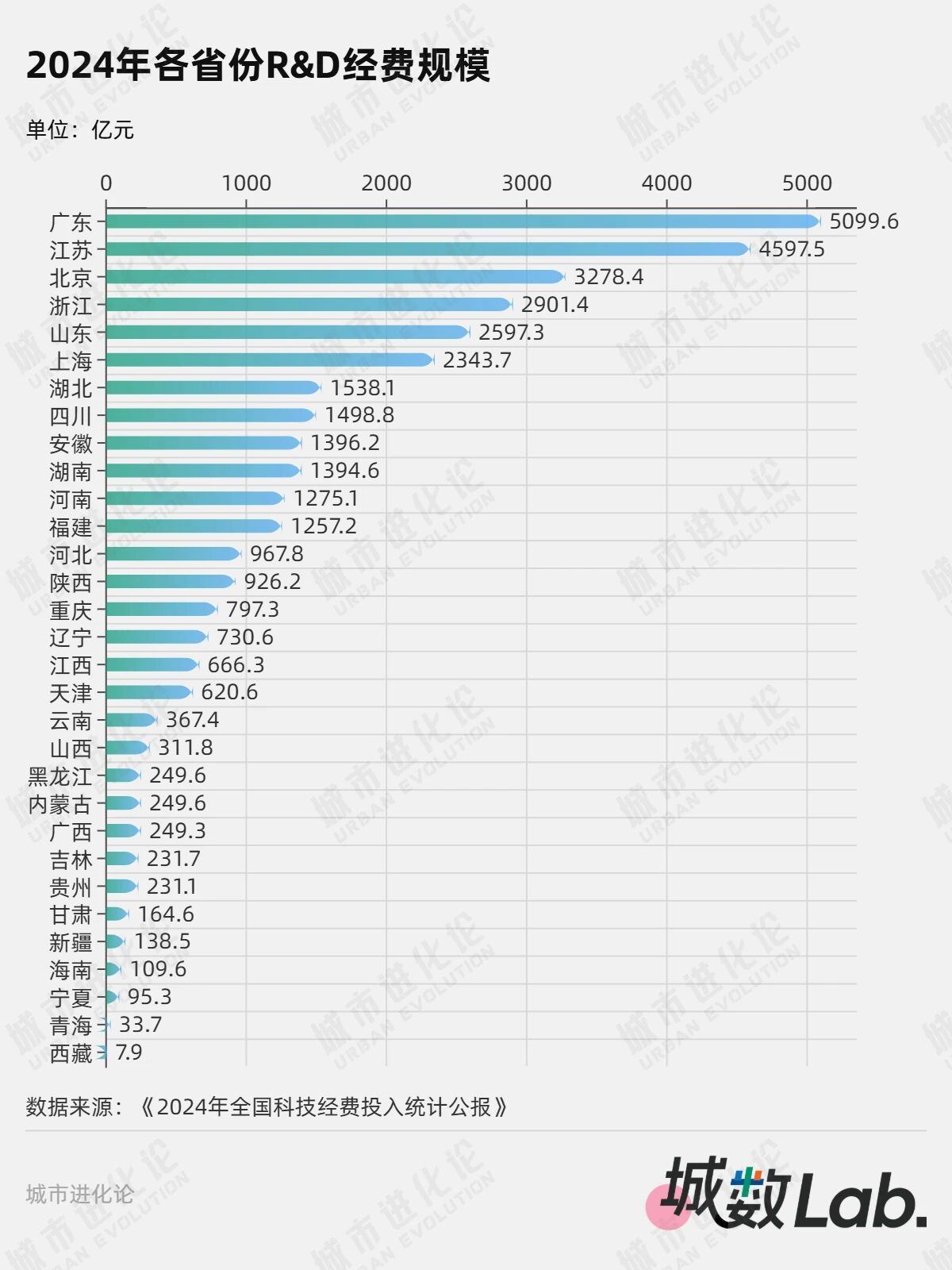
Core Insights - The scale and intensity of R&D activities are critical indicators of a country's technological strength and core competitiveness, with China ranking second globally in R&D expenditure for 2024 at 36,326.8 billion yuan, following the United States [1] - The R&D expenditure intensity in China is 2.69%, placing it 12th in the world and surpassing the European Union's level of 2.13% [1] - Six provinces in China contributed significantly to R&D funding, each exceeding 200 billion yuan, collectively accounting for over half of the national total [1] Group 1: R&D Expenditure Rankings - The top ten provinces in R&D expenditure are also among the top ten in GDP, indicating a strong correlation between economic size and R&D investment [4] - In 2024, Jiangsu leads with R&D expenditure of 5,099.6 billion yuan, followed by Guangdong at 4,800.6 billion yuan, and Beijing at 3,278.4 billion yuan [5] - Notably, Anhui ranks ninth in R&D expenditure despite having a smaller economy compared to provinces like Hunan and Fujian, which are ranked lower [6] Group 2: R&D Investment Intensity - R&D investment intensity reflects the commitment and prioritization of innovation within provinces, with Anhui achieving an intensity of 2.76%, ranking just behind Jiangsu and Zhejiang [9] - In 2024, Beijing and Shanghai saw an increase in R&D expenditure intensity by 0.36 percentage points, leading the nation, while Tianjin experienced a decline from 3.48% to 3.44% [16] - Anhui's R&D investment intensity has increased by 0.14 percentage points, showcasing its strong focus on innovation despite economic pressures [16] Group 3: Long-term Trends and Contributions - Over the past decade, Anhui has shown significant growth in both R&D expenditure and intensity, surpassing several provinces and demonstrating a strong upward trend [10] - In 2023, Anhui's corporate R&D investment exceeded 100 billion yuan for the first time, contributing over 80% to the overall growth in R&D spending [13] - The commitment to R&D investment remains strong across many provinces, even amid global economic slowdowns, highlighting a focus on long-term innovation strategies [13]