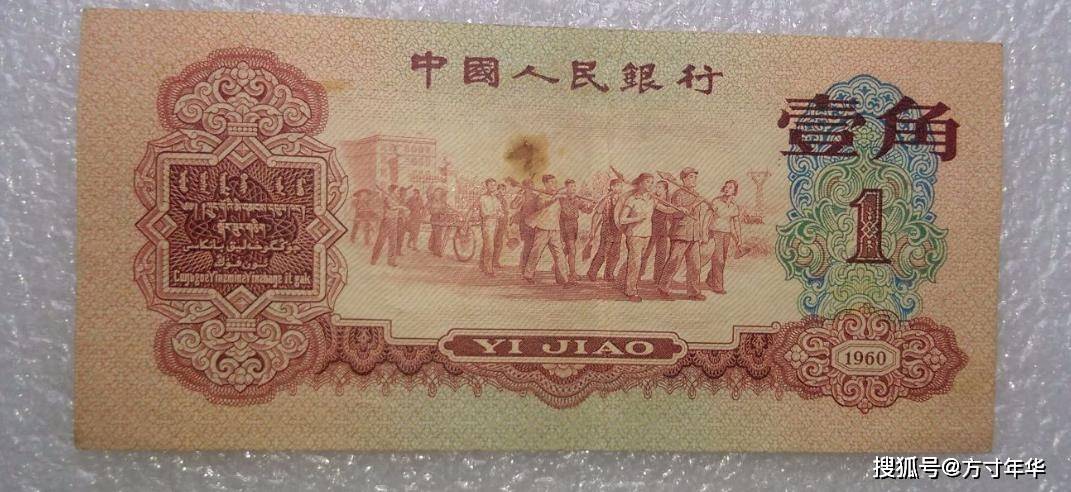
第三套人民币1角纸币

Search documents
这样的1角纸币,已增值16800倍,你能找到吗?
Sou Hu Cai Jing· 2025-10-07 03:14
Core Insights - The third set of Renminbi holds a unique position in China's currency collection system, being the first fully designed and printed by New China, and it reflects significant economic development from the 1960s to the 1980s [1] - Among the denominations, the one-jiao note is particularly notable, with three main versions: Zao Hong (red), Bei Lv (green), and Bei He (brown), each varying significantly in market value due to factors like issuance time and circulation [1][3] Summary by Category Zao Hong and Bei Lv Versions - Zao Hong one-jiao was issued in 1960 but quickly recalled due to design issues, making it rare and highly valued, with prices ranging from 4,000 to 6,000 yuan for ordinary specimens, and even higher for special versions [3] - Bei Lv one-jiao is also scarce and highly sought after, especially the watermarked version, often referred to as the "one-jiao king," with market prices reaching tens of thousands of yuan [3] Bei He Version - In contrast, Bei He one-jiao has the largest issuance and longest circulation, leading to a lower market price, typically around 10 yuan for common specimens and a few dozen yuan for uncirculated ones [5] - Despite its lower perceived value, Bei He one-jiao has hidden appreciation potential, particularly when considering details like condition, serial numbers, and grading [5] Value Enhancement Factors - Serial numbers significantly influence the value of Bei He one-jiao, with rare numbers like "0000010" increasing its value to 1,680 yuan, showcasing the power of scarcity [6] - Other desirable serial numbers include lucky numbers (e.g., "888," "666"), sequential numbers (e.g., "123456"), and special patterns, which can dramatically increase the market value [6] - The condition and grading of the notes also play a crucial role, with higher grades leading to substantial price increases, especially for uncirculated notes rated above 66 [6] Overall Market Dynamics - The third set of one-jiao notes, despite being a small denomination, has created significant interest in the collection market, with Zao Hong and Bei Lv being high-value "stars," while Bei He serves as a "popular representative" [8] - The true excitement in currency collection lies in discovering hidden values within seemingly ordinary notes, offering both financial appreciation and the thrill of the hunt for collectors [8]


第三套人民币有9种1角纸币,哪种才值钱呢?今天和大家说说
Sou Hu Cai Jing· 2025-06-10 04:40
Core Insights - The article discusses the market situation of the 1-jiao banknotes from the third series of the Renminbi, highlighting their popularity among collectors [1] - The 1-jiao banknotes include various versions, with the "1-jiao back green with watermark" being the most valuable [3] Version Analysis - The third series of 1-jiao banknotes consists of nine versions, including the "1-jiao back green with watermark," which is the most expensive, with market prices ranging from 39,000 to 41,000 yuan for uncirculated notes and 33,000 to 37,000 yuan for purchase prices [3] - The "red three convex" and "red three flat" versions have lower market values, with the "red three convex" priced at 110 to 120 yuan for uncirculated notes and 70 to 90 yuan for purchase prices, while the "red three flat" is around 30 yuan with a purchase price of 20 yuan [5] - The "1-jiao back green" has two versions: one with a watermark and one without. The version with a watermark is valued at over 30,000 yuan, while the non-watermarked version is priced between 2,500 and 2,700 yuan for uncirculated notes [6] - The "red two convex" and "red two flat" versions have very low market values, with uncirculated notes priced at just a few yuan and purchase prices even lower [7] - The "blue three crown" and "blue two crown" versions also have low market values, similar to the "red two" versions, with prices in the range of a few yuan [7]