聚丙烯(PP)拉丝

Search documents
聚丙烯区域之间供应压力分化 华南与其他大区之间价差将进一步走阔
Xin Hua Cai Jing· 2025-11-17 06:07
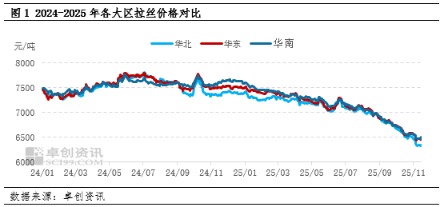
Core Viewpoint - The domestic PP filament market has shown a downward trend in prices since 2025, with the price gap between South China, East China, and North China narrowing from January to October, but recently widening again. Supply pressure in South China is expected to ease due to concentrated maintenance of PP filament facilities, leading to an anticipated widening of the price gap between South China and other regions [1][5]. Price Trends - Since 2025, prices across major regions have exhibited a consistent downward trend, primarily due to declining crude oil prices and increased supply from new production facilities. The operating rates remain high, contributing to supply-side pressure, while insufficient new orders from downstream factories have limited demand, further suppressing PP prices [1][3]. Regional Price Differences - The price gap between South China and North China reached a maximum of 270 CNY/ton, while the gap between South China and East China peaked at 145 CNY/ton. The minimum gaps recorded were -130 CNY/ton for both South China-North China and South China-East China, and -60 CNY/ton for East China-North China. The price differences among the three regions narrowed from January to October but have recently expanded [3][5]. Recent Market Dynamics - The recent price decline in North China has been more pronounced compared to South and East China, leading to increased price disparities. Despite new installations in South and East China, maintenance of several facilities has countered the pressure from new production, resulting in relatively stable prices in these regions. In contrast, North China continues to face significant supply pressure due to its large production capacity [5][7]. Future Outlook - In the short term, no new production facilities are expected to come online nationwide. In South China, several production lines are currently offline, and maintenance of existing facilities is scheduled, which will reduce supply pressure and strengthen price support. Conversely, the East China region has seen fewer maintenance activities, while North China faces strong supply impacts, limiting support from the supply side. It is anticipated that the price gap between South China and other regions will continue to widen, with increased allocation of resources to South China [7][8].