胶囊尺寸的微型共生型自供电无导线心脏起搏器

Search documents
我国科学家研制“胶囊版”自供电微型心脏起搏器
Xin Lang Cai Jing· 2026-01-25 18:15
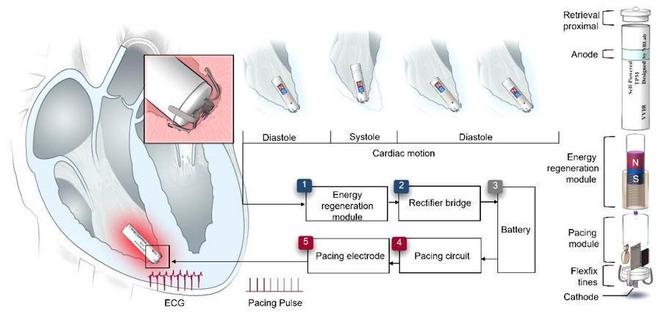
Core Viewpoint - The development of a capsule-sized, self-powered, wireless cardiac pacemaker represents a significant advancement in the treatment of heart disease, addressing the long-standing issue of battery replacement in traditional devices [1] Group 1: Innovation and Technology - A research team comprising institutions such as the University of Chinese Academy of Sciences and Tsinghua University has successfully developed a micro-sized, self-sustaining cardiac pacemaker [1] - The key innovation of this pacemaker is its integrated high-efficiency energy regeneration module, which captures kinetic energy from the heart's own beats through electromagnetic induction and converts it into electrical energy [1]
我国科学家研制出“胶囊版”自供电微型心脏起搏器
Xin Hua She· 2026-01-24 13:24
Core Viewpoint - The development of a capsule-sized self-powered wireless cardiac pacemaker represents a significant advancement in the field of implantable electronic devices, aiming to achieve lifelong maintenance-free operation for patients with heart conditions [1][3]. Group 1: Technological Innovation - A research team from multiple prestigious institutions in China has successfully developed a micro-sized self-powered wireless cardiac pacemaker, which has been published in the journal Nature Biomedical Engineering [3]. - The pacemaker features an integrated energy regeneration module that captures kinetic energy from the heart's own beats through electromagnetic induction, converting it into electrical energy [3][5]. - Testing has shown that the output power of this device exceeds the critical energy threshold required for lifelong operation, enabling precise regulation of heart rhythms [3][5]. Group 2: Design and Efficiency - The device incorporates a minimalist magnetic levitation energy storage structure that minimizes energy loss and mechanical friction, achieving near-zero startup thresholds and high kinetic energy conversion efficiency [5]. - The design simplifies system complexity while enhancing the long-term stability of the device, which is crucial for its performance in clinical settings [5]. Group 3: Clinical Implications - Animal experiments demonstrated that the new pacemaker could autonomously operate for a month, continuously supplying energy and effectively regulating heart rhythms, validating its clinical feasibility [5]. - The technology has the potential to extend the lifespan of pacemakers to match that of natural hearts, addressing the challenges associated with secondary surgeries for patients [5].