自动驾驶轨迹规划

Search documents
强化学习应用在自动驾驶中的一些思考
自动驾驶之心· 2025-12-23 00:53
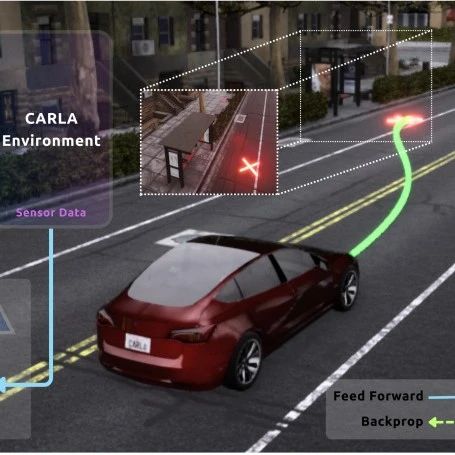
Core Viewpoint - The article discusses the application of reinforcement learning (RL) fine-tuning in trajectory planning for autonomous driving, emphasizing the transition from open-loop to closed-loop training methods to enhance the effectiveness of training models [3][4]. Group 1: Training Methodology - The mainstream planning modules based on learning typically use imitation learning, which can struggle with out-of-distribution scenarios during real-world testing [3]. - A closed-loop training approach is proposed, which simulates real vehicle testing environments, making it more effective than open-loop training [4]. - The article introduces a network structure based on Waymo's previous work, MotionLM, which outputs trajectories in an autoregressive manner, ensuring causal relationships are maintained [4][6]. Group 2: Input and Output Structure - The network's input is designed to be scene-centered, summarizing static information over a specified time frame rather than relying on the current frame alone, which helps prevent the vehicle from navigating outside the perceived road [6]. - Many imitation learning methods combine single-frame perception with ground truth (GT) data over several seconds, which can lead to causal inconsistencies if the perception range is limited [7]. Group 3: Reward Function and Training Phases - The training process consists of two phases: pretraining and reinforcement learning, with a simple reward function that balances efficiency and safety by considering both GT fitting and collision avoidance [11]. - The reward function is calculated by normalizing the rewards across all samples and time steps, allowing for the omission of a critic network, similar to the GRPO method [13]. Group 4: Challenges and Future Directions - The article notes that many imitation learning methods introduce auxiliary losses that can lead to undesirable model outputs, highlighting the limitations of open-loop training [14]. - The core value of reinforcement learning lies in closed-loop learning, which can significantly enhance model capabilities even with smaller datasets [14].

干货 | 基于深度强化学习的轨迹规划(附代码解读)
自动驾驶之心· 2025-07-29 23:32
Core Viewpoint - The article discusses the advancements and applications of reinforcement learning (RL) in the field of autonomous driving, highlighting its potential to enhance decision-making processes in dynamic environments. Group 1: Background and Concepts - The concept of VLA (Variational Learning Algorithm) and its relation to embodied intelligence is introduced, emphasizing its similarity to end-to-end autonomous driving [3] - Reinforcement learning has gained traction in various industries following significant milestones like AlphaZero in 2018 and ChatGPT in 2023, showcasing its broader applicability [3] - The article aims to explain reinforcement learning from a computer vision perspective, drawing parallels with established concepts in the field [3] Group 2: Learning Methods - Supervised learning in autonomous driving involves tasks like object detection, where a model is trained to map inputs to outputs using labeled data [5] - Imitation learning is described as a method where models learn actions by mimicking human behavior, akin to how children learn from adults [6] - Reinforcement learning differs from imitation learning by focusing on optimizing actions based on feedback from interactions with the environment, making it suitable for sequential decision-making tasks [7] Group 3: Advanced Learning Techniques - Inverse reinforcement learning is introduced as a method to derive reward functions from expert data, particularly useful when defining rewards is challenging [8] - The Markov Decision Process (MDP) is explained as a framework for modeling decision-making tasks, where states, actions, and rewards are interrelated [9] - Dynamic programming and Monte Carlo methods are discussed as techniques for solving reinforcement learning problems, emphasizing their role in optimizing decision-making processes [11][12] Group 4: Reinforcement Learning Algorithms - Various reinforcement learning algorithms are categorized, including on-policy and off-policy methods, highlighting their differences in training stability and data utilization [25][26] - The article outlines key algorithms such as Q-learning, SARSA, and policy gradient methods, explaining their mechanisms and applications in reinforcement learning [27][29] - Advanced algorithms like TRPO and PPO are presented, focusing on their strategies for ensuring stable training and optimizing policy updates [57][58] Group 5: Applications in Autonomous Driving - The importance of reward design in autonomous driving is emphasized, with safety, comfort, and efficiency being key factors [62] - The article discusses the need for closed-loop training systems in autonomous driving, where vehicle actions influence the environment, necessitating dynamic modeling of other vehicles [62] - The integration of end-to-end learning with reinforcement learning is highlighted as a method to adapt to changing environments in real-time [63]