舞剧《大染坊》

Search documents
一份“大染坊年礼”中的剧院温度
Xin Lang Cai Jing· 2026-01-26 16:56
年礼包含有春联、红包、福字、窗花、日历,特别是舞剧《大染坊》主人公陈寿亭的一封"手写信",让人 觉得特别走心。 说走心,是因为它懂观众。当初看舞剧《大染坊》时,多少人被陈寿亭身上的那股自强不息、百折不挠 的"鲁商精神"打动,又有多少人为染坊炸毁而落泪神伤。剧院有心,通过创意年礼,把"陈寿亭"从历 史"请"到了现实:"上月试演,承蒙诸位捧场,台下掌声脆如绸缎,眼中热忱暖胜炭火。诸君懂我实业坚守,懂 我齐鲁骨气。因有诸位共鸣,此戏方得其魂。今备薄礼,福字春联,聊表寸心。愿新岁里,家家户户如染缸好 布,日子鲜亮,阖家安康……"又道:"莫陷苦难甘沉睡,须携丹心唤后生。"以上既是"陈寿亭"所言,也是剧院 与观众的情感对话,也让剧中人物精神在现实中得以延续。 CS 包 开奖 大发生在新闻 下出版 & S WE rspt . STATE #408 # Para grades r gray prace T 营 are w W P P M M . . . E WARE SPAN . Fine in 中: 中 . 级集团 新立系 > 各类布料 欢迎选购 BBARABA rear lars coul **** # 40 sti F ...

人性底色与时代光影的交响
Xin Lang Cai Jing· 2026-01-01 16:39
Core Viewpoint - The dance drama "Dye House" presents a narrative that intertwines color symbolism with the struggles of a businessman, Chen Shouting, during turbulent times, reflecting on human nature and moral choices in the face of adversity [3][4][5]. Summary by Sections Artistic Expression - The production utilizes color as a narrative device, symbolizing hope, struggle, and moral dilemmas faced by the protagonist [3][4]. - The choreography and stage design emphasize the significance of fabric and color, enhancing the emotional depth of the performance [5][6]. Character Development - Chen Shouting's journey from a struggling youth to a determined businessman is marked by pivotal choices that reflect his moral compass, particularly in his decision to support the resistance against Japanese forces [4][5]. - The portrayal of supporting characters, such as Zhou Caiqin and Lu Jiajun, adds layers to the narrative, showcasing their roles in Chen's life and the broader context of the era [3][10]. Themes and Symbolism - The dance drama explores themes of sacrifice, national identity, and the impact of external forces on personal choices, with color serving as a metaphor for these themes [4][5][6]. - The use of "shadow" as a motif represents the internal struggles and moral conflicts faced by the characters, particularly in moments of decision-making [6][7]. Performance Quality - The lead actor, Liu Jia, successfully embodies Chen Shouting, bringing emotional depth and technical skill to the role, which has been well-received during previews [9][10]. - The supporting cast, including the antagonist Fujii, also delivers strong performances, contributing to the overall impact of the production [10]. Anticipation for Future Performances - The production team, led by directors Kong Dexin and Guo Haifeng, aims to refine the performance further, promising an engaging experience for audiences upon its official release [10][11].
色彩“染”就《大染坊》
Xin Lang Cai Jing· 2025-12-22 17:14
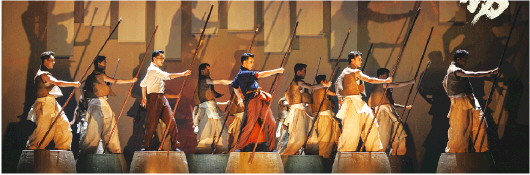
Core Viewpoint - The dance drama "Dye House" produced by the Shandong Provincial Department of Culture and Tourism showcases the rich history and artistry of the textile dyeing industry in China, using color as a narrative device to explore the life of the protagonist, Chen Shouting, and the broader themes of national spirit and personal struggle [7][9]. Group 1: Artistic Expression - The dance drama utilizes color as a central theme, representing the protagonist's life experiences and values through different hues, reflecting the historical context of the textile industry in Shandong during a tumultuous period [7][8]. - The choreography incorporates elements of the dyeing process, such as dyeing, drying, and color mixing, emphasizing the beauty and strength of the dancers' movements [8]. - The visual design of the production, including costumes and stage elements, uses color to convey the emotional journey of the characters and the narrative progression without the need for dialogue [8][9]. Group 2: Historical Context - The narrative is set against the backdrop of China's long-standing dyeing tradition, dating back to the Shang and Zhou dynasties, and highlights the evolution of the dyeing industry through significant historical changes [7]. - The character of Chen Shouting symbolizes the resilience and determination of modern Chinese entrepreneurs, illustrating the connection between personal ambition and national identity [7][9]. - The progression of colors in the drama, from pure white to deep red, symbolizes the awakening of national spirit and the intertwining of individual struggles with the fate of the nation [9].