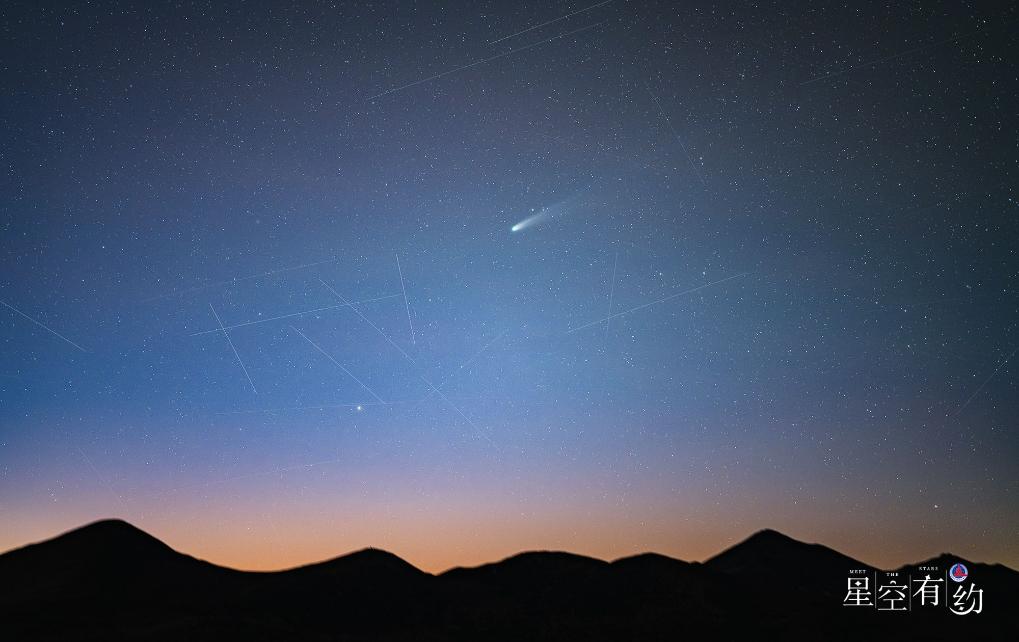
莱蒙彗星

Search documents
星空有约|星尾作笔,甲子飞白
Xin Hua She· 2025-12-31 02:47
Core Insights - The article highlights the significance of comets in China's astronomical history, particularly focusing on the discovery of the first comet by Chinese scientists 60 years ago and the upcoming appearance of a new comet named C/2025 A3 (Tsuchinshan) [1][4] Group 1: Historical Context - The first comet discovered by China, 62P/Tsuchinshan, was observed in 1965 using a telescope purchased from Germany, marking a milestone in Chinese astronomy [1] - The second comet, 60P/Tsuchinshan, was discovered shortly after, further establishing the importance of the Zijinshan Observatory in the field [1] Group 2: Upcoming Astronomical Events - The brightest comet of 2025, C/2025 A6 (Lemmon), is expected to be a major attraction for sky watchers in the Northern Hemisphere, showcasing a long and bright tail [2][3] - The orbital period of the Lemmon comet exceeds 1000 years, making its appearance a rare event [3] Group 3: Scientific Exploration - The article discusses the global interest in the interstellar visitor comet ATLAS (3I/ATLAS), which has captured the attention of astronomers worldwide, including observations from advanced telescopes like Hubble and James Webb [3][4] - Comets are described as carriers of material from other star systems, providing insights into the formation and evolution of celestial bodies [4]
秀我中国|今年以来最亮彗星“莱蒙”巡游天际
Xin Hua She· 2025-10-27 13:49
Group 1 - The C/2025 A6 (Lemmon) comet, known as "Lemmon Comet," has an orbital period of approximately 1150 to 1350 years and is currently the brightest comet observed on Earth this year [2] - The comet passed its perihelion on October 21 and is expected to reach its closest point to the Sun on November 8 [2] - On the night of October 26, numerous astronomy enthusiasts gathered in Yangquan, Shanxi, to observe the comet despite the cold weather [2]
“千年一遇”的彗星来了,如何观测?
Xin Hua She· 2025-10-22 03:24
Core Viewpoint - C/2025 A6 (Lemmon) comet, referred to as Lemmon comet, is a "once-in-a-millennium" comet that has recently gained global attention due to its brightness and visibility during its close approach to Earth [1][2] Group 1 - Lemmon comet is expected to be the brightest comet of the year, with its brightness increasing from magnitude 21.5 to between 4 and 5 [2] - The comet has an orbital period of approximately 1150 to 1350 years, classifying it as a long-period comet [2] - Observers across various locations in China, including Beijing, Tianjin, Sichuan, Shenzhen, and Xinjiang, have successfully captured images of the comet during dawn or dusk [5][6] Group 2 - Observers are advised to prepare their equipment and choose locations away from city lights for optimal viewing conditions, such as rural areas or mountain tops [8] - The visibility of the comet will decrease after it passes the perihelion, making it harder to observe in the northern hemisphere [6] - The comet's appearance includes a faint dust tail and a narrow ion tail, providing unique visual effects when photographed in scenic locations [5][6]