血小板

Search documents
输血小科普
Xin Lang Cai Jing· 2025-12-23 17:02
Group 1 - Blood is essential for life and plays a critical role in the body, but there are common misconceptions about blood transfusions [1] - Transfusions are not a means to "supplement nutrition"; they are primarily used in cases of severe anemia or blood loss when the body cannot tolerate hypoxia [1] - Direct blood transfusions between relatives are not permissible due to the time required for blood testing and the higher risk of severe reactions such as graft-versus-host disease [1] Group 2 - There is a misconception that "whole blood" is better than "component blood"; however, modern transfusions are tailored to specific needs, such as red blood cells for anemia or platelets for low platelet counts [1] - Whole blood can lose efficacy during storage, potentially leading to adverse reactions or increased burden on the recipient [1]
我国学者揭示具有卓越再生修复潜能的血小板群体
Huan Qiu Wang Zi Xun· 2025-08-19 05:50
Core Insights - The research conducted by the team at the Chinese Academy of Medical Sciences reveals significant differences in the molecular characteristics and functional biases of platelets at different developmental stages, particularly between embryonic and adult platelets [1][2]. Group 1: Molecular Characteristics - The study utilized transcriptomics and proteomics to uncover molecular expression differences between embryonic and adult platelets, finding that genes related to classical coagulation and immune regulation are downregulated in embryonic platelets, while factors associated with tissue development and extracellular matrix reconstruction are significantly upregulated [2]. - Embryonic platelets are highly enriched in pathways related to the development of multiple systems, indicating their supportive role beyond hemostasis during embryonic development [2]. Group 2: Functional Advantages - The research demonstrated that embryonic platelets exhibit a strong interaction with fibroblasts, significantly promoting fibroblast proliferation and accelerating wound healing [2]. - In a diabetic mouse model with non-healing skin injuries, embryonic platelets showed superior repair capabilities compared to adult platelets, enhancing wound closure, epidermal regeneration, granulation tissue absorption, and collagen deposition [2]. Group 3: Clinical Implications - The identification of a CD59-positive "embryonic-like" subpopulation in adult platelets, which decreases with individual development, is linked to the diminished repair capacity of adult platelets, providing a theoretical basis for enriching repair-type platelets for clinical precision therapy [4]. - The study also confirmed that iPSC-derived platelets possess similar molecular characteristics and functional advantages as embryonic platelets, supporting their potential clinical application and overcoming limitations associated with embryonic platelet use [4]. - The findings open new pathways for the precise application of platelets in areas such as ischemic transfusion, immune regulation, and trauma repair, providing groundbreaking theoretical and practical foundations for clinical translation [4].

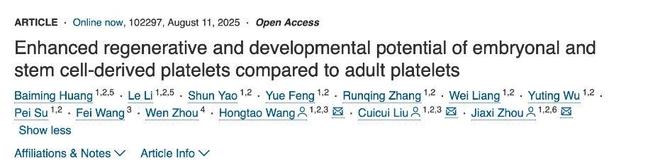
Cell子刊:胚胎和干细胞来源的血小板具有更强的再生和发育潜能
生物世界· 2025-08-12 04:11
Core Viewpoint - The study published in Cell Reports Medicine highlights that embryonal and stem cell-derived platelets exhibit enhanced regenerative and developmental potential compared to adult platelets, suggesting new avenues for customized platelet therapies to meet specific clinical needs [4][9]. Group 1: Research Findings - The research team conducted transcriptomic and proteomic analyses of mouse embryonic platelets, revealing that embryonic platelets show reduced classical immune regulation and coagulation features but enhanced developmental characteristics compared to adult platelets [6]. - Embryonic platelets interact more actively with various cell types, such as fibroblasts, significantly accelerating the healing of difficult wounds [6]. - Mechanistically, embryonic platelets promote fibroblast proliferation by releasing higher levels of insulin-like growth factor-2 (IGF2) [6]. Group 2: Unique Platelet Subpopulations - A specific subpopulation of CD59(a)+ platelets, which shares functional similarities with embryonic platelets, was identified in both mice and humans [7]. - Platelets derived from human induced pluripotent stem cells (hiPSCs) exhibit molecular and functional characteristics similar to those of embryonic platelets [7]. Group 3: Implications for Clinical Applications - The unique multi-omics characteristics and superior regenerative potential of embryonic and hiPSC-derived platelets provide a new direction for the development of customized platelet therapies tailored to specific clinical needs [9].