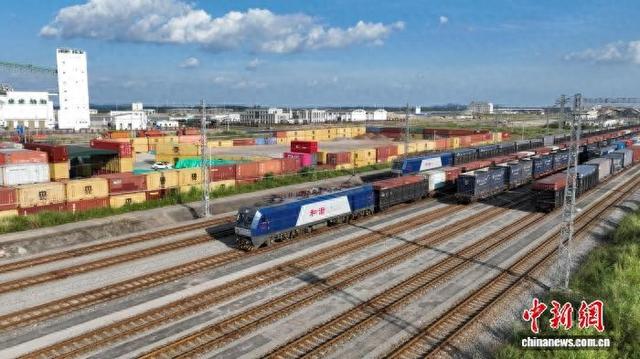
西部陆海新通道铁海联运班列运输服务

Search documents
澳大利亚至中国西部城市海铁江联运测试班列首发
Guang Xi Ri Bao· 2025-11-17 02:35
今年以来,国铁南宁局深挖西部陆海新通道班列货源,不断优化运输组织,实现集装箱运输上量。 今年截至11月12日,西部陆海新通道铁海联运班列累计运输货物124.4万标箱,同比增长60.4%。(宋 瑶 吴柯荣) 11月13日14时53分,伴随着嘹亮的汽笛声,装载着澳大利亚锂辉石等货物的西部陆海新通道X9578 次铁海联运班列从钦州港东站驶出,开往重庆小南垭站。 为保障该批货源顺利发运,国铁南宁局沿海铁路公司钦州车务段钦州港东站根据客户提报运输需 求,提前备足空箱,优先安排空车装运,通过调配倒运汽车、装卸机具及人员,提高倒运及装车效率。 同时,积极采取提效措施,保障车站列车编成、货检作业和列检作业同步进行,班列完成编组后50分钟 内具备开车条件,最大限度提高运输效率,保障班列快速发运。 据了解,该班列从澳大利亚海运至钦州港后,通过铁路从钦州港东站运输至重庆小南垭站,再从重 庆珞璜港装船江运到四川宜宾。此前货源运输方式主要是经华东港口从长江走散货船到重庆果园港口 后,客户自行拖车运输至宜宾。此次开启的"海+铁+江"集装箱联运模式,为企业节省了时间和物流成 本。 ...
前三季度西部陆海新通道货运量同比增长70.3%
Guang Xi Ri Bao· 2025-10-07 02:42
Core Insights - The Western Land-Sea New Corridor's rail-sea intermodal trains have seen a significant increase in container shipments, reaching 1.09 million TEUs in the first three quarters of the year, marking a 70.3% year-on-year growth [1][2] - The year 2023 is projected to be the fastest year for shipment growth since the corridor's inception, with expectations to exceed 1.3 million TEUs and a total transport volume surpassing 5 million TEUs [1] Group 1 - The X9590 train, carrying 90 containers of goods from Thailand, Indonesia, and the UAE, departed from Qinzhou Port East Station to Chongqing Tuanjie Village Station [1] - The milestone of 1 million TEUs was achieved in just 247 days this year, compared to over four years for the first million TEUs [1] - The rail department has expanded the new corridor from the initial "Yugui New" line to 26 regular routes, enhancing connectivity with the China-Europe Railway Express [2] Group 2 - The established routes include 15 regular lines starting from Beibu Gulf Port and Zhanjiang Port, creating an efficient transport network covering major cities in the western region [2] - As of August 2025, the types of goods transported via the corridor have expanded to 1,316, including electronics, vehicles, machinery, and food, fostering a positive cycle of logistics and trade [2] - The rail-sea intermodal trains have reached 18 provinces, 75 cities, and 163 stations in China, connecting to 577 ports in 127 countries and regions globally [2]
西部陆海新通道跑出“加速度” 前三季度货运量破百万标箱
Zhong Guo Xin Wen Wang· 2025-10-01 10:06
Core Insights - The Western Land-Sea New Corridor's iron-sea combined transport has seen a significant increase in container shipments, surpassing 1.09 million TEUs in the first three quarters of the year, marking a year-on-year growth of 70.3% [1][3] - This year is noted as the fastest growth year since the launch of the service, achieving the milestone of 1 million TEUs in just 247 days, compared to over four years for the first million [3] - The corridor is expected to exceed 1.3 million TEUs by the end of the year, with total transport volume projected to surpass 5 million TEUs [3] Transport Network Development - Over the past eight years, the railway department has expanded the corridor from a single "Yugui New" line to 26 regular routes connecting major cities in the western region, facilitating seamless integration with the China-Europe Railway Express [3] - The established routes include 15 regular lines starting from Beibu Gulf Port and Zhanjiang Port, creating an efficient transport network centered around Chongqing and Chengdu [3] Import and Export Growth - The corridor has facilitated rapid growth in imports such as South African mineral products, Australian lithium ore, and Southeast Asian rubber, while also enabling exports of local products like potatoes from Gansu and sugar from Guangxi [4] - The development of cross-regional and cross-border supply chains is accelerating, with various industrial chains being established, including collaborations between the Guangdong-Hong Kong-Macao Greater Bay Area and Guangxi [4] Infrastructure and Capacity Enhancements - The company has improved container handling capabilities at the Qinzhou Railway Container Center Station, increasing unloading capacity from 2 to 4 trains, which supports the export of domestic electric vehicles to markets in the Middle East and Southeast Asia [4] - As of now, the iron-sea combined transport has reached 163 stations across 75 cities in 18 provinces in China, connecting to 577 ports in 127 countries and regions globally [4]