贝雕台灯

Search documents
广西烟火 | 镂月裁云贝生花
Guang Xi Ri Bao· 2025-12-01 03:09
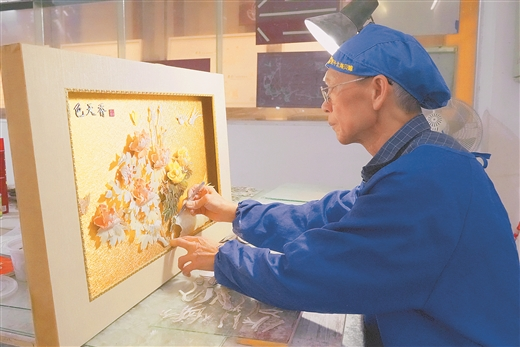
Core Perspective - The article highlights the significance of Beihai shell carving as a national intangible cultural heritage, showcasing its artistic value and cultural history rooted in the maritime Silk Road [1][4]. Group 1: Cultural Heritage and Artistic Value - Beihai shell carving is recognized as China's first national-level intangible cultural heritage project in the shell carving category, reflecting a blend of historical techniques and modern artistry [1]. - The craft has evolved from its origins in the Qin and Han dynasties, gaining prominence during the Ming and Qing dynasties, and is seen as a microcosm of maritime cultural exchange [1][4]. Group 2: Techniques and Craftsmanship - The shell carving process involves over ten intricate steps, including shaping, carving, polishing, and assembling, emphasizing the importance of material and technique [2][4]. - The artisans utilize various types of shells, each contributing unique characteristics to the final product, demonstrating a deep respect for natural materials [2][3]. Group 3: Revival and Modernization - After a decline in the 1990s, the industry saw a revival in 2004 when artisans returned to traditional methods, focusing on natural aesthetics rather than artificial coloring [2][4]. - The Beihai shell carving industry has expanded, with approximately 20 enterprises and studios currently operating, and the workforce has grown from over 20 to more than 100 since 2021, attracting younger generations [4][5]. Group 4: Educational and Community Engagement - The Beihai Shell Carving Museum serves as a cultural hub, where artisans mentor young students, ensuring the transmission of skills and knowledge [5]. - Innovative designs incorporating shell carving into everyday items have made the craft more accessible and popular among the public, enhancing its relevance in contemporary society [4][5].