超细月壤连续纤维

Search documents
从月壤到“月宫” 中国科学家“解锁”智造月球科研站
Xin Lang Cai Jing· 2025-12-22 18:17
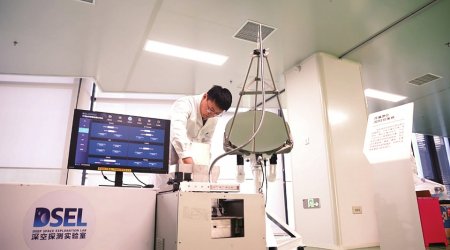
Core Viewpoint - The article discusses China's advancements in lunar exploration, particularly focusing on the development of in-situ resource utilization technologies, such as the lunar regolith 3D printing system, aimed at building sustainable research stations on the Moon [4][5][6]. Group 1: Lunar Construction Technologies - The "lunar regolith in-situ 3D printing system" is being tested to create structural components using lunar soil, utilizing concentrated solar energy to achieve temperatures exceeding 1300 degrees Celsius [4][6]. - The goal is to construct a sustainable lunar base using local resources, minimizing reliance on Earth for supplies, and enabling autonomous operations and maintenance [5][6]. - Various technological approaches are being explored, including the production of high-performance fibers from lunar regolith, which could lead to new engineering materials suitable for the Moon's environment [6][7]. Group 2: Future Lunar Missions and Collaboration - Future lunar construction will involve a collaborative effort of heterogeneous robotic systems, each performing specific tasks such as surveying, transporting regolith, and assembling structures [7]. - China is fostering international collaboration in lunar exploration, having established partnerships with over 60 global research institutions and hosting the International Society for Deep Space Exploration [7][8]. - The Chinese space agency plans to achieve its first crewed lunar landing by 2030 and establish a basic international lunar research station by 2035, marking a significant shift from sample return missions to resource utilization [8].

科学与健康|从月壤到“月宫”!中国科学家“解锁”智造月球科研站
Xin Hua She· 2025-12-19 12:59
Core Insights - The article discusses China's advancements in lunar in-situ resource utilization, focusing on the development of a lunar research station using lunar regolith as a primary building material and autonomous intelligent robots for construction [2][4][6]. Group 1: Lunar Research and Development - The successful completion of the Chang'e 6 mission marks the end of China's three-step lunar exploration strategy, emphasizing the importance of utilizing lunar resources for sustainable research station construction [2]. - The "lunar regolith in-situ 3D printing system" is being tested at the Deep Space Exploration Laboratory, showcasing innovative approaches to extraterrestrial construction [2][3]. Group 2: Technological Innovations - Researchers are using parabolic mirrors to focus sunlight thousands of times, generating temperatures exceeding 1300 degrees Celsius to melt lunar regolith for 3D printing [3]. - A new method for producing high-performance fibers from lunar regolith has been developed, with successful experiments yielding ultra-fine fibers suitable for the moon's environment [5]. Group 3: Future Vision and Collaboration - The construction of the lunar research station aims to minimize reliance on Earth supplies by utilizing lunar materials and achieving autonomous operations [4][6]. - China has established collaborations with over 60 international research institutions in the field of deep space exploration, promoting knowledge sharing and joint efforts to address extraterrestrial survival challenges [6]. Group 4: Strategic Goals - China plans to achieve its first manned lunar landing by 2030 and establish a basic international lunar research station by 2035, with various design proposals being explored by different universities [6]. - The transition from merely retrieving samples from space to utilizing space resources signifies a significant shift in China's deep space exploration strategy [7].