月球原位自主智造

Search documents
从月壤到“月宫” 中国科学家“解锁”智造月球科研站
Xin Lang Cai Jing· 2025-12-22 18:17
Core Viewpoint - The article discusses China's advancements in lunar exploration, particularly focusing on the development of in-situ resource utilization technologies, such as the lunar regolith 3D printing system, aimed at building sustainable research stations on the Moon [4][5][6]. Group 1: Lunar Construction Technologies - The "lunar regolith in-situ 3D printing system" is being tested to create structural components using lunar soil, utilizing concentrated solar energy to achieve temperatures exceeding 1300 degrees Celsius [4][6]. - The goal is to construct a sustainable lunar base using local resources, minimizing reliance on Earth for supplies, and enabling autonomous operations and maintenance [5][6]. - Various technological approaches are being explored, including the production of high-performance fibers from lunar regolith, which could lead to new engineering materials suitable for the Moon's environment [6][7]. Group 2: Future Lunar Missions and Collaboration - Future lunar construction will involve a collaborative effort of heterogeneous robotic systems, each performing specific tasks such as surveying, transporting regolith, and assembling structures [7]. - China is fostering international collaboration in lunar exploration, having established partnerships with over 60 global research institutions and hosting the International Society for Deep Space Exploration [7][8]. - The Chinese space agency plans to achieve its first crewed lunar landing by 2030 and establish a basic international lunar research station by 2035, marking a significant shift from sample return missions to resource utilization [8].

从月壤到“月宫”!月球科研站准备这样建→
Xin Lang Cai Jing· 2025-12-20 11:53
Core Insights - The article discusses China's advancements in lunar research, particularly focusing on in-situ resource utilization and the construction of a lunar research station using lunar regolith as a primary building material [1][2]. Group 1: Lunar Construction Technology - Chinese scientists are exploring the concept of in-situ autonomous manufacturing on the Moon, utilizing lunar regolith as a raw material for building structures [1]. - A "lunar regolith in-situ 3D printing system" has been developed, which uses concentrated solar energy to melt lunar soil at temperatures exceeding 1300 degrees Celsius, enabling the creation of solid bricks and components [1][3]. - The goal is to minimize reliance on Earth for supplies by utilizing lunar resources for sustainable construction and operation of a lunar base [2]. Group 2: Advanced Material Development - Researchers have successfully developed high-performance fibers from lunar regolith, achieving ultra-fine continuous fibers with diameters of 10 to 20 micrometers [3]. - This innovation opens new possibilities for manufacturing composite materials suitable for the Moon's extreme environment [3]. Group 3: Robotic Collaboration - Future lunar construction will require a collaborative effort from heterogeneous robotic systems, including surveying, transporting, and assembling robots [3]. - The vision includes equipping these robotic systems with "collective intelligence" to enable autonomous and efficient operations on the lunar surface [3]. Group 4: Future Plans and Goals - Various universities in China are proposing different designs for lunar habitats, with plans to establish an international lunar research station by 2035 [4]. - The Chinese National Space Administration aims for a manned lunar landing by 2030, marking significant milestones in lunar exploration [4].
中国科学家“解锁”智造月球科研站
Xin Lang Cai Jing· 2025-12-19 23:33
Core Insights - The article discusses China's advancements in lunar resource utilization and the development of autonomous construction technologies for a sustainable lunar research station, emphasizing the shift from sample return missions to in-situ resource utilization [1][5]. Group 1: Lunar Construction Technologies - The focus of future lunar research station construction is on "in-situ material extraction, collaborative intelligent manufacturing, and autonomous operations" [2]. - A "lunar regolith in-situ 3D printing system" has been developed, utilizing concentrated solar energy to melt lunar soil at temperatures exceeding 1300 degrees Celsius for construction purposes [1][3]. - Researchers are exploring methods to create high-performance fibers from lunar regolith, successfully producing ultra-fine fibers with diameters of 10 to 20 micrometers [3]. Group 2: Collaborative Robotics and Smart Systems - The construction on the lunar surface will require a heterogeneous robotic cluster for collaborative operations, including surveying, transporting lunar soil, and assembling structures [3]. - Key technologies needed for this vision include reliable long-distance communication, high-precision collaborative positioning, and intelligent planning for robotic clusters [3][4]. Group 3: International Collaboration and Future Plans - China has established partnerships with over 60 international research institutions in the field of deep space exploration, promoting knowledge sharing and collaborative problem-solving [4]. - The Chinese government aims to achieve its first crewed lunar landing by 2030 and establish a basic international lunar research station by 2035 [5].
从月壤到“月宫”!中国科学家“解锁”智造月球科研站
Xin Lang Cai Jing· 2025-12-19 13:17
Core Insights - The article discusses China's advancements in lunar resource utilization and the development of autonomous construction technologies on the moon, emphasizing the shift from sample return missions to in-situ resource utilization [1][5]. Group 1: Lunar Construction Technologies - The focus is on "in-situ autonomous manufacturing" using lunar regolith as a primary building material, with solar energy being harnessed to create high-temperature conditions for 3D printing [1][3]. - A "lunar regolith in-situ 3D printing system" has been demonstrated, showcasing the potential for constructing durable structures on the moon [1]. - Researchers are exploring methods to create high-performance fibers from lunar regolith, which could lead to new engineering materials suitable for the moon's environment [3]. Group 2: Collaborative Efforts and Future Plans - China has established partnerships with over 60 international research institutions in the field of deep space exploration, promoting a collaborative approach to lunar resource development [4]. - Various universities in China are proposing different designs for lunar bases, indicating a broad range of innovative ideas for future lunar habitation [4]. - The National Space Administration of China aims to achieve the first human landing on the moon by 2030 and establish a basic international lunar research station by 2035 [5]. Group 3: Technological Challenges and Solutions - The extreme conditions on the moon, including temperature fluctuations, vacuum, and radiation, pose significant challenges for manufacturing equipment, necessitating reliable long-term operation [3]. - Future lunar construction will require a heterogeneous robot swarm capable of collaborative operations, with a focus on developing "collective intelligence" for autonomous and efficient teamwork [3][4].
科学与健康|从月壤到“月宫”!中国科学家“解锁”智造月球科研站
Xin Hua She· 2025-12-19 12:59
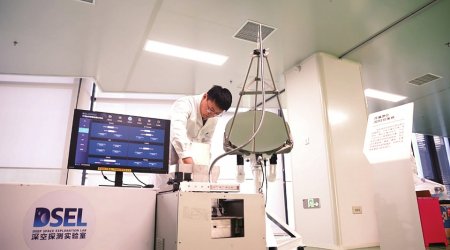
Core Insights - The article discusses China's advancements in lunar in-situ resource utilization, focusing on the development of a lunar research station using lunar regolith as a primary building material and autonomous intelligent robots for construction [2][4][6]. Group 1: Lunar Research and Development - The successful completion of the Chang'e 6 mission marks the end of China's three-step lunar exploration strategy, emphasizing the importance of utilizing lunar resources for sustainable research station construction [2]. - The "lunar regolith in-situ 3D printing system" is being tested at the Deep Space Exploration Laboratory, showcasing innovative approaches to extraterrestrial construction [2][3]. Group 2: Technological Innovations - Researchers are using parabolic mirrors to focus sunlight thousands of times, generating temperatures exceeding 1300 degrees Celsius to melt lunar regolith for 3D printing [3]. - A new method for producing high-performance fibers from lunar regolith has been developed, with successful experiments yielding ultra-fine fibers suitable for the moon's environment [5]. Group 3: Future Vision and Collaboration - The construction of the lunar research station aims to minimize reliance on Earth supplies by utilizing lunar materials and achieving autonomous operations [4][6]. - China has established collaborations with over 60 international research institutions in the field of deep space exploration, promoting knowledge sharing and joint efforts to address extraterrestrial survival challenges [6]. Group 4: Strategic Goals - China plans to achieve its first manned lunar landing by 2030 and establish a basic international lunar research station by 2035, with various design proposals being explored by different universities [6]. - The transition from merely retrieving samples from space to utilizing space resources signifies a significant shift in China's deep space exploration strategy [7].