跨省跨区电力应急调度

Search documents
我国首个跨省跨区电力应急调度文件正式发布!10月1日起施行
中关村储能产业技术联盟· 2025-10-13 09:41
Core Viewpoint - The article discusses the implementation of the "Cross-Province and Cross-Region Power Emergency Dispatch Management Measures," which aims to enhance the management of power emergency dispatching in China, ensuring safety and supply stability in the electricity sector starting from October 1, 2025 [7][24]. Summary by Sections General Principles - The emergency dispatching mechanism is established to address safety risks and power supply imbalances, prioritizing market-based solutions before resorting to emergency measures [11][27]. - The National Development and Reform Commission (NDRC) is responsible for managing emergency dispatching, while the National Energy Administration oversees execution and settlement [11][27]. Implementation Organization - Emergency dispatching should avoid causing safety risks and should not be a regular practice; it is initiated under specific conditions related to safety and supply [13][14]. - The process involves a tiered management approach, where provincial dispatching agencies can request emergency measures based on predefined conditions [14][15]. Pricing Mechanism and Settlement Management - The pricing for emergency dispatching is determined based on market prices from the sending province and the receiving province, with specific calculations for transmission costs and losses [16][17]. - Costs incurred from emergency dispatching are shared between users and power generation companies based on a defined ratio, ensuring fair distribution of expenses [17][18]. Safeguards - The article emphasizes the need for compliance and fairness in emergency dispatching, with responsibilities clearly outlined for all involved parties, including grid companies and trading institutions [21][24]. - Monthly reports on the execution of emergency dispatching will be submitted to the NDRC and the National Energy Administration to ensure transparency and accountability [25][30]. Background and Significance - The management measures were developed in response to the need for a robust emergency dispatching framework, particularly highlighted during periods of high demand and supply challenges [25][26]. - The new measures aim to refine the existing emergency dispatching rules, ensuring a more effective response to power supply issues while integrating with market mechanisms [26][29].

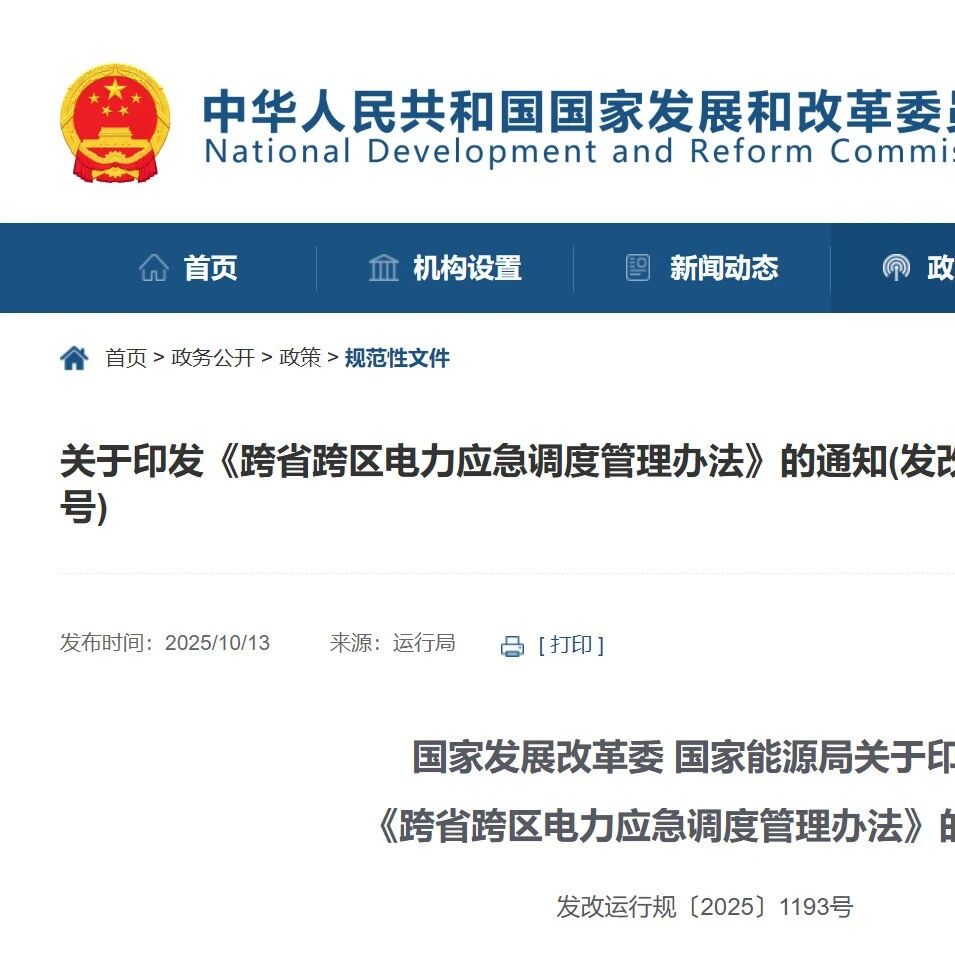
国家发改委、国家能源局重磅发布!
中国能源报· 2025-10-13 02:27
Core Viewpoint - The article discusses the implementation of the "Cross-Province and Cross-Region Power Emergency Dispatch Management Measures" by the National Development and Reform Commission and the National Energy Administration, emphasizing the prioritization of market-based methods for resource allocation and pricing in the event of power supply risks and imbalances [3][6]. Summary by Sections General Principles - The measures aim to establish a robust emergency mechanism for power dispatch across provinces and regions, ensuring safety and supply needs are met [8]. - The National Development and Reform Commission is responsible for managing emergency dispatch, while the National Energy Administration oversees execution and regulatory compliance [8]. Implementation Organization - Emergency dispatch will be organized by national and regional power dispatch agencies, ensuring that safety risks and supply imbalances are addressed without causing additional risks [11][12]. - The initiation of emergency dispatch requires specific conditions related to safety and supply balance, with a preference for safety in cases where both are at risk [11][12]. Pricing Mechanism and Settlement Management - The pricing for emergency dispatch will be based on the market transaction prices from the sending province, adjusted for system operation costs [14]. - The settlement of costs will follow a principle of shared benefits and burdens between sending and receiving provinces, with specific ratios for cost distribution [16][19]. Safeguards - Power dispatch agencies are required to ensure compliance and fairness in emergency dispatch operations, while also coordinating with power trading institutions for information disclosure [22]. - The State Grid and Southern Grid companies must enhance their emergency dispatch implementation details and report their execution status monthly to the relevant authorities [24][25].