
跨省跨区电力应急调度

Search documents
跨省跨区电力应急调度机制更完善
Jing Ji Ri Bao· 2025-11-12 00:14
Core Viewpoint - The issuance of the "Emergency Dispatch Management Measures for Cross-Province and Cross-Region Electricity" by the National Development and Reform Commission and the National Energy Administration aims to standardize and enhance the emergency dispatching system for electricity, ensuring stable supply and efficient resource allocation across regions [1][2]. Group 1: Background and Development - The emergency dispatching system is crucial for ensuring stable electricity supply, with significant developments since 2021, including the establishment of interim measures and rules to address supply issues when market mechanisms fail [1][2]. - The "Interim Measures" and "Interim Rules" have served as important references for emergency dispatching, leading to a more refined policy framework for cross-province and cross-region electricity operations [1][2]. Group 2: Highlights of the Management Measures - The management measures clarify the role of emergency dispatching in ensuring safety and supply, excluding requirements related to promoting consumption, thus focusing on safety and supply as primary objectives [2][3]. - The measures establish a connection mechanism between emergency dispatching and the electricity market, prioritizing market solutions while ensuring that emergency dispatching meets safety and supply needs [3]. - Detailed workflows and responsibilities for emergency dispatching are outlined, ensuring efficient implementation and coordination among relevant parties, including dispatching agencies and electricity trading institutions [3]. Group 3: Implementation and Future Steps - The National Development and Reform Commission plans to enhance the cross-province and cross-region electricity operation adjustment mechanism, ensuring effective implementation of the management measures through continuous monitoring and policy alignment [4]. - Local electricity authorities and grid companies are encouraged to develop supporting policies and implementation details to facilitate the effective execution of the management measures [4].
首个国家层面规范性文件出台 跨省跨区电力应急调度机制更完善
Jing Ji Ri Bao· 2025-11-11 23:59
Core Viewpoint - The issuance of the "Cross-Province and Cross-Region Power Emergency Dispatch Management Measures" by the National Development and Reform Commission and the National Energy Administration marks the first national-level normative document for cross-province and cross-region power emergency dispatch, aiming to ensure stable power supply and enhance the efficiency of power resource flow across a broader area [1][2]. Group 1: Key Highlights of the Management Measures - The management measures clarify the functional positioning of power emergency dispatch to ensure safety and supply, excluding requirements related to promoting consumption [2][3]. - The measures establish a connection mechanism between power emergency dispatch and the electricity market, adhering to the principle of "market regulation first, emergency dispatch as a backup" [3]. - Detailed workflows and responsibilities for power emergency dispatch are outlined, ensuring efficient implementation based on demand [3]. Group 2: Implementation and Future Steps - The National Development and Reform Commission plans to combine effective government action with market efficiency to continuously improve the cross-province and cross-region power operation adjustment mechanism [4]. - Ongoing tracking of the implementation of the management measures will be conducted, with local power authorities and grid companies required to develop supporting policies and implementation details [4].
首个国家层面规范性文件出台——跨省跨区电力应急调度机制更完善
Jing Ji Ri Bao· 2025-11-11 22:07
Core Viewpoint - The issuance of the "Cross-Province and Cross-Region Power Emergency Dispatch Management Measures" by the National Development and Reform Commission and the National Energy Administration marks the first national-level normative document for cross-province and cross-region power emergency dispatch, aiming to ensure stable power supply and enhance the efficiency of power resource allocation across a broader area [1][2]. Group 1: Emergency Dispatch Framework - Cross-province and cross-region power emergency dispatch is a crucial measure for ensuring stable power supply [1]. - The "Interim Measures" and "Interim Rules" established a framework for emergency dispatch when market mechanisms fail to address power supply issues, leading to a more refined policy system [1][2]. - The new management measures emphasize the importance of safety and supply assurance, excluding requirements related to promoting consumption [2][3]. Group 2: Market Integration and Operational Efficiency - The management measures clarify the connection between emergency dispatch and the power market, prioritizing market adjustments while ensuring emergency dispatch serves as a safety net [3]. - Specific mechanisms for the integration of emergency dispatch with market pricing and electricity volume have been established, ensuring that supply and demand are addressed through market solutions first [3]. - Detailed workflows and responsibilities for all parties involved in emergency dispatch have been outlined, promoting efficient and demand-driven implementation [3]. Group 3: Implementation and Future Steps - The National Development and Reform Commission plans to enhance the cross-province and cross-region power operation adjustment mechanism and monitor the implementation of the management measures [4]. - Local power authorities and grid companies are encouraged to develop supporting policies and implementation details to ensure effective execution of the management measures [4].
跨省跨区电力应急调度管理办法印发
Ren Min Ri Bao· 2025-10-13 22:20
Core Viewpoint - The article discusses the issuance of the "Cross-Province and Cross-Region Electric Power Emergency Dispatch Management Measures" by the National Development and Reform Commission and the National Energy Administration, aimed at enhancing the regulation and effectiveness of emergency dispatch to ensure stable electricity supply [1] Group 1: Emergency Dispatch Functionality - The Measures clarify the role of emergency dispatch in ensuring safety and supply, excluding requirements related to promoting consumption [1] - It emphasizes that the integration of renewable energy into the electricity market should primarily be achieved through market mechanisms, rather than being a part of emergency dispatch scenarios [1] Group 2: Market Integration - The Measures establish a connection mechanism between emergency dispatch and the electricity market, adhering to the principle of "market regulation first, emergency dispatch as a backup" [1] - Specific methods for linking emergency dispatch electricity volume and pricing with the electricity market are outlined, guiding supply and demand parties to resolve issues through the market first while ensuring effective emergency dispatch for safety and reasonable profit [1] Group 3: Implementation and Responsibilities - Detailed workflows and responsibilities for all parties involved in electric power emergency dispatch are specified to ensure implementation is demand-driven and efficient [1] - As the first national-level normative document on cross-province and cross-region electric power emergency dispatch, the Measures are expected to enhance the effectiveness and regulation of emergency dispatch, especially when market mechanisms fail to address electricity safety supply issues [1]
我国首个跨省跨区电力应急调度文件正式发布!10月1日起施行
中关村储能产业技术联盟· 2025-10-13 09:41
Core Viewpoint - The article discusses the implementation of the "Cross-Province and Cross-Region Power Emergency Dispatch Management Measures," which aims to enhance the management of power emergency dispatching in China, ensuring safety and supply stability in the electricity sector starting from October 1, 2025 [7][24]. Summary by Sections General Principles - The emergency dispatching mechanism is established to address safety risks and power supply imbalances, prioritizing market-based solutions before resorting to emergency measures [11][27]. - The National Development and Reform Commission (NDRC) is responsible for managing emergency dispatching, while the National Energy Administration oversees execution and settlement [11][27]. Implementation Organization - Emergency dispatching should avoid causing safety risks and should not be a regular practice; it is initiated under specific conditions related to safety and supply [13][14]. - The process involves a tiered management approach, where provincial dispatching agencies can request emergency measures based on predefined conditions [14][15]. Pricing Mechanism and Settlement Management - The pricing for emergency dispatching is determined based on market prices from the sending province and the receiving province, with specific calculations for transmission costs and losses [16][17]. - Costs incurred from emergency dispatching are shared between users and power generation companies based on a defined ratio, ensuring fair distribution of expenses [17][18]. Safeguards - The article emphasizes the need for compliance and fairness in emergency dispatching, with responsibilities clearly outlined for all involved parties, including grid companies and trading institutions [21][24]. - Monthly reports on the execution of emergency dispatching will be submitted to the NDRC and the National Energy Administration to ensure transparency and accountability [25][30]. Background and Significance - The management measures were developed in response to the need for a robust emergency dispatching framework, particularly highlighted during periods of high demand and supply challenges [25][26]. - The new measures aim to refine the existing emergency dispatching rules, ensuring a more effective response to power supply issues while integrating with market mechanisms [26][29].

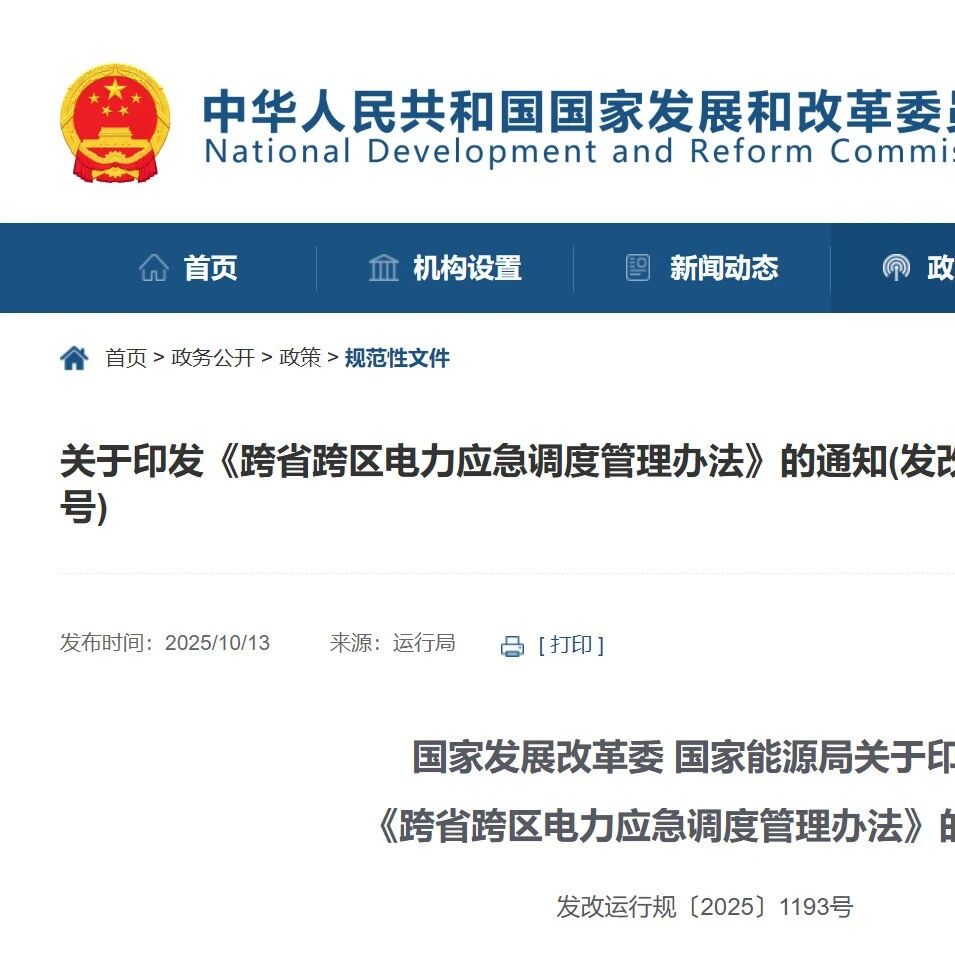
国家发改委就《跨省跨区电力应急调度管理办法(征求意见稿)》公开征求意见
news flash· 2025-06-13 07:57
Group 1 - The National Development and Reform Commission (NDRC) is soliciting public opinions on the draft of the "Emergency Dispatch Management Measures for Cross-Province and Cross-Region Electricity" [1] - The measures prioritize resource allocation and price formation through market-oriented methods such as long-term trading and spot trading when there are safety risks or power balance gaps [1] - If market-oriented methods are insufficient to resolve issues, electricity dispatch agencies may implement emergency dispatch in the day-ahead or intraday stages [1]