达芬奇手术机器人系统

Search documents
The Innovation重磅综述!澳大联合港中大构建多尺度协作集成式手术机器人蓝图
机器人大讲堂· 2026-03-17 06:13
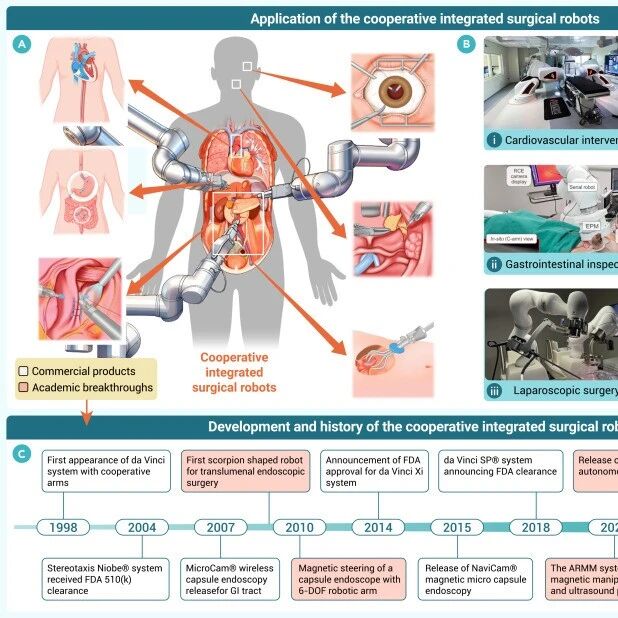
Core Viewpoint - The article discusses the emergence of "collaborative integrated surgical robots" as a new subclass of surgical robots, emphasizing their potential to enhance precision, safety, and efficiency in minimally invasive surgeries through multi-robot collaboration [1][2]. Group 1: Definition and Characteristics - The paper introduces the concept of "collaborative integrated surgical robots," defining them as a multi-robot system rather than a single tool extension, capable of executing complex multi-target tasks through collaboration [2]. - These robots can be homogeneous or heterogeneous, with different subsystems responsible for various surgical functions such as cutting, imaging, and drug delivery [2]. - The advantages of collaborative integrated surgical robots include high performance, multi-functionality, excellent interactive control, accurate positioning and visualization, and mixed drive capabilities [3][4][5]. Group 2: Key Technologies - The paper identifies four core technologies essential for the implementation of collaborative integrated surgical robots, which are crucial for achieving "precise minimally invasive" surgery [6]. - Multi-robot collaboration system integration, which forms the foundation of these surgical robots, has been successfully adopted in commercial products like the da Vinci surgical system [6][8]. - Various functional end-effectors that integrate with specialized surgical instruments enhance the operational capabilities of the robots [8]. - Sensor systems and intelligent control mechanisms are vital for closed-loop control and real-time tracking of surgical instruments within the patient [9]. - Medical imaging and navigation technologies are necessary for preoperative and intraoperative guidance, allowing for precise navigation to target areas [9]. Group 3: Collaborative Modes - The paper categorizes different collaborative modes of surgical robots based on surgical tasks, including: - Collaborative magnetic control surgical robots that use external magnetic fields to navigate micro-robots within the body for minimally invasive procedures [12]. - Collaborative rigid instrument surgical robots, exemplified by the da Vinci system, which are evolving towards higher autonomy [13][15]. - Collaborative soft instrument surgical robots made from flexible materials that can navigate complex anatomical structures [17]. - Collaborative multi-scale surgical robots that combine macro and micro robots for intricate tasks, addressing limitations of traditional surgery [18]. Group 4: Multidisciplinary Integration - The research highlights the interdisciplinary nature of collaborative integrated surgical robots, requiring inputs from clinical medicine, medical imaging, pathology, materials science, and control engineering to enhance their functionality and safety [21]. Group 5: Clinical Impact and Future Outlook - The paper presents clinical case studies demonstrating the advantages of these robots, such as reducing surgery time for rectal cancer from 227.5 minutes to 184 minutes and significantly lowering vascular injury rates in cardiovascular interventions [22]. - The introduction of collaborative integrated surgical robots represents a significant leap in surgical concepts, envisioning a future where surgical teams consist of various specialized robots working under the guidance of physicians [24].