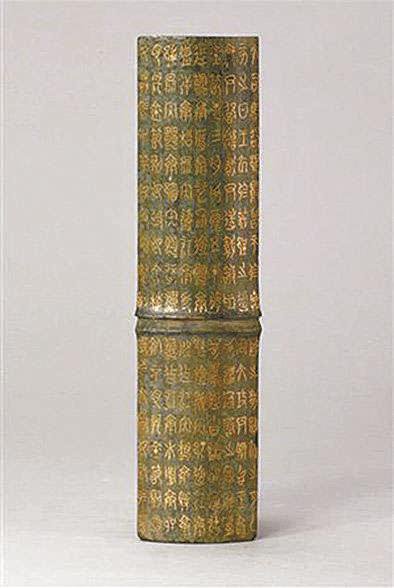
鄂君启金节

Search documents
金节为证 合符通行
Xin Lang Cai Jing· 2026-01-15 23:33
Core Viewpoint - The article discusses the significance of the E Jun Qi Jin Jie, an ancient Chinese artifact, as a testament to the early legal and commercial practices in China, highlighting its role in contract law and governance [2][5][7] Group 1: Historical Context and Significance - The E Jun Qi Jin Jie, discovered in Anhui, consists of five bamboo-shaped artifacts used as transportation permits during the Warring States period, showcasing the evolution of commercial law in ancient China [2][4] - The inscriptions on the artifacts reflect a sophisticated legal framework, including clear subjects, rights, obligations, and penalties, indicating advanced legislative thought during the Warring States period [3][4] Group 2: Legal and Administrative Insights - The artifacts embody the principle of "合符" (He Fu), a verification mechanism that required both the issuer and holder to possess matching halves, representing an early form of contract [2][6] - The regulations inscribed on the artifacts regarding transportation limits and taxation reveal a structured approach to economic management and legal governance in ancient China [4][6] Group 3: Modern Implications and Continuity - The principles derived from the E Jun Qi Jin Jie resonate with contemporary legal practices, particularly in the context of administrative law and market economy, emphasizing the importance of contract spirit and credit systems [5][6] - Current initiatives in digital management, such as electronic certificates and signatures, reflect the enduring legacy of the "合符为信" concept, demonstrating the evolution of legal practices from ancient to modern times [5][7]