法治文明

Search documents
金节为证 合符通行
Xin Lang Cai Jing· 2026-01-15 23:33
Core Viewpoint - The article discusses the significance of the E Jun Qi Jin Jie, an ancient Chinese artifact, as a testament to the early legal and commercial practices in China, highlighting its role in contract law and governance [2][5][7] Group 1: Historical Context and Significance - The E Jun Qi Jin Jie, discovered in Anhui, consists of five bamboo-shaped artifacts used as transportation permits during the Warring States period, showcasing the evolution of commercial law in ancient China [2][4] - The inscriptions on the artifacts reflect a sophisticated legal framework, including clear subjects, rights, obligations, and penalties, indicating advanced legislative thought during the Warring States period [3][4] Group 2: Legal and Administrative Insights - The artifacts embody the principle of "合符" (He Fu), a verification mechanism that required both the issuer and holder to possess matching halves, representing an early form of contract [2][6] - The regulations inscribed on the artifacts regarding transportation limits and taxation reveal a structured approach to economic management and legal governance in ancient China [4][6] Group 3: Modern Implications and Continuity - The principles derived from the E Jun Qi Jin Jie resonate with contemporary legal practices, particularly in the context of administrative law and market economy, emphasizing the importance of contract spirit and credit systems [5][6] - Current initiatives in digital management, such as electronic certificates and signatures, reflect the enduring legacy of the "合符为信" concept, demonstrating the evolution of legal practices from ancient to modern times [5][7]


媒体是怎样报道“吸毒记录封存”的?
Xin Jing Bao· 2025-12-01 11:30
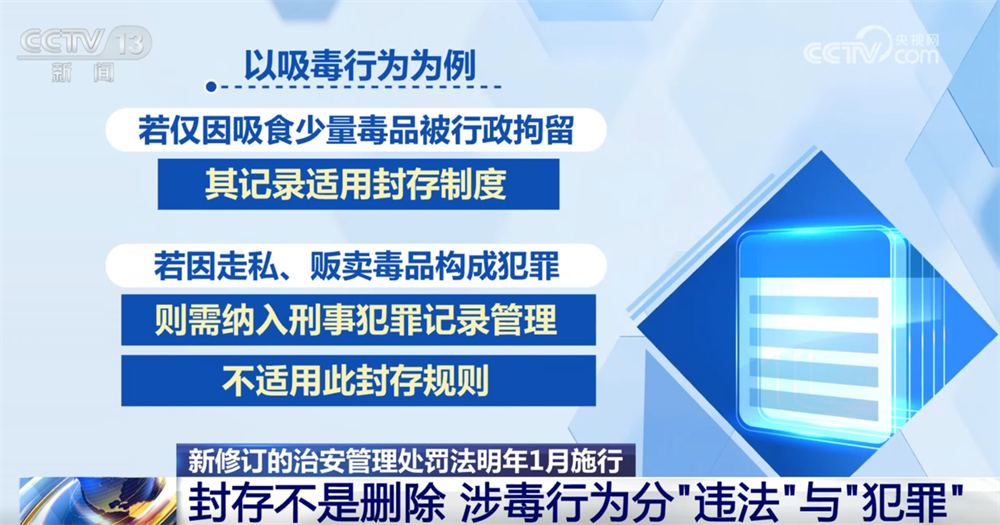
Core Viewpoint - The new policy regarding the sealing of drug-related administrative detention records, effective from January 1, aims to balance legal progress with humanistic care, addressing the issue of lifelong restrictions for minor offenses [1][3]. Group 1: Supportive Opinions - Supporters argue that the policy reflects legal progress and humanistic concern, breaking the cycle of "one-time offense, lifelong limitation" [3]. - Data indicates that from 2019 to 2023, public security agencies handled 40.35 million cases, averaging 8.07 million cases annually, suggesting that over 800 million individuals face administrative penalties each year, most of which are minor violations [3]. Group 2: Opposing Opinions - Critics express concerns about public safety, fairness, and the deterrent effect of penalties, fearing that the policy may "tolerate violations" and provide "green lights" for specific groups [4]. - There is a public worry that sealing drug records may infringe on community safety, with fears of "hidden risks" and a potential reduction in police reporting of celebrity drug cases, which could weaken societal deterrence [4]. Group 3: Media Response - Mainstream media aims to clarify misconceptions, emphasizing that "sealing" does not equate to "deletion," as records remain intact within the public security system and can still be accessed by relevant authorities for specific purposes [8][9]. - Experts highlight that the sealing of records is intended to protect all individuals equally and represents a shift from severe penalties to a more civilized legal approach [9]. - Media outlets raise critical questions regarding the implications of sealing records, such as its potential impact on deterrence and the need for strict regulations on who can access sealed records [9].