钠荧光多普勒激光雷达

Search documents
中国科学家在南极“追光”
Xin Hua Wang· 2026-02-04 03:42
Core Viewpoint - The article highlights China's Antarctic research efforts, focusing on the study of auroras and their implications for understanding space weather and its effects on Earth. Group 1: Aurora Research - Auroras serve as indicators of space weather, resulting from interactions between solar wind and Earth's magnetic field [2][3] - The concept of "auroral ripples" was introduced by Chinese researchers, indicating a new phenomenon observed at the edges of auroral arcs [3] - The research conducted at the Zhongshan Station is crucial for developing space weather models and improving long-distance radio communication [3][7] Group 2: Advanced Observation Techniques - The use of laser radar at Zhongshan Station allows for detailed diagnostics of atmospheric responses during auroral events [4][6] - Laser radar systems can create profiles of temperature, wind fields, and atmospheric composition, contributing to a comprehensive understanding of atmospheric conditions [6] - Collaborative observations between laser radar and aurora monitoring enhance the development of a "solar wind-magnetosphere-ionosphere-atmosphere" coupling model [6] Group 3: Importance of Antarctic Research - The Antarctic region is critical for global atmospheric circulation and is directly affected by space weather phenomena [7] - Data from aurora monitoring at Zhongshan Station can be utilized for space weather warnings, safeguarding satellite navigation, communication, and power grids [7][10] - Since 2010, China has established an advanced atmospheric observation system at Zhongshan Station, contributing to significant research outcomes in auroras and space plasma waves [10]

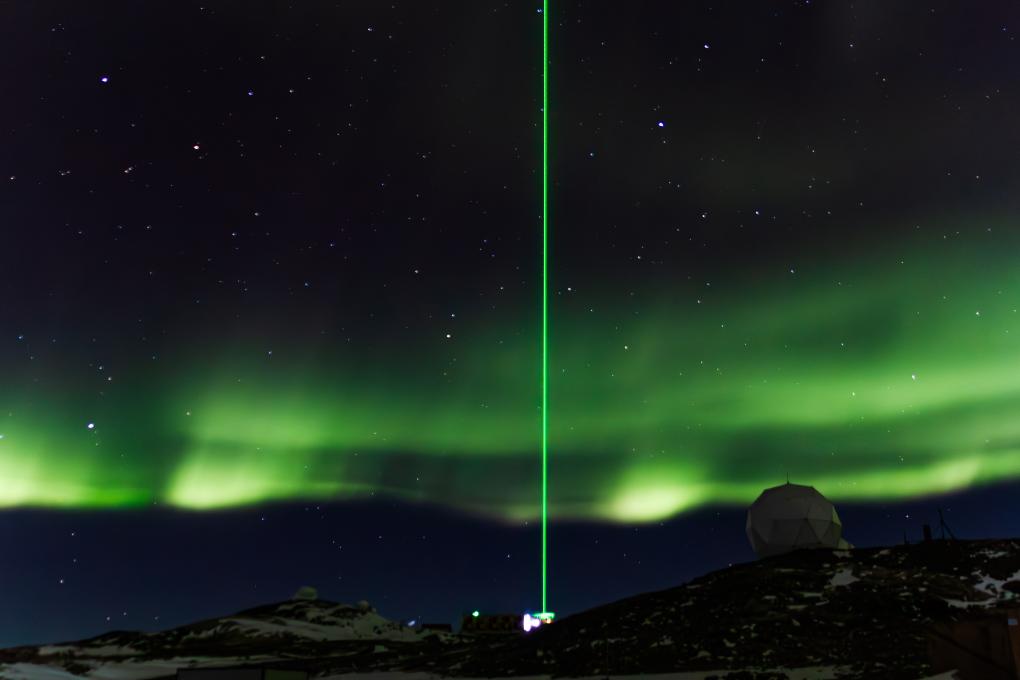
科学与健康|中国科学家在南极“追光”
Xin Hua She· 2026-02-03 14:17
Core Viewpoint - The article discusses China's Antarctic research efforts, particularly focusing on the study of auroras and their implications for understanding space weather and its effects on Earth [2][4][9]. Group 1: Aurora Research - Auroras are described as a result of interactions between solar wind and Earth's magnetic field, particularly near the magnetic poles where more solar particles enter [3]. - The Chinese Polar Research Center has proposed the concept of "aurora ripples," which refers to a newly discovered green glowing structure at the edges of auroral arcs, potentially caused by plasma gradient drift instability [4]. - The research conducted at the Zhongshan Station is crucial for developing space weather models and improving long-distance radio communication and satellite orbit determination [4][9]. Group 2: Observation Techniques - The use of all-sky imaging and spectrometers at Zhongshan Station allows for comprehensive monitoring of auroras and the analysis of particle energy through light wavelength [4]. - Laser radar systems are employed to diagnose atmospheric responses during aurora events, capturing subtle changes in temperature and wind patterns, akin to an "electrocardiogram" of the atmosphere [5][6]. - The integration of laser radar with aurora observations aims to create a comprehensive model of the coupling between solar wind, magnetosphere, ionosphere, and atmosphere [8]. Group 3: Importance of Research - The Antarctic region is identified as a critical area for global atmospheric circulation and is significantly impacted by space weather, which can affect satellite navigation, communication, and power grids [9]. - Since 2010, China has established an advanced atmospheric observation system at Zhongshan Station, contributing to international research efforts in auroras and space plasma [11]. - The challenging conditions of the Antarctic environment, including extreme cold, highlight the dedication of researchers in maintaining and operating observation equipment [11].