非晶软磁材料

Search documents
行业聚焦:全球非晶和纳米晶软磁材料市场头部企业份额调研(附Top 10 厂商名单)
QYResearch· 2025-10-16 02:18
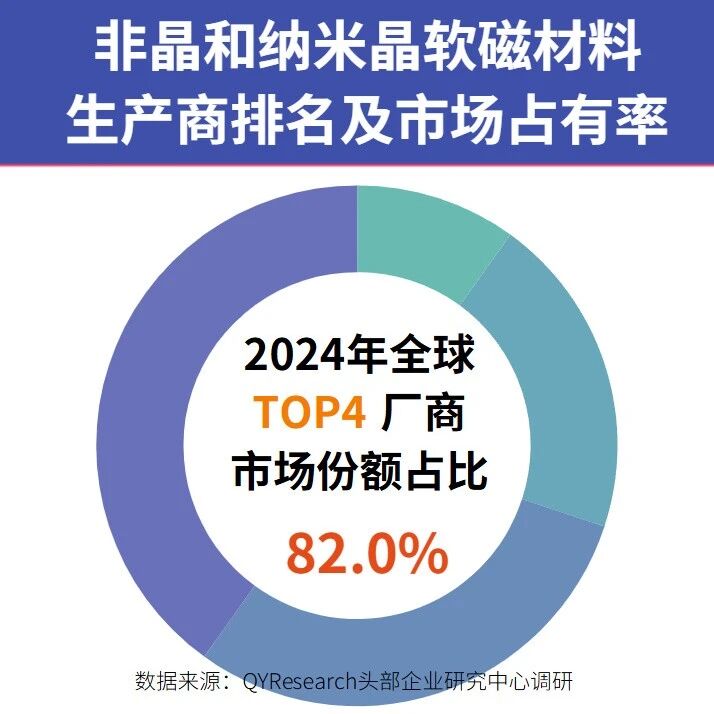
Core Viewpoint - The global market for amorphous and nanocrystalline soft magnetic materials is projected to reach $1.53 billion by 2031, with a compound annual growth rate (CAGR) of 8.9% in the coming years [2][3]. Market Overview - Amorphous soft magnetic materials are characterized by their disordered atomic structure, leading to low coercivity, high magnetic permeability, and low iron loss, making them suitable for applications in power electronic transformers, inductors, motors, and energy-saving devices [1]. - Nanocrystalline soft magnetic materials are produced through heat treatment of amorphous alloys, resulting in a composite structure that combines the benefits of both amorphous and crystalline materials, offering lower magnetic losses and superior frequency characteristics [1]. Market Size and Growth - The amorphous soft magnetic materials segment currently dominates the market, accounting for approximately 52.8% of the total market share, with an estimated market size of around $420 million in 2024 [11]. - The demand for high-performance, low-loss magnetic materials is increasing due to the rapid development of renewable energy generation, electric vehicles, charging infrastructure, and smart grids [11]. Key Drivers - The shift towards more efficient soft magnetic materials is driven by stricter global energy-saving standards and the trend towards green manufacturing, which encourages manufacturers of transformers, inductors, and motors to adopt higher efficiency materials [11]. - Technological advancements, such as precision alloy melting, rapid quenching of strips, and improvements in heat treatment processes, have significantly enhanced product performance and consistency while reducing production costs [11]. Major Players - The leading manufacturers in the global market for amorphous and nanocrystalline soft magnetic materials include Bomatec, Qingdao Yunlu, AnTai Technology, Jiangsu Guoneng, and VACUUMSCHMELZE, with the top four companies holding approximately 82.0% of the market share in 2024 [8].